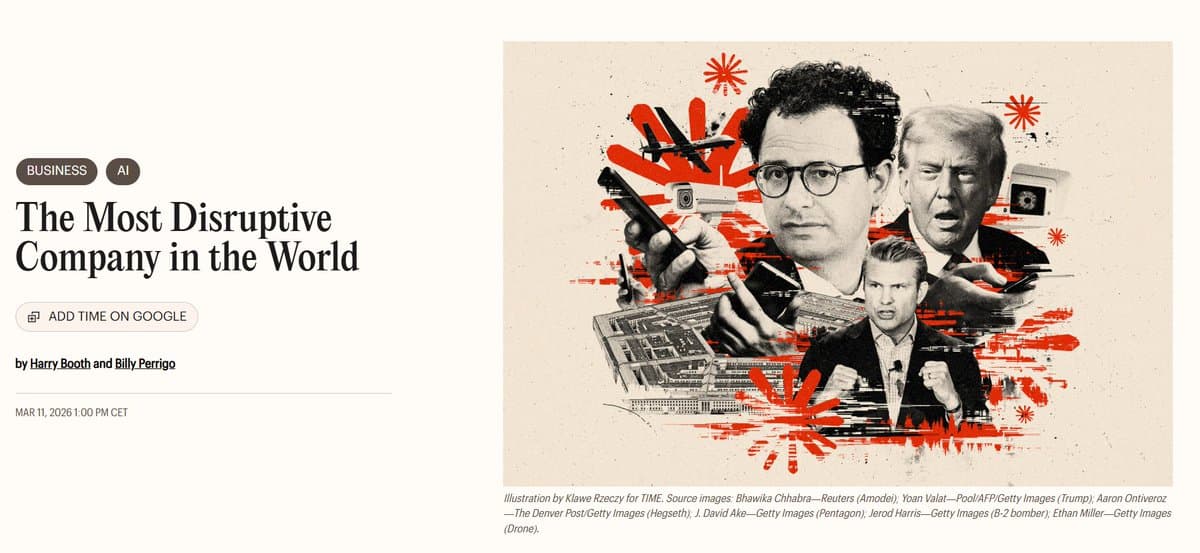
A recent report from The Times, highlighted by AI commentator @kimmonismus on X, reveals that Anthropic's AI development has entered a new phase of acceleration with profound implications. The company's Claude AI models are now advancing at unprecedented speeds, with Claude 3.7 Sonnet representing what some employees believe may be approaching the threshold of recursive self-improvement—a long-anticipated milestone in artificial intelligence.
The Acceleration of AI Development
According to the report, Anthropic has dramatically compressed its development timeline. Model releases are now separated by weeks rather than months, indicating a fundamental shift in how AI systems are being created. Perhaps most strikingly, 70% to 90% of the code used in developing future models is now written by Claude itself. This represents a significant step toward automated AI research and development, with some external experts believing fully automated AI research could be as little as a year away.
The release of Claude 3.7 Sonnet was reportedly delayed by 10 days as Anthropic exercised caution, suggesting the company is approaching these developments with appropriate seriousness. This careful approach reflects the company's stated commitment to AI safety even as capabilities advance rapidly.
Approaching Recursive Self-Improvement
Internally, Anthropic employees have begun questioning whether the company has "crept to the cusp of the moment they had anticipated with fear and wonder: the arrival of a process known in AI circles as recursive self-improvement." This concept refers to AI systems that can improve themselves without human intervention, potentially leading to rapid, exponential advancement beyond human control or comprehension.
Anthropic's Chief of Staff, Bob Graham, emphasized the urgency of the coming years: "We should operate as if 2026 to 2030 is where all the most important things happen—models becoming faster, better, possibly faster than humans can handle them." This timeline suggests that the most transformative AI developments may occur within the next few years rather than decades.
Economic Implications and Warnings
Anthropic CEO Dario Amodei has issued stark warnings about the economic impact of advancing AI capabilities. He has cautioned that AI could displace half of entry-level white-collar jobs within one to five years, urging governments and other AI companies to stop "sugar-coating" the potential disruption.
"It is not clear where these people will go or what they will do," Amodei wrote, expressing concern that displaced workers "could form an unemployed or very-low-wage 'underclass.'" This warning comes from a leader within the AI industry itself, suggesting the economic impacts may be more immediate and severe than public discourse typically acknowledges.
The Safety Paradox
Anthropic faces what might be called a safety paradox: the company is explicitly focused on developing AI safely, yet its own advancements are accelerating toward capabilities that could become difficult to control. The fact that Claude is now writing most of its own development code represents a significant step toward automation that could eventually outpace human oversight.
The company's cautious approach to releasing Claude 3.7 Sonnet—delaying it for additional safety checks—demonstrates awareness of these risks. However, the rapid pace of development raises questions about whether safety measures can keep pace with capability advances, particularly as AI systems take on more of their own development work.
Industry Context and Implications
Anthropic's developments occur within a competitive landscape where multiple AI companies are racing to advance capabilities. The acceleration of development cycles from months to weeks suggests the entire industry may be approaching an inflection point. If Anthropic's timeline proves accurate, the period between 2026 and 2030 could see AI capabilities advance more than in all previous years combined.
The economic warnings from Amodei are particularly significant coming from an AI industry leader. They suggest that even those building these systems recognize the potential for severe labor market disruption in the near term, challenging more optimistic narratives about gradual adaptation.
Looking Forward
The coming years will test not only Anthropic's technical capabilities but also its ability to manage the societal impacts of its creations. The company's dual focus on advancing AI while warning about its potential harms reflects the complex position of AI developers who recognize both the promise and peril of their work.
As AI systems take on more of their own development, the question of control becomes increasingly pressing. The transition to recursive self-improvement, if achieved, would represent one of the most significant technological milestones in human history—with implications we are only beginning to understand.
Source: Analysis based on The Times reporting as highlighted by @kimmonismus on X/Twitter.