Key Takeaways
- A technical guide on building a customer review triage system using LangGraph, LangChain, Groq, and Pydantic.
- It explains how agentic workflows enable conditional routing based on sentiment analysis.
What Happened
A comprehensive technical guide published on Towards AI walks through the theory and implementation of building an intelligent customer review triage system using a modern AI stack: LangGraph, LangChain, Groq, and Pydantic. The system uses LLaMA 3 (specifically llama-3.3-70b-versatile) as its core large language model.
The guide emphasizes the shift from simple, stateless LLM interactions to agentic workflows — systems where LLMs act as reasoning engines within structured, multi-step processes capable of making decisions, routing information, and executing tasks autonomously.
Technical Details
The Core Stack
- LangChain: An open-source framework providing standardized abstractions for models, prompts, and chains, allowing developers to swap providers (e.g., OpenAI to Groq) with minimal code changes.
- LangGraph: An extension of LangChain built for creating stateful, multi-actor applications with LLMs. It models workflows as graphs (directed, cyclic, or acyclic), enabling conditional branching, loops, and retry mechanisms.
- Groq: The inference engine used to run LLaMA 3 at low latency.
- Pydantic: A Python data validation library that enforces structured output from LLMs, converting unpredictable text into guaranteed JSON schemas.
The Architecture
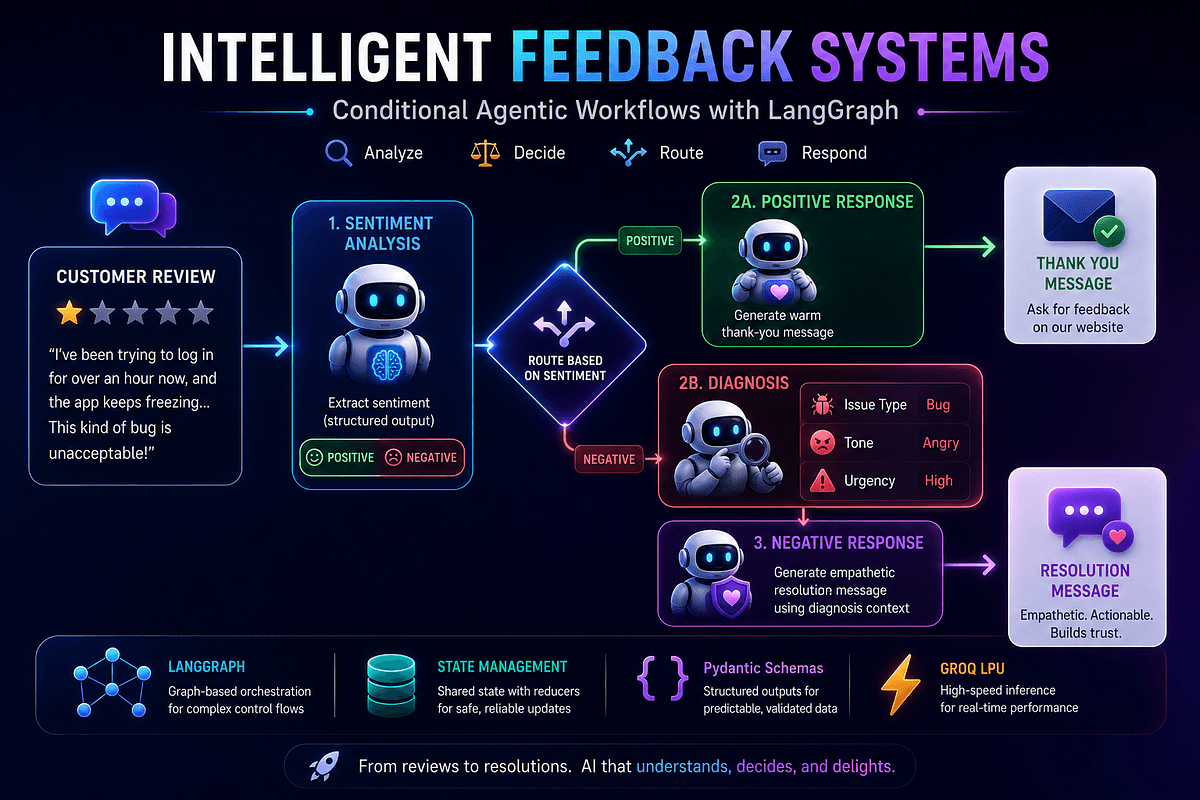
The demo implements a customer service triage system with the following flow:
- Input: Raw customer review text.
- State Initialization: The review is loaded into a
ReviewStateobject. - Sentiment Extraction (Node 1): An LLM call forced by a Pydantic schema outputs exactly "positive" or "negative".
- Routing (Conditional Edge): A Python function checks sentiment:
- Positive → Node 2: A simple LLM call writes a warm thank-you note.
- Negative → Node 3: A diagnostic LLM call categorizes the issue type, emotional tone, and technical urgency.
- Negative Resolution (Node 4): A final LLM call uses the diagnosis (tone, urgency, issue type) to draft a tailored empathetic apology and resolution strategy.
This design ensures simple tasks (positive reviews) are handled in one step, while complex, sensitive tasks (negative reviews) undergo a multi-step analytical process before generating a response.
Key Technical Concepts
- Temperature = 0: Forces deterministic output for categorization tasks.
- State Machines: The workflow is modeled as a finite state machine where each node updates a shared state.
- Structured Output: Pydantic schemas guarantee that LLM outputs are machine-readable (e.g., JSON with specific fields and types).
Retail & Luxury Implications
While the source is a general technical tutorial, its direct application to retail and luxury customer service is clear and immediate.
Customer Review Triage
Luxury retailers like Kering, Richemont, and Burberry receive thousands of customer reviews across e-commerce sites, social media, and feedback forms. A manual triage process is slow and inconsistent. An agentic workflow can:
- Automatically route positive reviews to a simple acknowledgment system.
- Flag negative reviews for detailed diagnosis (e.g., product quality, shipping delay, sizing issues).
- Generate context-aware responses that reflect brand tone and specific customer concerns.
Sentiment-Based Routing
For luxury brands, sentiment analysis is not just about positive vs. negative — it's about detecting nuanced emotions like disappointment, frustration, or entitlement. The LangGraph architecture allows for complex conditional routing based on multiple dimensions (sentiment, urgency, issue type).
Consistency at Scale
Luxury retail demands consistent brand voice across all touchpoints. By using Pydantic schemas to enforce structured output, brands can ensure that automated responses adhere to predefined tone guidelines while still being personalized.
Business Impact
- Reduced response time: Positive reviews can be acknowledged instantly; negative reviews are diagnosed and routed to appropriate teams faster.
- Improved customer satisfaction: Tailored responses based on issue type and emotional tone demonstrate empathy and competence.
- Operational efficiency: Frees human agents to handle only the most complex or high-urgency cases.
Implementation Approach
- Technical requirements: Python, LangChain, LangGraph, Groq API key (or alternative LLM provider), Pydantic.
- Complexity: Moderate — requires understanding of state machines, graph-based workflows, and prompt engineering.
- Effort: A prototype can be built in days; production deployment requires integration with existing CRM and review aggregation systems.
Governance & Risk Assessment
- Privacy: Customer reviews may contain personal data. Ensure LLM inference is done in a compliant environment (e.g., on-premises or with a GDPR-compliant provider).
- Bias: Sentiment models can exhibit bias against certain dialects or expressions. Regular auditing is recommended.
- Maturity: This is a production-ready approach for customer service automation, but requires careful prompt design and testing to avoid inappropriate responses.
gentic.news Analysis
This guide represents a practical, code-level demonstration of a concept that has been discussed extensively in the AI industry: conditional agentic workflows. The key innovation here is not the individual components (LangChain, Pydantic, etc.) but their orchestration into a stateful, decision-making graph.
For retail and luxury AI practitioners, this is directly applicable. The customer review triage use case is a natural fit for brands that already collect feedback but struggle to act on it at scale. The ability to route reviews based on sentiment and issue type, then generate context-aware responses, addresses a real operational pain point.
However, readers should note the gap between a tutorial and production deployment. The guide uses a single model (LLaMA 3 70B via Groq) and a simple binary sentiment split. In practice, luxury brands may need multi-class sentiment, multilingual support, and integration with existing CRM systems. The architecture is extensible, but production engineering effort should not be underestimated.
From a competitive standpoint, this approach is consistent with the broader industry trend toward agentic AI — systems that combine LLM reasoning with programmatic control flow. Retailers who adopt this pattern early can gain an edge in customer experience personalization and operational efficiency.
Source: pub.towardsai.net