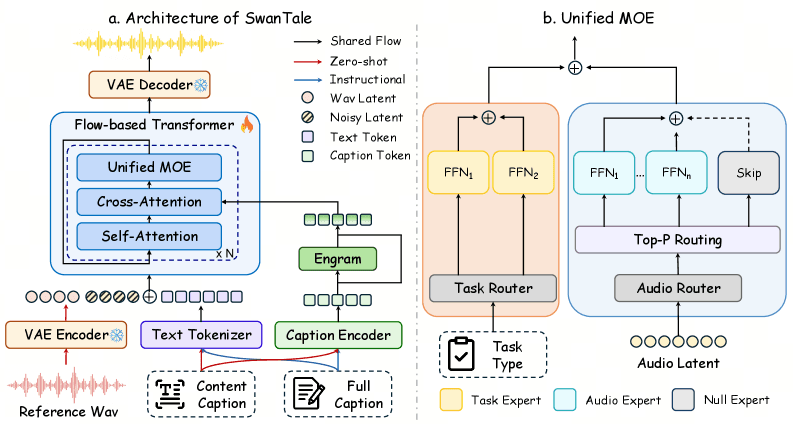
ByteDance released SwanTale on Hugging Face, a unified model for multi-speaker speech and audio generation. The model covers zero-shot and instruct tasks, including voice cloning, style control, and acoustic scene synthesis.
Key facts
- ByteDance released SwanTale on Hugging Face
- Unified multi-speaker speech and audio generation
- Supports zero-shot and instruct tasks
- Enables voice cloning, style control, scene synthesis
- No benchmark scores or model size disclosed
ByteDance released SwanTale on Hugging Face, a unified model for multi-speaker speech and audio generation across zero-shot and instruct tasks According to @HuggingPapers. The model handles expressive voice cloning, natural language style control, and acoustic scene synthesis.
Key Takeaways
- ByteDance released SwanTale, a unified speech-audio model on Hugging Face, covering voice cloning, style control, and scene synthesis.
- No benchmarks or technical details disclosed.
What SwanTale Claims to Do
The release positions SwanTale as a single architecture spanning three capabilities that typically live in separate models: voice cloning (zero-shot, meaning it can mimic a speaker from a short sample without fine-tuning), style control via natural language prompts, and acoustic scene synthesis (generating ambient soundscapes, not just speech).
That combination is notable. Most prior work separates TTS models like ElevenLabs or XTTS from audio generation models like AudioLDM or Stable Audio. SwanTale's promise is a single checkpoint that does both, which could simplify pipelines for game developers, video editors, and interactive voice agents.
What's Missing
ByteDance has not published benchmark scores, model size, training data, or an academic paper alongside the Hugging Face release. The announcement is sparse — no sample audio, no demo notebook, no API pricing. That makes it hard to verify whether SwanTale actually outperforms specialized models on each individual task.
The company's track record with open-source releases is mixed. ByteDance has open-sourced models like Seed-TTS and the BAGEL audio model, but often with limited documentation. SwanTale appears to follow that pattern: a model card with a description, but little technical depth.
Why This Matters
If SwanTale works as advertised, it could consolidate a fragmented toolchain. Instead of chaining a voice cloner to a text-to-audio model, developers could use one model for dialogue, narration, and sound effects. That's a meaningful shift for small teams building interactive media.
But the lack of evaluation data is a red flag. Without benchmarks, "unified" can mean "mediocre at everything." The community will need independent testing to see if SwanTale matches or exceeds specialized models on voice similarity, audio quality, and instruction following.
The Bottom Line
SwanTale is an interesting entry in the speech-audio convergence trend, but it's too early to call it a breakthrough. The Hugging Face release is a teaser, not a full technical disclosure. ByteDance needs to follow up with numbers and samples to back up the claims.
What to watch
Watch for ByteDance to publish a technical report or benchmark suite for SwanTale. If the model scores competitively against specialized TTS and audio generation baselines on public datasets, it could disrupt the fragmented toolchain. Also watch for sample audio demos and whether the model gains traction in the HF community.