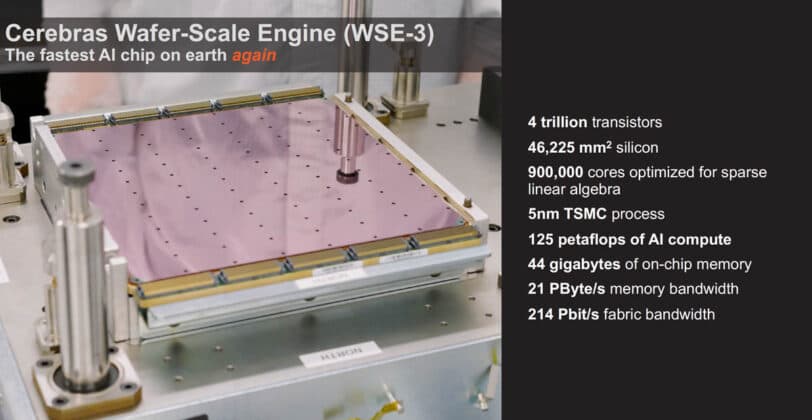
Cerebras developed vertical power delivery, flexible moving-pin interposers, and direct-impingement water cooling to prevent wafer-scale chips from cracking. The company rewrote mechanical engineering fundamentals to manage thermal and mechanical stress across a single monolithic silicon wafer.
Key facts
- Wafer-scale chip diameter: 300mm.
- Silicon fracture toughness: ~0.8 MPa·m^0.5.
- WSE-3 on-wafer bandwidth: 21 PB/s.
- Power load: 850W+ per wafer.
- Three innovations: vertical power, flexible interposers, water cooling.
Cerebras has disclosed three key mechanical innovations—vertical power delivery, flexible moving-pin interposers, and direct-impingement water cooling—that enable its wafer-scale chips to operate without self-destructing. According to @SemiAnalysis_, the company had to "rewrite the mechanical engineering playbook just to keep a single wafer from cracking itself apart."
The cracking problem
A standard silicon wafer measures 300mm in diameter. Under thermal cycling—from idle to 850W+ compute loads—the coefficient of thermal expansion mismatch between the silicon die and the organic substrate or socket can generate stresses exceeding silicon's fracture toughness (~0.8 MPa·m^0.5). For a monolithic wafer-scale chip, the crack propagation risk is orders of magnitude higher than for diced chips. Cerebras' solution combines three interdependent layers.
Vertical power delivery
Conventional chips route power laterally through the package substrate, creating in-plane thermal gradients. Cerebras moves power delivery vertically through the interposer, reducing lateral thermal expansion mismatches. This also shortens the power-delivery network impedance, critical for the chip's massive current draw.
Flexible moving-pin interposers
Rather than a rigid socket with fixed pins, Cerebras uses an interposer with moving pins that can accommodate differential thermal expansion between the wafer and the cooling plate. The pins adjust position dynamically as the wafer heats and cools, preventing stress concentration at any single point.
Direct-impingement water cooling
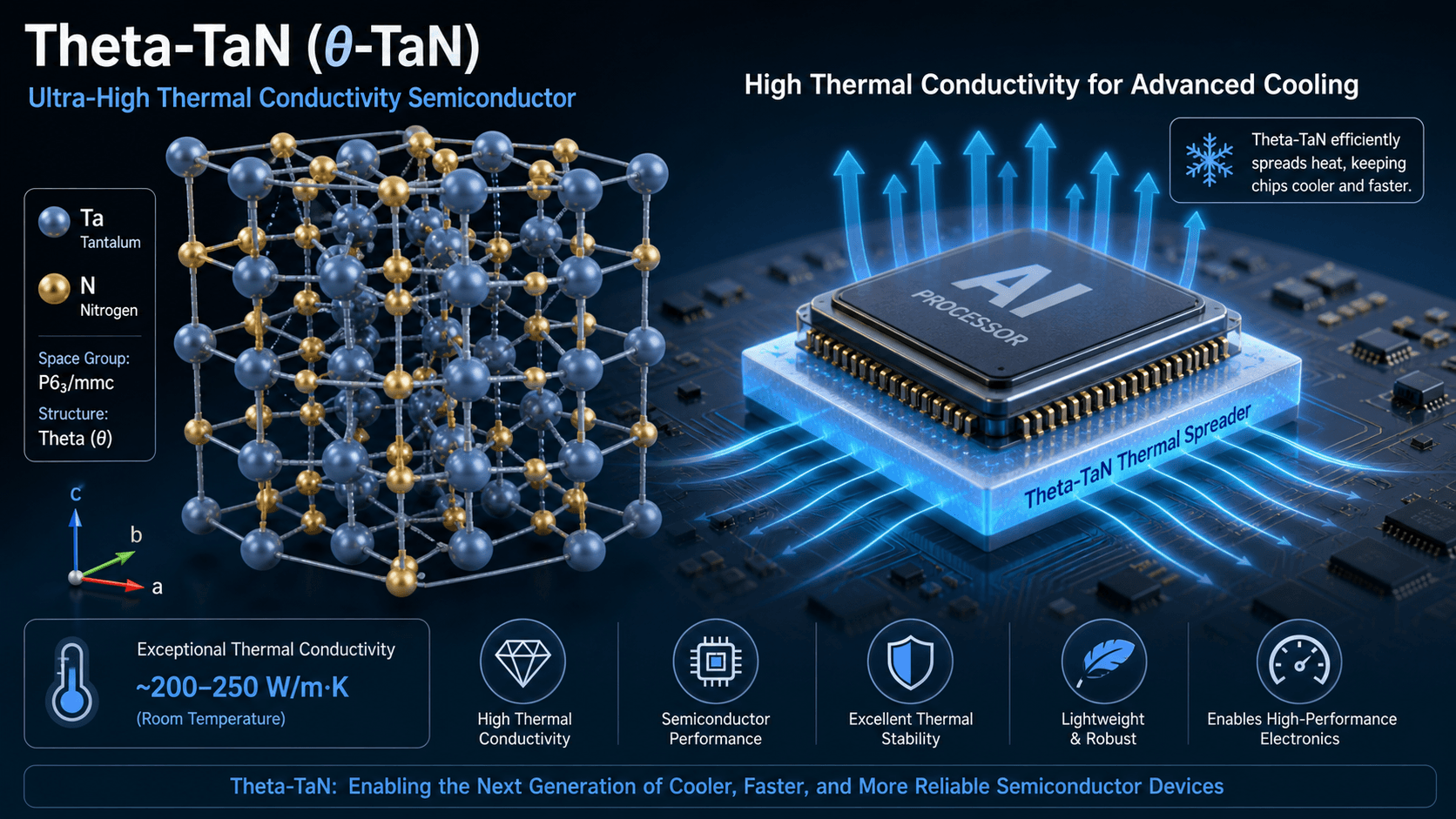
Liquid cooling is standard for high-power chips, but Cerebras directs water jets directly onto the back of the wafer through micro-nozzles, achieving higher heat transfer coefficients than cold-plate conduction. The water impingement also provides uniform cooling across the entire 300mm wafer surface, avoiding hot spots that could drive local thermal stress.
The unique take here is that Cerebras' mechanical innovations are arguably more differentiated than its silicon design. While competitors like Nvidia and AMD optimize at the die or chiplet level, Cerebras' wafer-scale approach forces fundamental rethinking of packaging, cooling, and stress management—disciplines that most AI chip companies treat as off-the-shelf procurement decisions. The company did not disclose specific thermal performance numbers or cost per wafer, but SemiAnalysis notes that the engineering complexity suggests a higher per-unit cost than conventional GPU systems.
What this means for the industry
Wafer-scale chips promise memory bandwidth advantages—Cerebras' WSE-3 delivers 21 PB/s of on-wafer bandwidth—but the mechanical engineering required to make them reliable at scale has been a black box. By revealing these details, Cerebras signals that the approach is production-ready, not just a lab experiment. However, the custom interposer and cooling system create a supply chain dependency that limits volume scaling compared to standard packaging.
Watch for
Whether Cerebras can transition from bespoke mechanical engineering to volume manufacturing. The company's next milestone is scaling from single-wafer systems to multi-wafer configurations—the cracking problem compounds when you tile multiple wafers together.
What to watch
Watch for Cerebras' next engineering disclosure on multi-wafer tiling—the cracking problem compounds when multiple wafers are interconnected, and any solution would signal readiness for large-scale clusters.