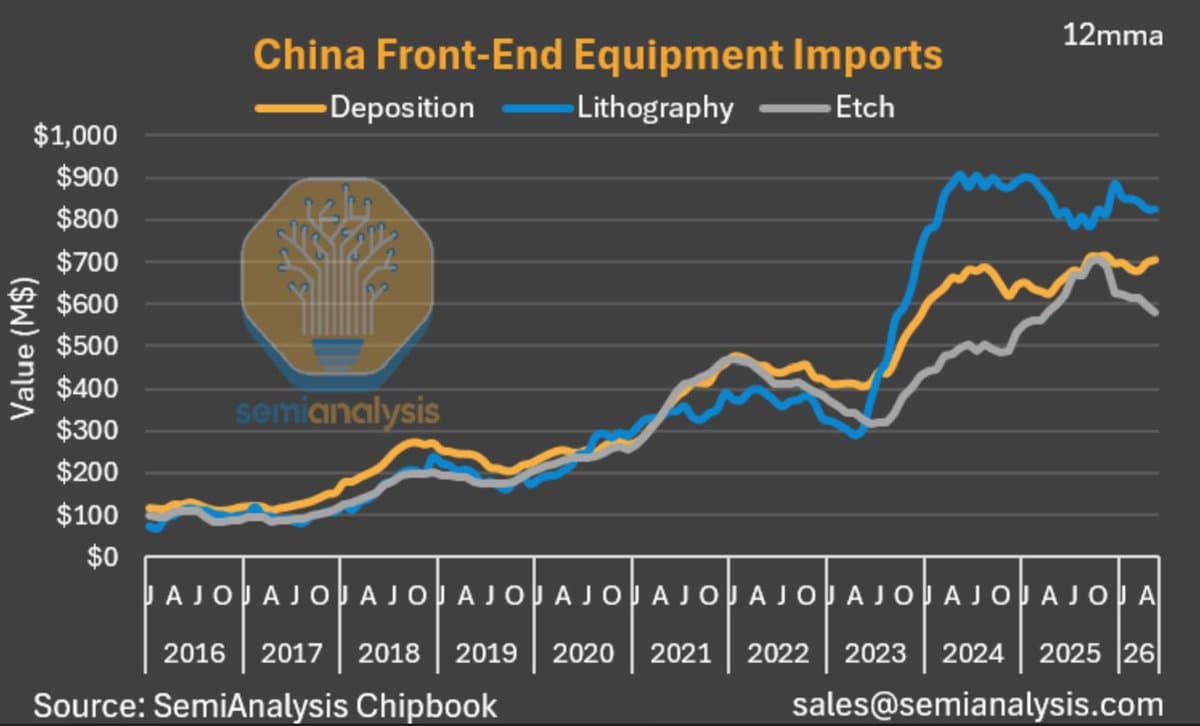
China's etch tool imports dropped 18% year-to-date while deposition imports rose 3%, per @SemiAnalysis_. This divergence signals that domestic etch localization is outpacing deposition, a shift with supply-chain implications for Applied Materials and Lam Research.
Key facts
- Etch imports down 18% YTD vs deposition up 3% YTD.
- Data sourced from Chinese customs by @SemiAnalysis_.
- Lam Research China revenue: 36% of 2024 total.
- Applied Materials China revenue: 32% of 2024 total.
- AMEC produces dielectric etch tools for 5nm-class nodes.
China's semiconductor equipment localization is proceeding unevenly, with etch tool self-sufficiency accelerating faster than deposition. According to @SemiAnalysis_, front-end import data shows etch imports down 18% year-to-date versus deposition imports up 3%. The figures, drawn from Chinese customs data, suggest domestic fabs are substituting imported etch tools with local alternatives more aggressively than for deposition gear.
The divergence matters because etch and deposition are complementary front-end processes—both critical for advanced nodes. If China's etch localization continues to outrun deposition, it could bottleneck domestic chip production or force fabs to stockpile deposition tools from Western suppliers like Applied Materials, Lam Research, and Tokyo Electron. The import data does not reveal which domestic etch suppliers are winning orders, nor does it break down tool types (e.g., dielectric vs. conductor etch).
This pattern follows broader US-China tech tensions. Since October 2022, US export controls have restricted Chinese access to advanced deposition and etch tools for sub-14nm nodes. The data implies Chinese equipment makers have made faster progress replicating etch tool designs, which are generally less complex than atomic-layer deposition systems. The 18% import drop suggests either volume substitution or a shift to older-node fabs that need fewer new tools.
What the Data Doesn't Say
The tweet does not specify whether the import decline reflects lower overall fab investment or genuine localization. China's total semiconductor equipment imports have fluctuated with capacity buildout cycles. A 2025 SEMI report showed China's equipment spending grew 14% in 2024 but slowed to 6% in 2025, per public filings. The etch-deposition gap could partly reflect project mix—memory fabs, which favor etch over deposition, have been less active.
Supply-Chain Implications
If the trend holds, Western etch suppliers face disproportionate China revenue risk. Lam Research derived 36% of 2024 revenue from China, per its annual filing; Applied Materials reported 32%. The 18% import drop, if sustained, could trim $500M-$800M from combined China etch revenue in 2026. Deposition tool suppliers may see less immediate impact.
Chinese domestic etch tool makers include AMEC (Advanced Micro-Fabrication Equipment Inc.), which produces dielectric etch tools for 5nm-class nodes, and Naura Technology, focused on more mature nodes. Neither company discloses China market share by tool type, making the SemiAnalysis import proxy one of the few public signals.
What to watch

Watch for Q1 2026 Chinese customs data, expected in April, to confirm whether the etch import trend accelerates. Also monitor Lam Research and Applied Materials Q2 earnings calls for China revenue guidance revisions. Any US export control expansion targeting etch tools would alter the trajectory.