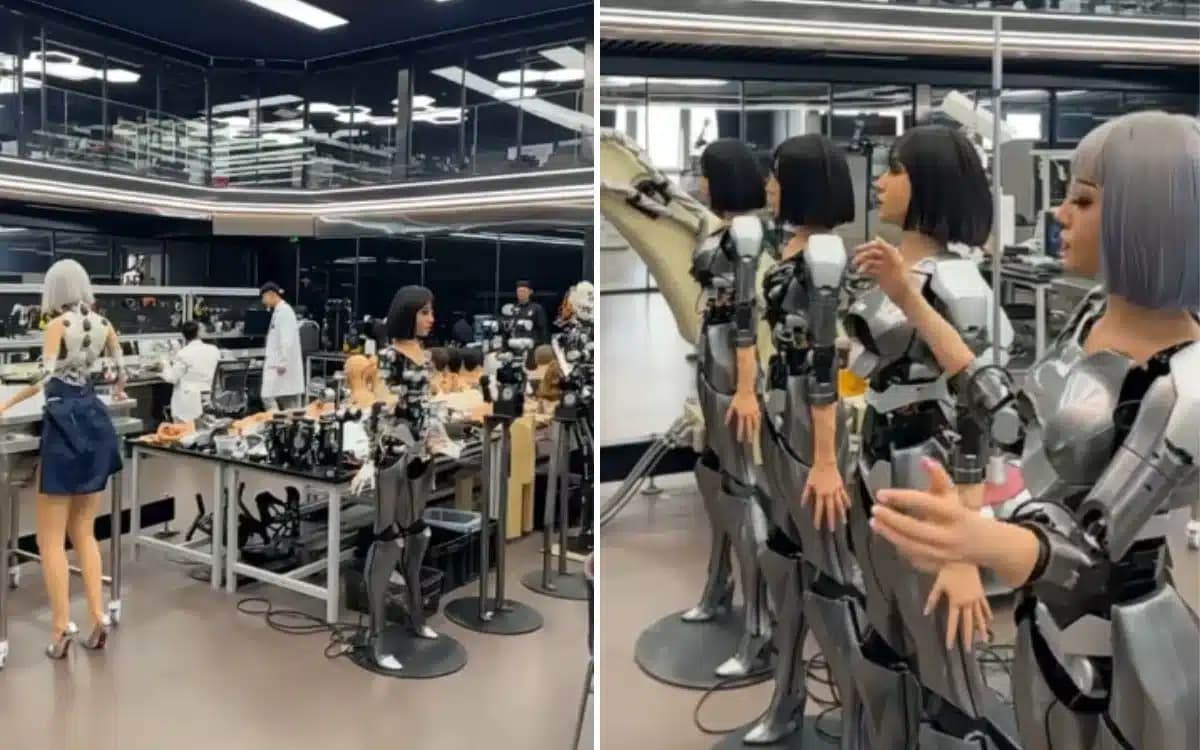
A new production facility in Foshan, China, has become the country's first fully automated assembly line dedicated to manufacturing humanoid robots. The line, which reportedly went live recently, represents a significant step toward the industrial-scale production of humanoid robots, a key goal for several Chinese tech and manufacturing giants.
What Happened
According to a social media post by AI commentator Rohan Paul, the production line is now operational. The core claim is that the facility is "fully automated," meaning robots are assembling other robots with minimal human intervention—a concept often described as "robots building robots."
The stated production capacity is substantial:
- Output: Over 10,000 humanoid robots per year.
- Cycle Time: One complete humanoid robot is assembled approximately every 30 minutes.
- Expansion Plans: Five additional production sites are already in the planning stages.
A linked video shows what appear to be robotic arms working at assembly stations within the facility.
Context: The Race for Humanoid Robot Production
The launch aligns with a major strategic push by China to establish leadership in humanoid robotics. In 2023, the Chinese Ministry of Industry and Information Technology (MIIT) published a blueprint aiming for mass production of humanoids by 2025, with a goal to become a global leader in the field by 2027.
This national initiative has spurred intense activity. Companies like UBTech Robotics, a Shenzhen-based leader, have been at the forefront. UBTech's Walker series robots have been deployed in industrial settings, and the company has been scaling its manufacturing capabilities. Other major players include Fourier Intelligence, which has showcased its GR-1 robot, and Xiaomi, which unveiled its CyberOne robot in 2022. The Foshan facility's "fully automated" claim suggests a move beyond pilot or low-volume assembly lines toward a true industrial manufacturing process.
Key Questions and Implications
The announcement, while light on specific technical details, points to several critical developments:
- Manufacturing Readiness: A 30-minute cycle time for a complex system like a humanoid robot indicates a highly optimized and standardized assembly process. This suggests progress in modular design and supply chain maturity for key components like actuators, sensors, and computing units.
- Scale Ambition: A target of 10,000+ units per year is an order of magnitude beyond most current humanoid production runs, which are often in the hundreds for research or limited commercial pilots. This scale is necessary to drive down unit costs, a major barrier to widespread adoption.
- The AI Integration Challenge: While the physical assembly may be automated, the core value of a humanoid robot lies in its AI "brain"—the perception, decision-making, and motion control software. Mass-producing the hardware is only half the battle; deploying and validating the AI systems that allow these robots to perform useful tasks in unstructured environments remains the primary technical hurdle.
gentic.news Analysis
This development is a direct manifestation of the industrial policy goals set by Beijing over two years ago. It moves the conversation from research prototypes and proof-of-concept videos to tangible manufacturing infrastructure. The location in Foshan, a major manufacturing hub in Guangdong province, is strategic, providing access to a dense ecosystem of parts suppliers and engineering talent.
The push for automation in robot assembly itself is logical. Humanoid robots, with their complex bipedal kinematics and numerous joints, are labor-intensive to assemble by hand. Automating their production is not just a publicity stunt; it's a necessity for achieving the cost targets required for economic viability in applications like logistics, manufacturing assist, and elderly care.
However, this announcement should be viewed as a milestone in the hardware production race, not a guarantee of commercial success. The real test will be the deployment of these robots. As we covered in our analysis of [Related Article: 'Tesla Optimus Gen 2 Showcases Improved Hands, But Autonomy Remains the Final Frontier' - gentic.news, Dec 2024], the industry's bottleneck has shifted from basic mobility to dexterous manipulation and autonomous task execution in real-world settings. A factory can produce 10,000 robots, but if the AI stack isn't robust enough for reliable, unattended operation, the business case collapses.
This also intensifies the geopolitical dimension of advanced robotics. The United States, through companies like Tesla (Optimus), Figure AI, and Boston Dynamics, and South Korea with Hyundai's Boston Dynamics acquisition, are on a parallel path. The emergence of high-volume production capacity in China adds a new layer of competition focused on scale and cost, potentially accelerating the global timeline for humanoid robot adoption.
Frequently Asked Questions
Who owns the humanoid robot factory in Foshan?
The original source does not specify the company operating the new fully automated line. Given the location and context, it is likely operated by one of China's leading humanoid robotics companies, such as UBTech Robotics or Fourier Intelligence, potentially in partnership with a major manufacturing firm. Official confirmation from the involved entities is awaited.
What will these 10,000+ humanoid robots be used for?
The initial applications for humanoids produced at this scale are expected to be in structured industrial and commercial environments. Primary use cases will likely include automated logistics (moving boxes in warehouses), manufacturing assist (feeding parts to machines, simple assembly), and potentially customer service or guided tours in public spaces. More complex tasks in unstructured homes or healthcare settings will come later as the AI software matures.
How does a 30-minute assembly time compare to car manufacturing?
It is much slower, highlighting the current complexity of humanoid assembly. A modern automotive assembly line can produce a car in roughly 60-90 seconds. A 30-minute cycle time for a humanoid is a starting point for industrialization. As design is standardized and automation improves, this cycle time is expected to decrease significantly to reach true mass-production speeds.
Is "full automation" in robot assembly really new?
While robotic arms (like those from KUKA or Fanuc) have been assembling cars and electronics for decades, applying this concept to the final assembly of humanoid robots themselves at a dedicated greenfield factory is a novel and symbolic step. It represents a closed loop where the tools of automation are used to build the next generation of automated workers.