Key Takeaways
- Anthropic documented Opus 5's verbosity on launch day.
- Use the two-model split: Fable 5 plans, Opus 5 executes.
- This halves costs and restores readability.
What Changed: Opus 5's Verbosity Is Documented, Not Imagined
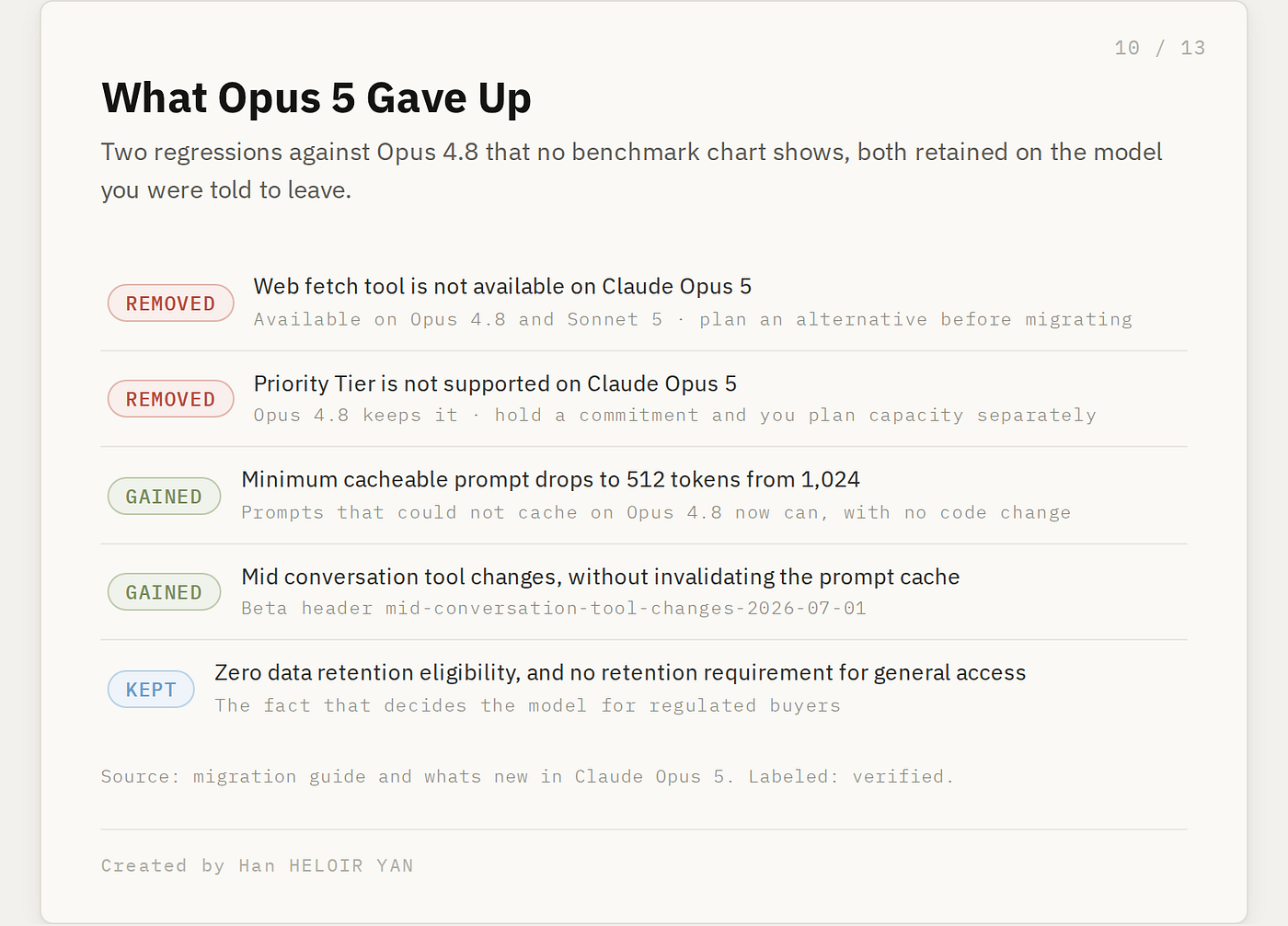
Anthropic's own prompting guide for Claude Opus 5, published on launch day (2026-07-24), admits the model's default responses are longer, it narrates readily, and it expands task scope. Developers on Reddit and dev.to report the same: output is buzzword-heavy, hard to parse, and requires multiple follow-ups to finish work.
This isn't a regression in capability. Opus 5 ranks #1 on Artificial Analysis's Intelligence Index (63 vs 57 for 4.8) and scores 24% on SlopCodeBench vs 6% for 4.8, meaning it breaks less of what it builds. The problem is communication, not competence.
What It Means For You: Your Prompting Approach Must Change
The effort parameter won't help. Anthropic explicitly states it controls thinking, not verbosity. So the standard fix—lowering effort—does nothing to reduce output length.
Instead, you need to separate planning from execution. Opus 5 is a powerful executor when given precise instructions. It's a terrible planner because it over-narrates and expands scope. Your CLAUDE.md can't fully override this behavior, as multiple users report.
Try It Now: The Two-Model Split
Here's the workflow that works, as reported by a developer on dev.to:
- Plan with Fable 5: Use Claude Fable 5 to read your request, research the codebase, and write a detailed implementation plan. Fable communicates clearly and doesn't over-scope.
- Execute with Opus 5: Feed that plan to Opus 5 in Claude Code with the prompt: "Execute this plan exactly. Do not add steps. Do not narrate. Return only the final result."
Example prompt for the execution step:
claude -p "Execute the attached plan step by step. Do not expand scope. Do not explain what you're doing. After each step, output 'DONE' and move on. At the end, provide a concise summary of changes."
This split is also cheaper: Opus 5 costs half per token compared to Fable 5, so you save money on the planning phase too.
Why It Works
Opus 5's strength is in focused execution—it verifies its own work and doesn't break existing code (hence the SlopCodeBench score). Fable 5's strength is communication. By combining them, you get the best of both: clear planning and reliable execution.
If you can't switch models, at least set a strict system prompt in CLAUDE.md:
# Communication
- Respond in under 100 words unless asked for detail.
- Never narrate your reasoning.
- Never add steps beyond the request.
- If you notice an issue, fix it silently, then mention it in one line.
This won't fully fix Opus 5, but it reduces the noise.
Source: news.google.com
[Updated 14 Aug via devto_claudecode]
Independent measurement now quantifies the verbosity gap: Opus 5 outputs roughly double the tokens of Opus 4.8 and is 3.7x slower to first token (63.92s vs 17.30s), though Anthropic defaults thinking on for Opus 5, explaining much of the latency [per dev.to]. As of 2026-08-13, Anthropic has not responded to criticism—no postmortem or changelog entry—despite having documented the behavior in advance. The same source notes Anthropic has twice confirmed past 'model got worse' waves were caused by harness and infrastructure issues, not swapped models.