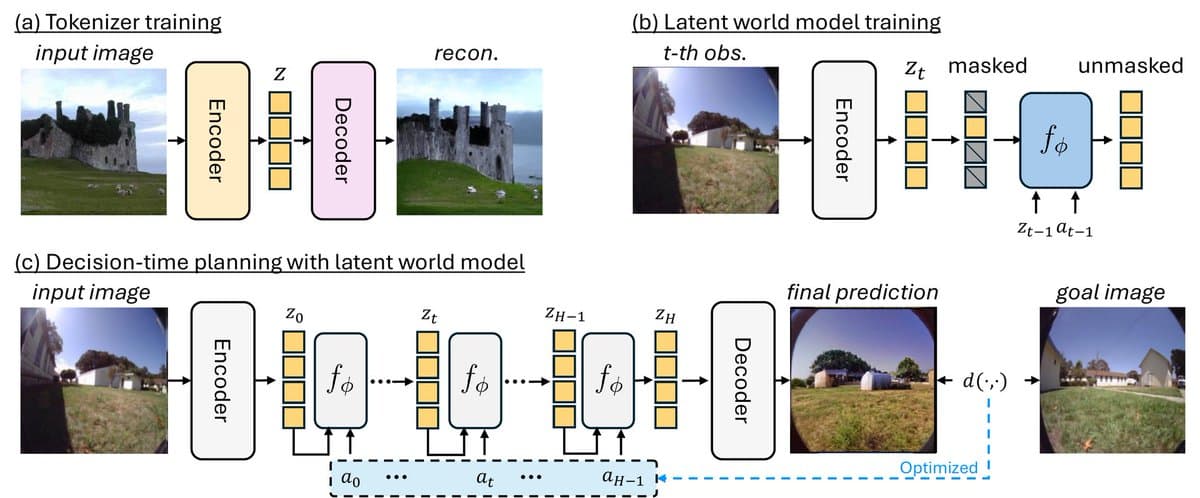
In a significant advancement for artificial intelligence and robotics, researchers have unveiled CompACT, a compact discrete tokenizer that dramatically compresses visual observations into just eight tokens for latent world models. This breakthrough promises to transform how robots perceive and interact with their environments, achieving a remarkable 40x speed improvement in planning while maintaining competitive accuracy for real-time robotic control applications.
The Compression Challenge in Robotic AI
Robotic systems face a fundamental challenge in processing visual information from their environments. Traditional approaches require extensive computational resources to analyze high-dimensional visual data, creating bottlenecks in real-time decision-making. The sheer volume of visual information—from camera feeds to sensor data—often overwhelms planning algorithms, forcing engineers to choose between accuracy and speed.
CompACT addresses this challenge through an innovative tokenization approach that reduces complex visual observations to a compact eight-token representation. This compression doesn't merely shrink data size; it distills essential environmental information into a format that latent world models can process with unprecedented efficiency.
How CompACT Achieves 40x Faster Planning
The core innovation of CompACT lies in its ability to extract and encode the most relevant information from visual observations while discarding redundant or less critical details. By compressing observations into just eight tokens, the system dramatically reduces the computational load on planning algorithms.
This efficiency gain translates directly to the reported 40x planning speed improvement. In practical terms, this means robots can make decisions and adjust their actions much more rapidly—a critical capability for applications requiring real-time responsiveness, such as autonomous navigation, manufacturing, or emergency response.
Maintaining Accuracy Through Intelligent Compression
Perhaps the most impressive aspect of CompACT's achievement is that this dramatic speed improvement comes without sacrificing accuracy. The researchers report that their system maintains "competitive accuracy" compared to more computationally intensive approaches.
This balance between speed and accuracy represents a significant breakthrough in robotic AI. Previous compression techniques often traded precision for efficiency, limiting their practical applications. CompACT's ability to preserve essential information while dramatically reducing processing requirements suggests a more sophisticated understanding of what visual elements matter most for robotic decision-making.
Implications for Real-Time Robotic Control
The implications of CompACT's 8-token compression extend across multiple domains of robotics and artificial intelligence. For industrial automation, faster planning could enable more responsive manufacturing robots that adapt to changing conditions in real time. In autonomous vehicles, quicker processing of visual data could enhance safety by reducing decision latency.
Service robots in healthcare, hospitality, or domestic settings could benefit from more fluid interactions with their environments. Even in research contexts, faster planning algorithms could accelerate the development and testing of new robotic capabilities by reducing computational barriers.
The Technical Architecture Behind the Breakthrough
While the source material doesn't provide detailed technical specifications, the description of CompACT as a "compact discrete tokenizer" suggests several important architectural choices. The term "discrete" indicates that the tokenizer produces distinct, separate representations rather than continuous embeddings—a design decision that likely contributes to both efficiency and interpretability.
The reference to "latent world models" indicates that CompACT integrates with systems that maintain internal representations of environmental dynamics. By feeding these models highly compressed but information-rich tokens, CompACT enables more efficient reasoning about possible future states and actions.
Future Directions and Applications
The development of CompACT opens several promising research directions. Future work might explore how this compression approach scales to different types of sensory data beyond visual observations, or how it performs in increasingly complex environments.
There's also potential for applying similar compression techniques to other AI domains where processing speed and efficiency are critical, such as natural language processing or audio analysis. The fundamental insight—that intelligent compression can dramatically improve planning efficiency without sacrificing accuracy—could inspire innovations across artificial intelligence.
Challenges and Considerations
While CompACT represents a significant advancement, several questions remain for practical implementation. The system's performance in edge cases, its robustness to varying lighting conditions or visual noise, and its adaptability to different robotic platforms will all require further investigation.
Additionally, the trade-off between compression and information retention—while reportedly favorable in initial testing—may present challenges in highly complex or unpredictable environments where seemingly minor visual details could prove critical for decision-making.
Conclusion: A New Paradigm for Robotic Perception
CompACT's 8-token compression represents more than just a technical optimization—it suggests a new paradigm for how robots perceive and reason about their environments. By focusing on essential information rather than processing every visual detail, this approach aligns more closely with how biological systems efficiently navigate complex worlds.
As robotic systems become increasingly integrated into daily life and critical infrastructure, innovations like CompACT that dramatically improve efficiency while maintaining accuracy will be essential. The reported 40x planning speed improvement could be the difference between a robot that responds adequately and one that responds instantaneously—a distinction that matters profoundly in applications where timing is everything.
Source: HuggingPapers on X/Twitter reporting on CompACT research