What Happened: The Evolution Beyond Prompt Engineering
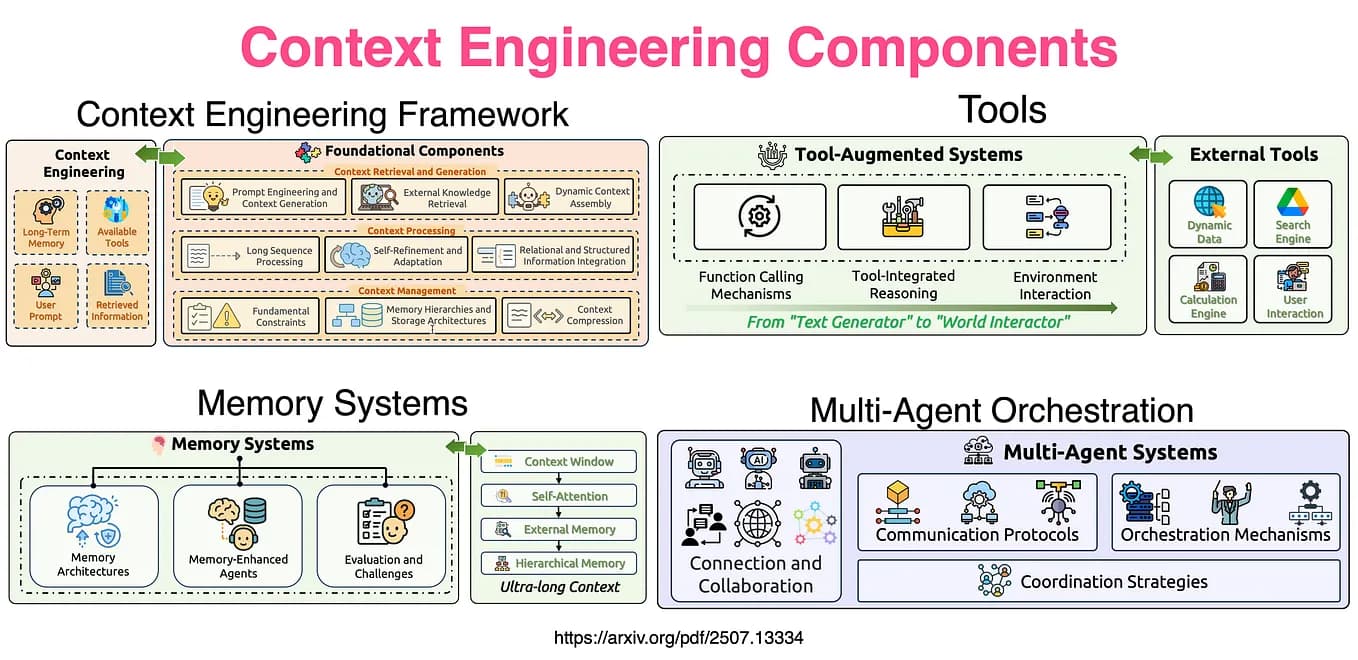
As AI systems transition from simple chatbots to autonomous, multi-step agents, the discipline of prompt engineering—crafting individual queries—has proven necessary but insufficient. A new paper titled "Context Engineering: From Prompts to Corporate Multi-Agent Architecture" introduces Context Engineering (CE) as a standalone discipline concerned with designing, structuring, and managing the entire informational environment in which an AI agent makes decisions.
The paper draws on multiple sources: vendor architectures (Google ADK, Anthropic, LangChain), academic work (ACE framework, Google DeepMind's intelligent delegation), enterprise research (Deloitte 2026, KPMG 2026), and the author's experience building a multi-agent system. It frames context as the agent's operating system—the foundational layer that determines what information is available, how it's structured, and what constraints apply.
The Context Engineering Framework
The paper proposes five quality criteria for effective context:
- Relevance: Information must be pertinent to the agent's current task
- Sufficiency: The context must contain enough information for sound decisions
- Isolation: Contexts should be separated to prevent contamination between tasks
- Economy: Context should be as concise as possible while meeting sufficiency
- Provenance: The source and lineage of contextual information must be traceable
The Cumulative Pyramid Maturity Model
The paper presents a four-level maturity model for agent engineering:
Level 1: Prompt Engineering - Crafting individual queries for stateless interactions
Level 2: Context Engineering - Designing the informational environment for agent decisions
Level 3: Intent Engineering - Encoding organizational goals, values, and trade-off hierarchies into agent infrastructure
Level 4: Specification Engineering - Creating a machine-readable corpus of corporate policies and standards enabling autonomous operation at scale
Each level subsumes the previous one as a necessary foundation. You cannot have effective intent engineering without solid context engineering, and you cannot scale with specification engineering without clear intent encoding.
The Enterprise Reality Gap
Enterprise data reveals a significant challenge: while 75% of enterprises plan agentic AI deployment within two years (Deloitte, 2026), deployments have "surged and retreated" as organizations confront scaling complexity (KPMG, 2026). The paper cites the Klarna case as illustrating a "dual deficit"—both contextual and intentional—where insufficient context engineering and unclear intent encoding led to scaling failures.
The paper's central thesis is clear: Whoever controls the agent's context controls its behavior; whoever controls its intent controls its strategy; whoever controls its specifications controls its scale.
Related Research: Advancing Agentic RAG Systems
Two companion papers provide technical depth on specific challenges in agentic systems:
Explainable Innovation Engine (arXiv:2603.09192) proposes upgrading the knowledge unit from text chunks to "methods-as-nodes." The system maintains a weighted method provenance tree for traceable derivations and a hierarchical clustering abstraction tree for efficient navigation. At inference time, a strategy agent selects explicit synthesis operators (induction, deduction, analogy), composes new method nodes, and records an auditable trajectory. This approach shows consistent gains over vanilla baselines, particularly in derivation-heavy settings.
EvalAct (arXiv:2603.09203) addresses reliability in multi-step reasoning by converting implicit retrieval quality assessment into an explicit action. The system enforces a coupled Search-to-Evaluate protocol where each retrieval is immediately followed by a structured evaluation score, yielding process signals aligned with the interaction trajectory. Experiments on seven open-domain QA benchmarks show EvalAct achieves the best average accuracy, with the largest gains on multi-hop tasks.
Technical Details: From Theory to Implementation
Context Engineering represents a paradigm shift from treating AI agents as isolated tools to viewing them as components within a corporate architecture. The technical implementation involves:
- Context Management Systems: Tools and protocols for structuring, versioning, and distributing context across agents
- Intent Encoding Frameworks: Systems for translating business objectives into machine-readable constraints and optimization functions
- Specification Repositories: Centralized, version-controlled stores of corporate policies, compliance requirements, and operational standards
- Provenance Tracking: End-to-end lineage tracking for all contextual information and agent decisions
The paper suggests that without these foundational elements, enterprises will continue to experience the "surge and retreat" pattern of AI deployment—initial excitement followed by scaling failures when complexity overwhelms ad-hoc approaches.
Retail & Luxury Implications
For retail and luxury companies exploring agentic AI, the Context Engineering framework provides a structured approach to overcoming the scaling challenges that have plagued early deployments. Consider these applications:
Personal Shopping Agents: A luxury brand could deploy AI shopping assistants that maintain rich customer context across interactions—purchase history, style preferences, budget constraints, and even emotional states from previous conversations. Proper context engineering ensures this information is relevant, sufficient, and isolated between different customer interactions.
Supply Chain Optimization Agents: Multi-agent systems for supply chain management require carefully engineered context about supplier relationships, logistics constraints, sustainability requirements, and demand forecasts. Intent engineering would encode the company's strategic priorities—whether to optimize for speed, cost, sustainability, or resilience.
Creative Collaboration Agents: For design teams, agents could assist with trend analysis, material selection, and sustainability assessment. Specification engineering would encode the brand's design language, quality standards, and ethical sourcing policies into machine-readable form.
Customer Service Escalation Systems: Intelligent systems that handle customer complaints and requests need context about the customer's history, the specific product issues, and company policies. The EvalAct approach could ensure each retrieval of customer data or policy information is immediately evaluated for relevance and accuracy before proceeding to the next step.
The Klarna case mentioned in the paper serves as a cautionary tale: without proper context and intent engineering, even successful pilot deployments fail to scale. For luxury brands where brand integrity and customer experience are paramount, uncontrolled agent behavior could be particularly damaging.
Implementation Considerations for Retail
Start with Clear Use Cases: Identify high-value applications where agentic AI could provide competitive advantage, then engineer context specifically for those domains.
Build Context Repositories: Create structured stores of brand knowledge, customer profiles, product information, and operational constraints that agents can access with proper provenance tracking.
Encode Brand Values as Intent: Translate luxury brand values—exclusivity, craftsmanship, heritage, sustainability—into machine-readable constraints and optimization functions.
Implement Gradual Autonomy: Begin with human-in-the-loop systems where agents make recommendations, then gradually increase autonomy as context and intent engineering mature.
Prioritize Explainability: Use approaches like the Explainable Innovation Engine to maintain audit trails of agent decisions, crucial for compliance and customer trust.
The paper's maturity model suggests that retail companies should view their AI journey as cumulative: master prompt engineering for simple chatbots, then implement context engineering for more complex agents, then encode strategic intent, and finally create comprehensive specifications for autonomous operation at scale.