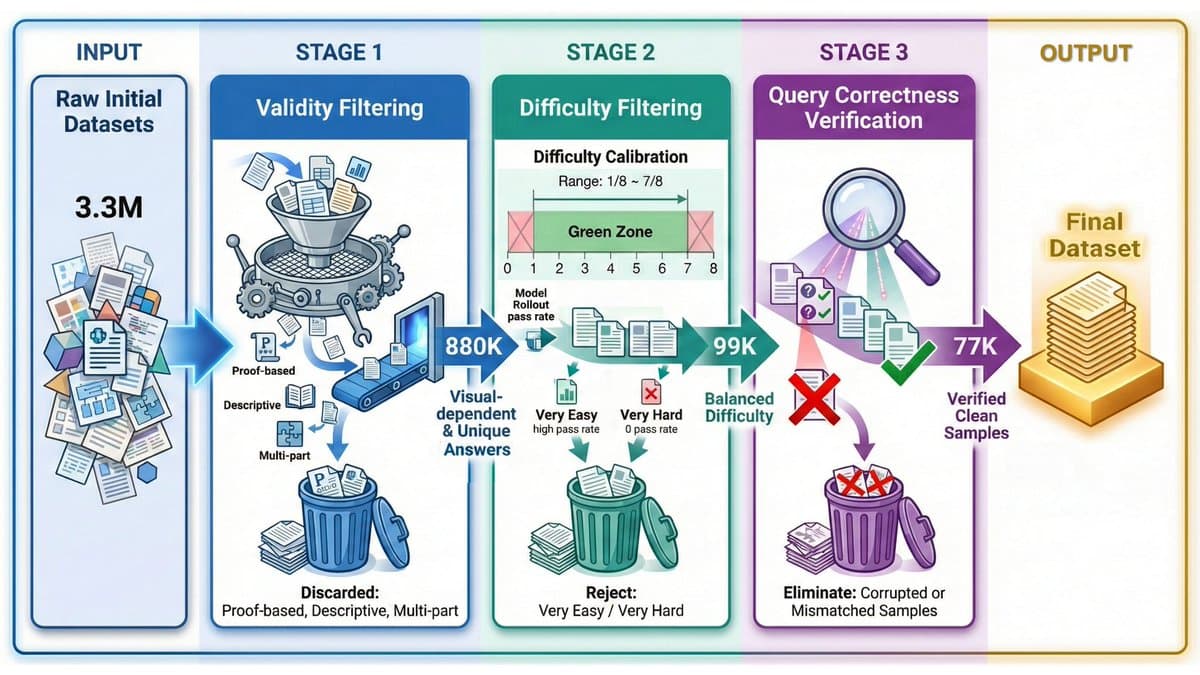
Researchers have unveiled DeepVision-103K, a groundbreaking mathematical dataset containing 103,000 verifiable visual instances specifically designed for training multimodal AI models. This comprehensive collection addresses a critical gap in artificial intelligence development: the ability to understand and reason about mathematical concepts presented in visual formats.
What Makes DeepVision-103K Special?
DeepVision-103K stands out for several key characteristics that differentiate it from previous mathematical datasets. First, it offers exceptional visual diversity, presenting mathematical concepts through varied representations including diagrams, charts, graphs, and geometric figures. This diversity is crucial for training AI systems that can recognize mathematical concepts regardless of their visual presentation.
Second, the dataset provides broad coverage of K-12 mathematical topics, spanning geometry, algebra, probability, and statistics. Each instance is carefully verified for accuracy, ensuring that models trained on this data learn correct mathematical relationships rather than superficial patterns.
Third, the dataset is specifically designed for RLVR (Reinforcement Learning with Visual Reasoning) training, making it particularly valuable for developing the next generation of multimodal AI systems that can combine visual understanding with logical reasoning.
The Visual Reasoning Challenge in AI
Current AI systems, while impressive in many domains, often struggle with tasks requiring visual mathematical reasoning. Large language models can solve text-based math problems with increasing proficiency, but when those same problems are presented visually—as a geometry diagram or statistical chart—their performance drops significantly.
This limitation stems from the fundamental challenge of connecting visual perception with abstract reasoning. Humans naturally integrate these capabilities, but AI systems typically treat vision and reasoning as separate processes. DeepVision-103K aims to bridge this gap by providing training data that explicitly connects visual mathematical representations with their underlying concepts.
Technical Specifications and Structure
The dataset contains 103,000 carefully curated instances, each consisting of a visual mathematical representation paired with verifiable ground truth information. The instances are distributed across mathematical domains:
- Geometry: Diagrams of shapes, angles, proofs, and spatial relationships
- Algebra: Visual representations of equations, functions, and algebraic structures
- Probability & Statistics: Charts, graphs, and visualizations of statistical concepts
Each instance includes metadata about the mathematical concept being illustrated, the visual representation type, and verification information confirming the correctness of the mathematical relationship shown.
Applications and Potential Impact
DeepVision-103K has significant implications for multiple AI application areas:
Educational Technology: AI tutors and learning platforms could use models trained on this dataset to better understand students' visual work, provide more accurate feedback on geometry proofs or statistical charts, and adapt explanations based on visual representations.
Scientific Research: Researchers working with visual data—from astronomy images to biological diagrams—could benefit from AI systems that understand the mathematical relationships embedded in visual representations.
Accessibility Tools: Systems that convert visual mathematical content into accessible formats (such as text descriptions for visually impaired users) would become more accurate and comprehensive.
Robotics and Autonomous Systems: Robots that need to understand spatial relationships, geometric constraints, or statistical patterns in their environment would benefit from improved visual mathematical reasoning.
The Broader Context of Multimodal AI Development
DeepVision-103K arrives at a crucial moment in AI development, as researchers increasingly focus on creating systems that can process and integrate multiple types of information. Recent advances in multimodal AI have shown promising results, but these systems often lack the specialized training data needed for complex reasoning tasks.
The dataset represents part of a growing trend toward creating more specialized, high-quality training resources for AI systems. As noted in the original announcement from HuggingFace, this work builds on previous efforts to create mathematical datasets while addressing specific limitations in visual diversity and coverage.
Challenges and Limitations
While DeepVision-103K represents significant progress, several challenges remain. The dataset focuses on K-12 mathematics, leaving more advanced mathematical concepts uncovered. Additionally, the visual representations, while diverse, may not capture all possible ways mathematical concepts appear in real-world contexts.
Researchers will need to address questions about how well models trained on this dataset generalize to novel visual representations and whether the reasoning capabilities transfer to other domains beyond mathematics.
Future Directions
The release of DeepVision-103K opens several promising research directions. Future work might expand the dataset to include more advanced mathematical concepts, incorporate dynamic visual representations (such as animations), or create similar datasets for other domains requiring visual reasoning.
Additionally, researchers could explore how models trained on DeepVision-103K perform on related tasks, such as generating visual explanations for mathematical concepts or solving problems that require both visual and textual understanding.
Conclusion
DeepVision-103K represents a significant step forward in developing AI systems with robust visual mathematical reasoning capabilities. By providing a large, diverse, and verified dataset specifically designed for RLVR training, this resource addresses a critical gap in current AI capabilities.
As multimodal AI systems become increasingly important across applications from education to scientific research, resources like DeepVision-103K will play a crucial role in ensuring these systems can understand and reason about the visual world with mathematical precision. The dataset not only advances technical capabilities but also moves us closer to AI systems that can genuinely understand complex visual information—a capability that has remained elusive despite remarkable progress in other AI domains.
Source: HuggingFace announcement of DeepVision-103K dataset