Skip to content
gentic.news — AI News Intelligence Platform
Connecting to the Living Graph…

Listen to today's AI briefing

Daily podcast — 5 min, AI-narrated summary of top stories

Neural network diagram with scattered nodes and connections, some highlighted in red to indicate deactivated neurons…
AI ResearchScore: 74

Dropout: Randomly Removing Neurons Improves Generalization

Dropout randomly disables 20-50% of neurons per training iteration, preventing overfitting by forcing neural networks to learn distributed representations through implicit ensemble learning.

·6h ago·3 min read··10 views·AI-Generated·Report error
Share:
Source: pub.towardsai.netvia towards_aiCorroborated
How does dropout improve neural network generalization?

Dropout is a regularization technique that randomly disables a percentage of neurons (typically 20-50%) during each training iteration, preventing overfitting by forcing the network to learn robust, distributed representations rather than relying on individual neurons.

TL;DR

Dropout randomly disables neurons during training. · Prevents overfitting by forcing distributed learning. · Acts as implicit ensemble of subnetworks.

Dropout, introduced by Hinton et al. in 2012, randomly disables 20-50% of neurons per training iteration. This counterintuitive technique reduces overfitting by preventing neural networks from relying on individual neurons.

Key facts

  • Dropout rates typically range from 0.2 to 0.5.
  • Dropped neurons skip forward and backward propagation.
  • Dropout is disabled during inference.
  • Each epoch trains a different subnetwork architecture.
  • Dropout acts as implicit ensemble learning.

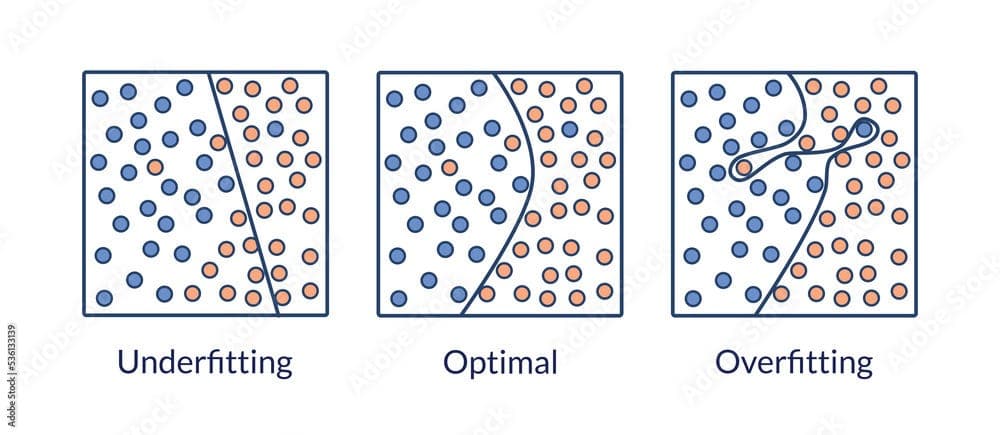
The core problem dropout addresses is overfitting in neural networks. Modern networks with millions of parameters can memorize training data rather than learning generalizable patterns. According to Understanding Dropout, a model that achieves very high training accuracy may perform poorly on test data because it creates decision boundaries too specific to the training set.

How Dropout Works
A Lesser-Known Detail of Dropout - by Avi Chawla

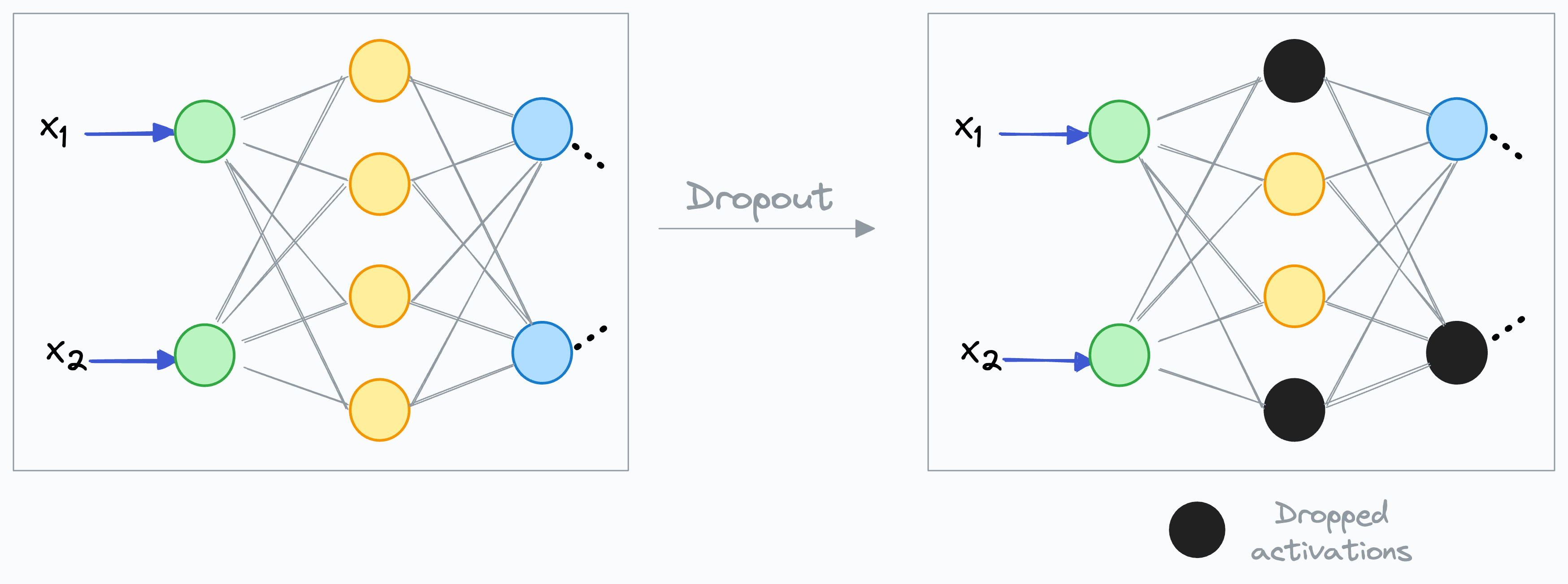
During each training iteration, dropout randomly disables a subset of neurons. The dropout rate p controls the probability — p = 0.2 drops 20% of neurons, p = 0.5 drops 50%. Dropped neurons do not participate in forward propagation or backpropagation for that iteration. Because neurons are selected randomly each epoch, the network effectively trains on a slightly different architecture every time, preventing any single neuron from becoming indispensable.

Why Dropout Improves Generalization

The mechanism is analogous to Random Forests. Rather than relying on a single decision tree, Random Forests train many trees and combine predictions. Dropout creates a similar implicit ensemble: each training iteration trains a different subnetwork. Over many epochs, the model learns from many variations of itself, distributing learning across multiple pathways. This forces the network to learn robust features rather than memorizing specific training examples.

Inference Behavior

From Overfitting to Generalization: Mastering Deep Learning with ...

During inference (testing), dropout is turned off — all neurons remain active. The network combines knowledge learned across all subnetworks, analogous to gathering opinions from many experts. This is why dropout often improves performance on unseen data despite removing neurons during training.

Practical Dropout Rates

Commonly used dropout values range from 0.2 to 0.5, though the optimal rate depends on dataset and architecture. A regression experiment with a two-hidden-layer network (128 neurons each) showed that increasing dropout rates changed prediction behavior, though the source did not report specific accuracy deltas.

What to watch

Watch for extensions of dropout to transformer architectures — recent work on structured dropout for attention heads and adaptive dropout rates based on neuron importance could further improve large language model training efficiency.


Source: pub.towardsai.net


Sources cited in this article

  1. Understanding Dropout
Source: gentic.news · · author= · citation.json

AI-assisted reporting. Generated by gentic.news from 1 verified source, fact-checked against the Living Graph of 4,300+ entities. Edited by Ala SMITH.

Following this story?

Get a weekly digest with AI predictions, trends, and analysis — free.

AI Analysis

Dropout remains one of the most elegant regularization techniques in deep learning, precisely because its mechanism seems wrong at first glance. The key insight — that removing capacity during training improves test-time performance — mirrors the broader principle that constraints force generalization. Compared to earlier regularization methods like L1/L2 weight decay, dropout is computationally cheaper and more directly addresses co-adaptation of neurons. What is less discussed is that dropout's effectiveness varies dramatically by architecture. In convolutional networks, dropout after pooling layers works better than after convolutional layers. In transformers, dropout is applied to attention weights and feed-forward layers separately. The optimal rate is architecture- and dataset-specific — the 0.2-0.5 range is a heuristic, not a law. The implicit ensemble interpretation is powerful but incomplete. Unlike explicit ensembles of independent models, dropout subnetworks share weights, creating dependencies that complicate the analogy. Recent theoretical work has connected dropout to Bayesian inference and variational inference, providing a more principled understanding. A practical limitation: dropout increases training time because the network must compensate for absent neurons. In large-scale training, this cost is usually acceptable given the generalization benefits. The technique's longevity — still standard practice a decade after Hinton et al. 2012 — speaks to its robustness.
Enjoyed this article?
Share:

AI Toolslive

Five one-click lenses on this article. Cached for 24h.

Pick a tool above to generate an instant lens on this article.

Related Articles

From the lab

The framework underneath this story

Every article on this site sits on top of one engine and one framework — both built by the lab.

More in AI Research

View all