Key Takeaways
- Researchers propose a dual-enhancement method for product bundling that integrates interactive graph learning with LLM-based semantic understanding.
- Their graph-to-text paradigm with Dynamic Concept Binding Mechanism addresses cold-start problems and graph comprehension limitations, showing significant performance gains on benchmarks.
What Happened
A new research paper posted to arXiv proposes "Dual-Enhancement Product Bundling," a hybrid AI approach that bridges interactive graph learning with large language model (LLM) capabilities for e-commerce product bundling recommendations. The method specifically addresses two critical limitations in existing approaches: collaborative filtering's dependency on historical interactions (leading to cold-start problems) and LLMs' inherent inability to directly model interactive graph structures.
The core innovation is a graph-to-text paradigm that employs a Dynamic Concept Binding Mechanism (DCBM) to translate graph structures into natural language prompts that LLMs can effectively process. This mechanism aligns domain-specific entities with LLM tokenization, enabling better comprehension of combinatorial constraints between products.
Technical Details
The proposed system operates through a dual-enhancement framework where graph learning and LLM understanding mutually reinforce each other:
Graph Learning Component: Models user-item and item-item interactions through graph neural networks, capturing collaborative signals and behavioral patterns.
LLM Semantic Component: Processes product descriptions, attributes, and contextual information to understand semantic relationships and complementarity.
Dynamic Concept Binding Mechanism (DCBM): This is the critical bridge between the two components. It dynamically maps graph nodes and edges to natural language concepts that LLMs can understand, addressing the fundamental mismatch between graph-structured data and LLM tokenization schemes. The DCBM learns to generate prompts that effectively communicate graph structural information to the LLM.
Dual Enhancement Loop: The graph component provides structural constraints to the LLM, while the LLM provides semantic understanding that enriches the graph representations, creating a virtuous cycle of improvement.
Experiments conducted on three benchmarks (POG, POG_dense, and Steam) demonstrated performance improvements ranging from 6.3% to 26.5% over state-of-the-art baselines. The method showed particular strength in cold-start scenarios where traditional collaborative filtering approaches struggle due to insufficient interaction data.
Retail & Luxury Implications
This research has direct applicability to luxury and retail e-commerce platforms facing specific challenges:

Cold-Start Problem for New Products: Luxury brands frequently launch limited-edition collections, capsule collaborations, and seasonal items with no historical interaction data. Traditional collaborative filtering fails in these scenarios, but this hybrid approach can leverage semantic understanding from product descriptions and attributes to make intelligent bundling recommendations from day one.
Complementarity Beyond Price Points: Luxury bundling isn't just about price optimization—it's about creating cohesive experiences and style narratives. The LLM component can understand that a $5,000 handbag complements a specific ready-to-wear collection based on design elements, brand heritage, and seasonal themes, not just purchase patterns.
Personalized Luxury Experiences: The graph component captures individual customer preferences and behaviors, while the LLM understands broader style contexts and brand narratives. Together, they can recommend bundles that are both personally relevant and stylistically coherent—suggesting that a customer who purchased minimalist jewelry might appreciate an avant-garde handbag from the same designer's experimental line.
Cross-Category Bundling: Luxury retail spans multiple categories (apparel, accessories, beauty, home). This approach can identify complementary items across traditionally separate categories by understanding both purchase patterns (graph) and semantic relationships (LLM)—suggesting a fragrance that matches the aesthetic of a ready-to-wear collection, for example.
Implementation Considerations: While promising, this approach requires significant technical infrastructure—graph neural networks, LLM integration, and the custom DCBM component. Luxury retailers would need rich product attribute data, customer interaction graphs, and potentially fine-tuned LLMs for fashion/luxury domain understanding.
gentic.news Analysis
This research arrives amid a surge of activity at the intersection of recommender systems and large language models. The arXiv repository has seen 33 articles this week alone (bringing its total to 312 in our coverage), with several recent papers exploring similar hybrid approaches. Just two days before this paper's submission, arXiv hosted "LLM-HYPER: Generative CTR Modeling for Cold-Start Ad Personalization via LLM-Based Hypernetworks" (April 13) and "Is Sliding Window All You Need? An Open Framework for Long-Sequence Recommendation" (April 14), indicating a clear research trend toward integrating LLMs with traditional recommendation techniques.

The paper's focus on cold-start problems directly addresses a persistent pain point in luxury retail, where new collections and limited editions represent significant revenue opportunities but lack historical data. This aligns with our recent coverage of MVCrec: A New Multi-View Contrastive Learning Framework for Sequential (April 16), which also tackles sequential recommendation challenges, though through different technical means.
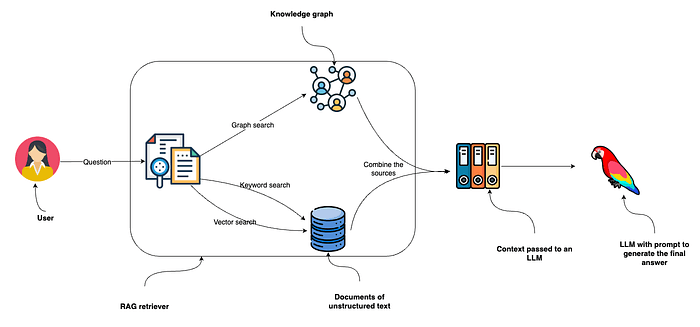
Notably, the proposed Dynamic Concept Binding Mechanism represents a novel approach to the fundamental challenge of making graph-structured data comprehensible to LLMs. While Retrieval-Augmented Generation (RAG) has been a dominant paradigm for grounding LLMs in external knowledge (appearing in 8 articles this week and 100 total), this paper takes a different route by translating graph structures directly into prompts rather than retrieving relevant text passages. This distinction is particularly relevant given our recent article "FRAGATA: A Hybrid RAG System for Semantic Search Over 20 Years of HPC" (April 16), which explores hybrid RAG approaches.
The performance improvements (6.3%-26.5%) are substantial in recommendation system terms, where even single-digit percentage gains can translate to significant revenue increases. However, luxury retailers should note that the benchmarks used (POG, POG_dense, Steam) are general e-commerce datasets, not luxury-specific. The true test will be adaptation to luxury contexts where product relationships are more nuanced and less transactional.
This research also intersects with broader concerns about LLM capabilities and limitations. The paper's acknowledgment that "LLMs lack inherent capability to model interactive graph directly" aligns with ongoing discussions in the AI community about the fundamental strengths and weaknesses of different AI architectures. It represents a pragmatic approach that plays to the strengths of both graph learning (structural understanding) and LLMs (semantic understanding), rather than forcing either technology to perform outside its natural capabilities.