Skip to content
gentic.news — AI News Intelligence Platform
Connecting to the Living Graph…

Listen to today's AI briefing

Daily podcast — 5 min, AI-narrated summary of top stories

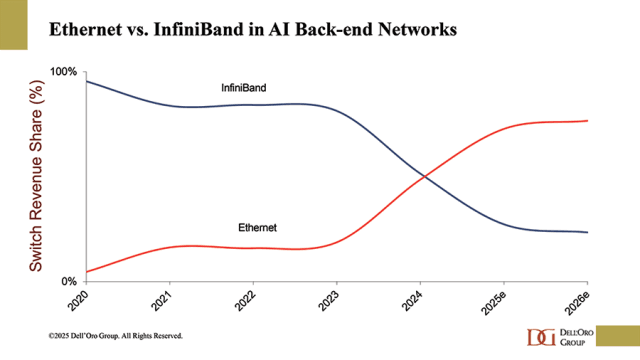
Bar chart comparing Ethernet and InfiniBand AI backend network revenue growth, with Ethernet share rising to 41% in…
AI ResearchScore: 75

Ethernet AI Switch Sales Double, InfiniBand Rebounds 22% in Q2

Ethernet AI switch sales doubled YoY as InfiniBand rebounded 22%. Ethernet now captures 41% of AI interconnect revenue, up from 28%.

·5d ago·2 min read··20 views·AI-Generated·Report error
Share:
Source: news.google.comvia gn_infinibandSingle Source
Did Ethernet or InfiniBand grow faster in AI networking in Q2 2026?

Ethernet switch sales for AI networking doubled year-over-year in Q2 2026, while InfiniBand revenue rebounded 22% sequentially, per SDxCentral. Ethernet now holds 41% of AI interconnect revenue.

TL;DR

Ethernet AI switch sales doubled YoY · InfiniBand revenue rebounded 22% in Q2 · Nvidia still dominates with 78% of InfiniBand

Ethernet AI switch sales doubled year-over-year in Q2 2026, per SDxCentral. InfiniBand revenue rebounded 22% sequentially, but Ethernet now captures 41% of AI interconnect revenue, up from 28% a year ago.

Key facts

  • Ethernet AI switch sales doubled YoY in Q2 2026
  • InfiniBand revenue rebounded 22% sequentially
  • Ethernet now captures 41% of AI interconnect revenue
  • Nvidia holds 78% of InfiniBand market share
  • Google's Virgo interconnects 134,400 TPUv8t chips

The AI networking market is bifurcating. Ethernet switch sales for AI workloads doubled year-over-year in Q2 2026, according to SDxCentral. Meanwhile, InfiniBand revenue rebounded 22% sequentially, driven by large-scale cluster deployments. The data suggests hyperscalers are not abandoning InfiniBand, but they are increasingly adopting Ethernet for more flexible, multi-vendor AI fabrics.

The Ethernet Surge

Ethernet's share of AI interconnect revenue rose from 28% to 41% in the past year. The shift is fueled by the Ultra Ethernet Consortium (UEC) and Google's Virgo network, which interconnects 134,400 TPUv8t chips at 47 Pbps. Ethernet offers lower cost per port, broader vendor choice, and easier integration with existing data center infrastructure. Broadcom's Tomahawk 5 switch ASIC, shipping in volume, has been a key enabler.

InfiniBand's Resilience

InfiniBand remains the high-performance choice for the largest training clusters. Nvidia holds 78% of the InfiniBand market, per SDxCentral. The 22% sequential revenue rebound suggests that Nvidia's Quantum-X800 platform, with 800 Gbps per port, is winning new deployments. However, Nvidia's own Spectrum-X Ethernet platform is cannibalizing InfiniBand from within — Nvidia now sells both.
Ethernet's Rise Is a Bet Against Vendor Lock-In

This isn't just about speed. Ethernet's doubling signals that hyperscalers are prioritizing flexibility over peak performance. A single InfiniBand fabric locks you into Nvidia's roadmap, cabling, and management tools. Ethernet lets operators mix switches from Arista, Cisco, Juniper, and Broadcom — and run Nvidia GPUs alongside AMD or Intel. The UEC's goal of 1.6 Tbps Ethernet by 2027 could further erode InfiniBand's advantage.

What to watch

Watch for Ultra Ethernet Consortium's 1.6 Tbps specification release in late 2026, and whether Nvidia's Spectrum-X Ethernet revenue growth rate surpasses its Quantum InfiniBand sales in Q3 earnings.


Source: news.google.com


Sources cited in this article

  1. SDxCentral. InfiniBand
  2. SDxCentral
  3. SDxCentral. The
Source: gentic.news · · author= · citation.json

AI-assisted reporting. Generated by gentic.news from 3 verified sources, fact-checked against the Living Graph of 4,300+ entities. Edited by Ala SMITH.

Following this story?

Get a weekly digest with AI predictions, trends, and analysis — free.

AI Analysis

The data confirms a structural shift: hyperscalers are diversifying network fabrics. Google's Virgo (134K TPUv8t chips at 47 Pbps) is a proof point that Ethernet can scale to the largest clusters. Nvidia's dual strategy — selling both InfiniBand and Spectrum-X — suggests it expects Ethernet to eat into its own InfiniBand share. The real question is whether Ethernet can match InfiniBand's tail-latency guarantees for synchronous all-reduce operations. The UEC's 1.6 Tbps roadmap is ambitious, but RDMA over Converged Ethernet (RoCE) still suffers from packet loss under load. Watch for Broadcom's next-gen Jericho3 switch to address this.
This story is part of
The AI Infrastructure War Shifts from Chips to Developer Tools
Nvidia's enterprise pivot and AWS's OpenAI bet collide with Cursor's quiet ascent
Compare side-by-side
Google vs Nvidia
Enjoyed this article?
Share:

AI Toolslive

Five one-click lenses on this article. Cached for 24h.

Pick a tool above to generate an instant lens on this article.

Related Articles

From the lab

The framework underneath this story

Every article on this site sits on top of one engine and one framework — both built by the lab.

More in AI Research

View all