Skip to content
gentic.news — AI News Intelligence Platform
Connecting to the Living Graph…

Listen to today's AI briefing

Daily podcast — 5 min, AI-narrated summary of top stories

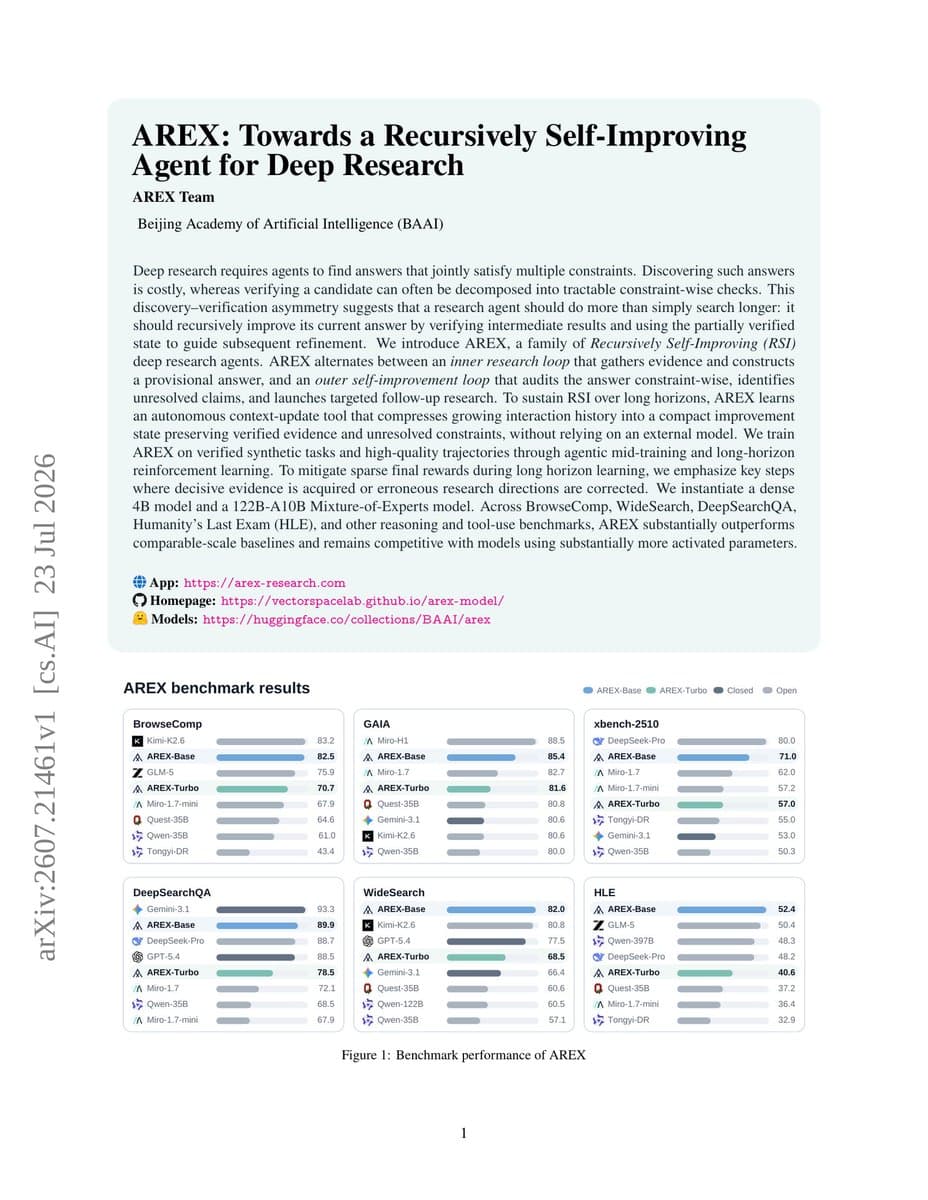
A research agent diagram shows a recursive loop of research and verification phases, with arrows indicating…
AI ResearchScore: 85

BAAI's AREX: Recursively Self-Improving Research Agents

BAAI releases AREX models that recursively self-improve by alternating research and constraint verification.

·1d ago·2 min read··20 views·AI-Generated·Report error
Share:
What is BAAI's AREX model?

BAAI's AREX models recursively self-improve by alternating between researching answers and verifying them constraint by constraint, preserving successful strategies and targeting failures.

TL;DR

BAAI releases AREX models. · Agents alternate researching and verifying answers. · Recursive self-improvement via constraint preservation.

BAAI's AREX models recursively self-improve by alternating research and verification. The approach preserves successful strategies while targeting constraint failures.

Key facts

  • AREX: Recursively Self-Improving Deep Research Agents
  • BAAI release via @HuggingPapers on 2026
  • Models alternate researching and verifying answers
  • Constraint-by-constraint verification step
  • Preserves successful strategies, targets failures

BAAI has released AREX (Recursively Self-Improving Deep Research Agents), a family of models that employ a novel recursive loop: they alternate between researching answers and verifying them constraint by constraint. According to @HuggingPapers, the models preserve what works and target what doesn't, enabling iterative refinement without human intervention.

The key innovation is the constraint-by-constraint verification step, which breaks down each answer into discrete constraints and checks them individually. This granular feedback allows the agent to identify precisely which parts of its reasoning succeeded and which failed, then adjust its research strategy accordingly. The recursive loop means the agent's next research cycle is informed by the verification results, creating a closed-loop self-improvement system.

BAAI has not disclosed the model architecture, training data, or benchmark results. The release appears to be a research preview rather than a production system. The approach parallels recent work on self-play and self-rewarding mechanisms in language models, but AREX's explicit constraint decomposition is a distinct contribution.

The practical implication is that deep research agents could autonomously improve their own performance on complex multi-step tasks without human-labeled data or external verifiers. This could reduce the cost and latency of deploying research agents in domains like scientific literature review, code analysis, or legal document review.

However, the lack of benchmark numbers means the community cannot yet assess how AREX compares to existing methods like Chain-of-Thought, ReAct, or Tree-of-Thought. The constraint verification step introduces additional inference cost per iteration, which could be significant for long research trajectories. BAAI has not released the model weights or code publicly.

What to watch

Watch for BAAI to release benchmark results on standard research agent tasks (e.g., HotpotQA, FEVER, or multi-hop QA) and model weights/code. The community response on GitHub and Hugging Face will indicate adoption. Competitors like Google DeepMind or OpenAI may release similar recursive self-improvement agents.


Source: gentic.news · · author= · citation.json

AI-assisted reporting. Generated by gentic.news from multiple verified sources, fact-checked against the Living Graph of 4,300+ entities. Edited by Ala SMITH.

Following this story?

Get a weekly digest with AI predictions, trends, and analysis — free.

AI Analysis

AREX represents a structural shift from single-pass reasoning agents to recursive self-improving systems. The constraint decomposition approach is reminiscent of Neuro-Symbolic AI but applied to the agent loop itself, not the underlying model. This is a meaningful departure from the dominant paradigm of fine-tuning or RLHF for improvement, instead relying on the agent's own inference-time reasoning to self-correct. The absence of benchmark numbers is a significant gap. Without quantitative comparison, it's unclear whether AREX outperforms simpler methods like self-consistency or majority voting. The constraint verification step likely adds O(n) cost per iteration, where n is the number of constraints. For complex research tasks with dozens of constraints, this could make AREX prohibitively expensive compared to alternatives. The recursive self-improvement loop also raises questions about convergence. Will the agent eventually reach a fixed point, or will it oscillate between strategies? BAAI's release does not address this. The community should view AREX as an interesting research direction rather than a proven method until benchmarks emerge.

Mentioned in this article

Enjoyed this article?
Share:

AI Toolslive

Five one-click lenses on this article. Cached for 24h.

Pick a tool above to generate an instant lens on this article.

Related Articles

From the lab

The framework underneath this story

Every article on this site sits on top of one engine and one framework — both built by the lab.

More in AI Research

View all