In a significant theoretical and practical advance for artificial intelligence, researchers have introduced Evo, a novel large language model architecture that fundamentally reimagines how machines generate text. Published on arXiv on February 20, 2026, this research presents a unified framework that bridges two previously distinct approaches to language generation: autoregressive models and diffusion models.
The Paradigm Problem in Language Generation
Traditional large language models have largely followed one of two paths. Autoregressive (AR) models, like GPT-4 and Claude, generate text sequentially—predicting each token based on previous tokens in a left-to-right fashion. This approach excels at producing coherent, contextually appropriate text with impressive efficiency but can struggle with long-range planning and complex reasoning tasks.
Diffusion models, which revolutionized image generation with systems like DALL-E and Stable Diffusion, work differently. They start with random noise and gradually refine it toward a coherent output through multiple denoising steps. While diffusion excels at exploration and planning, it's computationally expensive and has been challenging to apply effectively to discrete text data.
These two paradigms have remained largely separate in language AI development, with researchers typically choosing one approach over the other based on their specific needs. The Evo team, however, asked a more fundamental question: What if these aren't separate paradigms at all, but rather different points on a continuous spectrum of generation?
Evo's Revolutionary Approach: Latent Flow Generation
Evo introduces what the researchers call a "duality latent trajectory model" that reconceptualizes text generation as a continuous evolutionary process. Rather than treating tokens as discrete symbols to be predicted sequentially, Evo associates each token with a vector-valued embedding that evolves over what they term a "progression variable" $t_i \in [0, 1]$.

This progression variable represents the semantic maturity of each token. At low $t_i$ values, the model behaves like an autoregressive system—making confident, efficient refinements. At high $t_i$ values, it shifts toward diffusion-style behavior—engaging in more exploratory planning and uncertainty-driven generation.
"Rather than treating AR decoding and diffusion generation as separate paradigms," the researchers explain, "Evo reconceptualizes text generation as a latent flow." This allows the model to adaptively balance between AR and diffusion modes based on the uncertainty and complexity of each generation task.
Theoretical Foundation and Implementation
The theoretical breakthrough behind Evo is the demonstration that both autoregressive and diffusion models emerge as discretizations of a shared probability flow. The researchers derive Evo's training objective from a unified variational evidence lower bound (ELBO), providing a mathematically rigorous foundation for their approach.
Practically, Evo is implemented as a time-conditioned Transformer governed by a shared vector field. The model is trained end-to-end to jointly infer latent codes and their progression times, learning when to apply which generation strategy automatically.
During decoding, this architecture enables efficient, semantics-aware refinement. The model can allocate computational resources where they're most needed—applying fast AR-style generation for straightforward continuations while engaging more sophisticated diffusion-style planning for complex reasoning tasks.
Performance and Benchmark Results
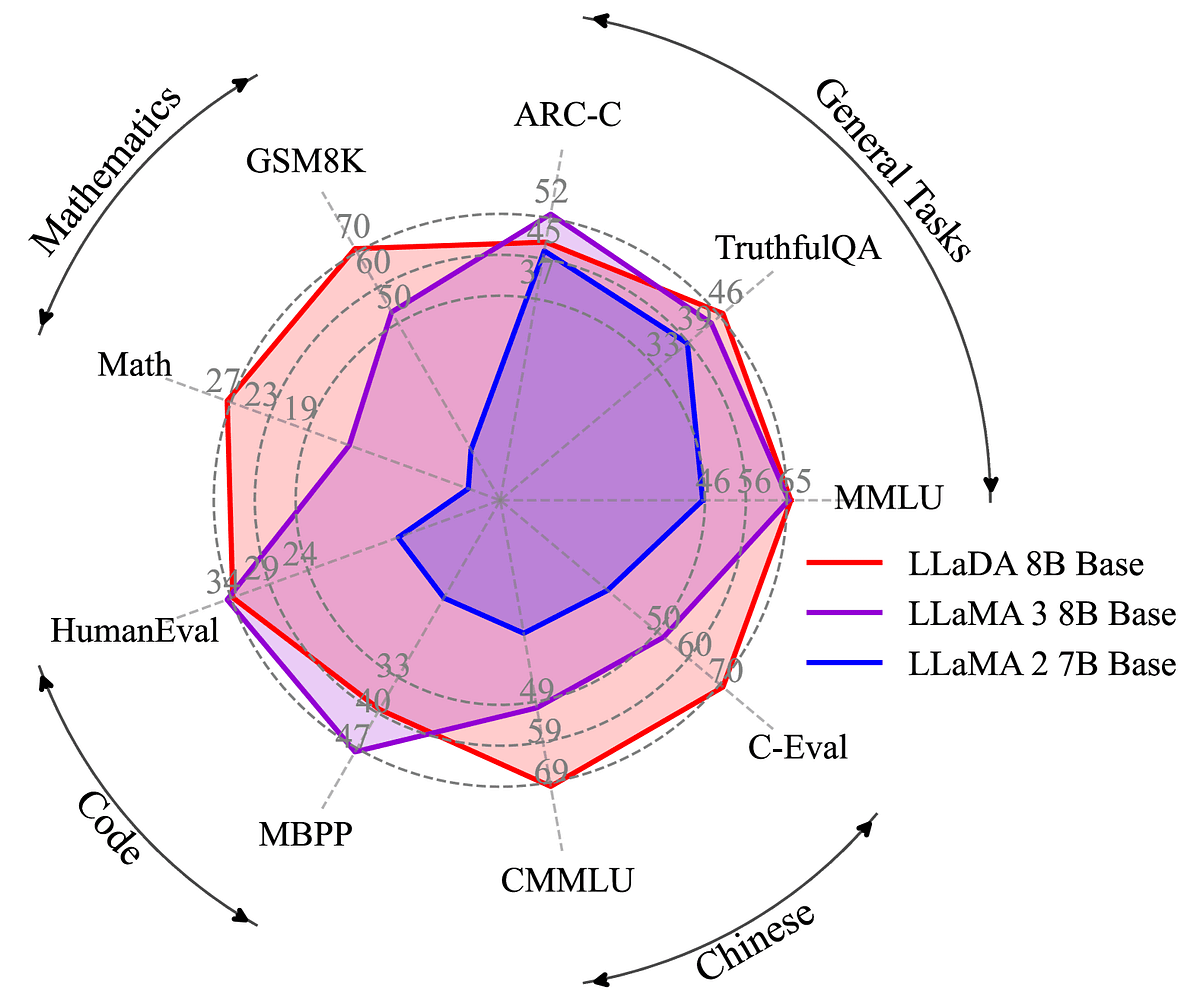
The empirical results are striking. The Evo 8B model (with 8 billion parameters) achieves state-of-the-art or highly competitive results across 15 diverse benchmarks, including:
- Reasoning tasks (GSM8K, ARC-C)
- Code generation (HumanEval, MBPP)
- General language understanding
Perhaps most impressively, Evo achieves these results while maintaining fast inference speeds—addressing one of the primary criticisms of diffusion approaches to language generation. The model demonstrates strong generation quality, robust symbolic reasoning, and decoding efficiency simultaneously.
Implications for AI Development
Evo's approach represents more than just another incremental improvement in model architecture. It suggests a fundamental shift in how we conceptualize language generation in AI systems. By viewing AR and diffusion not as competing paradigms but as complementary aspects of a continuous process, Evo opens new pathways for model design.

This research arrives at a critical moment in AI development. As noted in recent arXiv publications and industry discussions, large language models have faced increasing criticism for their limitations in achieving human-level reasoning and autonomy. Evo's ability to balance efficient generation with sophisticated planning addresses several of these concerns directly.
The framework also has implications for model efficiency and specialization. By dynamically allocating computational resources based on task complexity, Evo-like architectures could enable more efficient deployment of AI systems across diverse applications—from simple text completion to complex problem-solving.
Future Directions and Open Questions
While Evo represents a significant advance, several questions remain open. The researchers note that their current implementation focuses on text generation, but the underlying framework could potentially extend to multimodal generation—combining text, images, and other data types within the same evolutionary flow.
Additionally, the progression variable $t_i$ currently represents semantic maturity, but future work might explore more sophisticated interpretations—perhaps linking it to confidence metrics, task complexity, or even user preferences.
The publication of Evo on arXiv, while not yet peer-reviewed in the traditional sense, follows the platform's established role as a primary dissemination channel for cutting-edge AI research. As with other recent arXiv publications on topics ranging from image-based shape retrieval to verifiable reasoning frameworks, Evo contributes to the rapid evolution of AI capabilities.
Conclusion: A New Paradigm for Language AI
Evo delivers what the researchers describe as "a new paradigm for LLM design"—one that doesn't force a choice between efficiency and sophistication, between confident refinement and exploratory planning. By unifying autoregressive and diffusion approaches within a continuous evolutionary framework, Evo points toward a future where AI language models can adapt their generation strategy to the specific demands of each task.
As AI systems continue to advance, architectures like Evo that bridge previously separate paradigms may prove crucial for developing more capable, efficient, and versatile language models. The evolutionary approach to text generation represents not just another technical improvement, but a fundamental rethinking of how machines create language—one that could shape AI development for years to come.
Source: arXiv:2603.06617v1, "Evo: Autoregressive-Diffusion Large Language Models with Evolving Balance," submitted February 20, 2026.