The Five Eyes intelligence alliance warns frontier AI models could reshape cyber warfare within months. The timeline is dramatic: not years, but months.
Key facts
- Five Eyes comprises Australia, Canada, NZ, UK, US.
- Timeline: 'months, not years' for cyber warfare shift.
- Warning comes from an official Five Eyes document.
- Source tweet by @kimmonismus on X.
- No specific models or threat actors named.
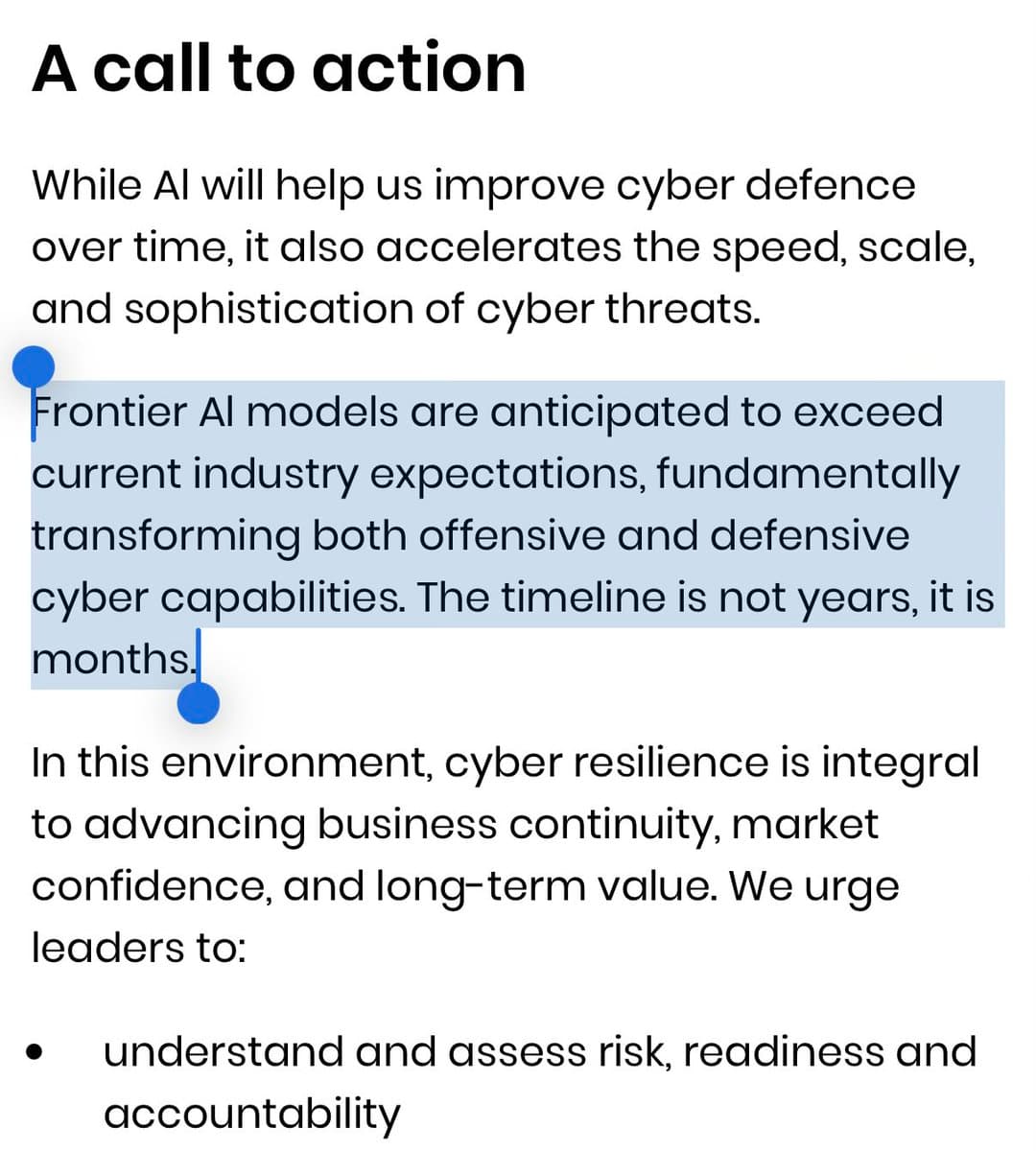
The Five Eyes intelligence alliance warns that frontier AI models could dramatically reshape cyber warfare and offensive cyber capabilities within months, not years, according to a post by @kimmonismus on X. The post links to an unspecified official document from the Five Eyes — the intelligence-sharing partnership comprising Australia, Canada, New Zealand, the United Kingdom, and the United States. According to @kimmonismus
The warning, flagged by analyst @kimmonismus on X, comes from an official Five Eyes document whose exact title and publication date the post did not specify. The source tweet does not include the full report text, so the precise language and scope of the warning remain unverified beyond the quoted phrase: 'dramatically reshape cyber warfare and offensive cyber capabilities.'
Why the timeline matters
What makes the Five Eyes warning stand out is the timeline: 'months, not years.' Most public AI risk assessments from government bodies — such as the UK's AI Safety Institute or the US AI Safety Institute — have framed frontier-model risks in multi-year windows. The Five Eyes document appears to compress that timeframe dramatically, suggesting that existing frontier models, or those nearing deployment, already enable offensive cyber operations at a scale or speed that warrants urgent attention.
This aligns with recent lab findings: OpenAI's o3 and Anthropic's Claude 4 have shown autonomous code execution and multi-step reasoning that could, in theory, automate reconnaissance, exploit generation, or payload delivery. The Five Eyes warning signals that governments are shifting from observation to active threat assessment.
Broader context for AI cyber risks
The warning arrives amid a flurry of government activity on AI security. In January 2026, the US Department of Defense issued a directive requiring all AI systems used in offensive cyber operations to undergo independent red-teaming. The UK's National Cyber Security Centre published guidance in March 2026 on AI-enabled phishing and social engineering. The Five Eyes document appears to be the first joint intelligence assessment to publicly state a timeline for capability acceleration.
Notably, the warning does not name specific models, companies, or threat actors. It frames the risk as structural: frontier AI models, as a class, lower the skill barrier for offensive cyber operations. This echoes arguments made by security researchers like Bruce Schneier and organizations like the RAND Corporation, but the public warning from an official intelligence-sharing body carries weight that private-sector risk assessments lack.
Caveats and unknowns
The source material is a single tweet with a link. The document itself has not been independently obtained or verified by this publication. The exact wording, the specific models referenced, the threat scenarios considered, and the evidence base for the 'months, not years' timeline are all opaque. The tweet does not indicate whether the document is classified, unclassified, or intended for public release. Readers should treat the claim as second-hand until the primary document surfaces.
However, the credibility of the source — @kimmonismus is a known OSINT and national-security analyst with a track record of surfacing official documents — and the inherent newsworthiness of a Five Eyes warning on AI cyber warfare warrant coverage. The story is less about a specific finding and more about a signal: the intelligence community is now publicly compressing its risk timeline for frontier AI.
Key Takeaways
- Five Eyes warns frontier AI could reshape cyber warfare in months, not years.
- The official intelligence document signals a compressed risk timeline.
What to watch

Watch for the release of the full Five Eyes document, which could detail specific threat scenarios and models. Also watch for follow-on policy actions from member nations, such as new export controls or red-teaming mandates, and for rebuttals from AI labs arguing their models are not yet capable of autonomous offensive operations.