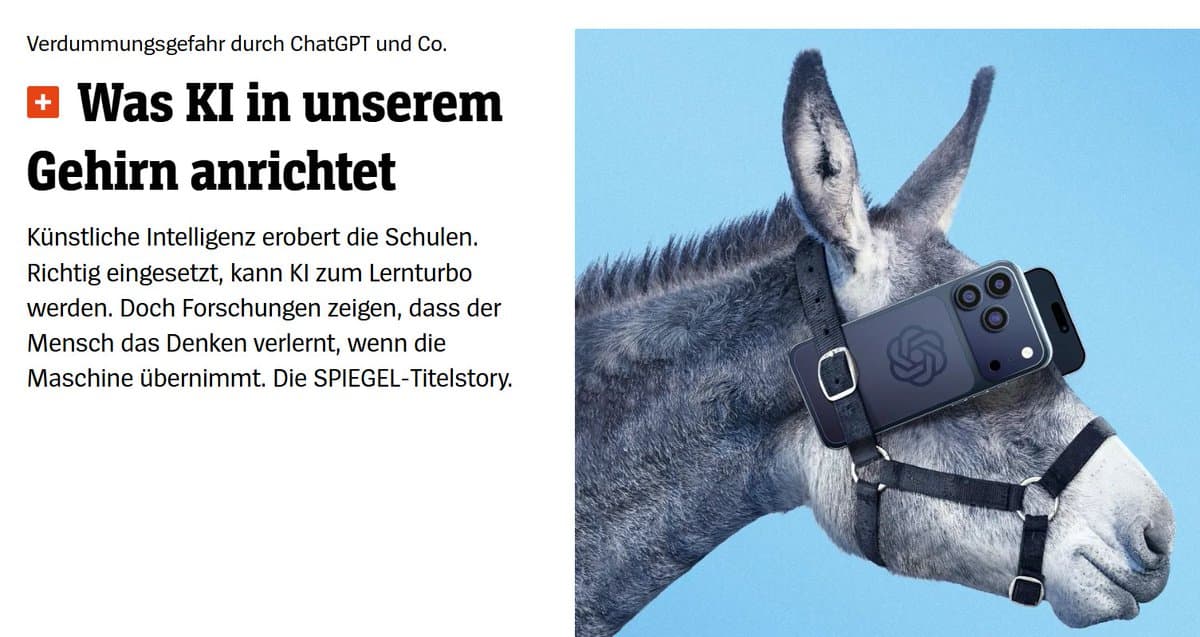
A front cover from one of Germany's most influential news magazines has become a flashpoint in an ongoing debate about the country's cultural attitude toward artificial intelligence. The latest issue of DER SPIEGEL features a bold, provocative question on its cover: "Wie dumm macht uns KI?" ("How stupid is AI making us?").
For critics like AI commentator and X user @kimmonismus, the cover is a prime example of "German Angst"—a term describing a pervasive national tendency toward risk aversion, caution, and pessimism—applied to technological progress. The cover frames the dominant narrative around AI not as one of enabling potential, but of intellectual and societal degradation.
The Spark: A Cover Question
The source material is a social media post criticizing the cover's framing. The poster expresses frustration with what they see as a consistent pattern in German media and public discourse: a focus on the threats, risks, and downsides of AI, often at the expense of exploring its constructive possibilities.
"I'm still waiting for the time when one of the big journalistic houses will publish a cover page and ask what possibilities AI enables for a good future," writes @kimmonismus. The argument is that this editorial choice by a major publication like DER SPIEGEL reinforces a public mindset that could hinder Germany's ability to compete and innovate in a field critical to the future global economy.
Context: "German Angst" and the AI Debate
This incident is not isolated. It taps into a longstanding discussion about Germany's relationship with technology. "German Angst" has historically manifested in debates around nuclear power, genetic engineering, and digitalization, often characterized by thorough regulation and public skepticism.
In the AI domain, this has translated into a strong German and European focus on the EU AI Act, one of the world's first comprehensive attempts to regulate artificial intelligence based on risk categories. While many experts agree robust governance is necessary, critics argue that an excessive focus on precaution can stifle innovation, drive talent and startups to other regions, and shape a public narrative of fear rather than informed engagement.
The Competitive Landscape

The debate occurs against a backdrop of intense global competition in AI. The United States and China have established clear leads in foundational model development and deployment, driven by massive private investment and, in China's case, significant state direction. Other European nations, like France with its thriving startup ecosystem (e.g., Mistral AI) and the UK with its AI safety initiatives, are carving out distinct positions.
Germany, despite its engineering prowess and strong industrial base (a potential advantage in applied industrial AI), is often perceived as lagging in the race to build and shape foundational AI technologies. The cultural and media narrative, as exemplified by the SPIEGEL cover, is seen by some as a contributing factor to this position.
gentic.news Analysis
This social media critique highlights a critical, non-technical bottleneck in AI development: national culture and narrative. While much of our coverage focuses on model architectures, benchmark scores, and funding rounds, the societal container in which innovation occurs is equally decisive. Germany's case is a potent example of how deep-seated cultural tendencies—in this case, precautionary principle and "Angst"—directly influence media framing, public opinion, and, ultimately, policy and commercial ambition.
This story connects to a broader trend we've observed across Europe: a tension between innovation drive and regulatory caution. For instance, our coverage of the EU AI Act's final passage detailed the delicate balance lawmakers tried to strike between setting guardrails and not crushing startups. The SPIEGEL cover suggests that in the German public sphere, the cautionary narrative is dominant. This contrasts with, for example, the UK's effort to brand itself as a global hub for AI safety research, a frame that engages with risk but from a position of leadership and opportunity.
For practitioners and companies in Germany, this environment presents a specific challenge. It means advocating for AI's potential often requires first overcoming a default skeptical or fearful public discourse. The outcome of this cultural debate will significantly impact whether Germany leverages its world-class manufacturing and engineering sectors to become a leader in Industrial AI and AI-augmented precision engineering, or remains a cautious adopter of technologies shaped elsewhere.
Frequently Asked Questions
What is "German Angst"?
"German Angst" is a cultural term referring to a pronounced tendency in German society toward anxiety, caution, and risk aversion, particularly regarding new technologies, social changes, or environmental issues. It is often cited as a driving force behind the country's strong regulatory frameworks and thorough public debates on topics like nuclear power, genetic modification, and data privacy.
How does Germany's approach to AI differ from the US or China?
Germany's approach, largely shaped within the EU context, is heavily oriented toward regulation and ethical guardrails (exemplified by the EU AI Act), with a strong focus on data privacy (GDPR) and human-centric AI. This contrasts with the US's more market-driven, innovation-first approach led by major tech corporations, and China's state-directed strategy that prioritizes national AI capability and social governance applications, with different privacy considerations.
What is DER SPIEGEL's influence in Germany?
DER SPIEGEL is one of Germany's most prestigious and widely read weekly news magazines, known for its in-depth investigative journalism and significant influence on political and public opinion. Its cover stories are particularly prominent and are seen as setting the agenda for national discussions on key issues.
Are there German companies or research institutes leading in AI?
Yes, despite the cultural debates, Germany has significant AI strengths. The German Research Center for Artificial Intelligence (DFKI) is one of the world's largest nonprofit AI research labs. Companies like SAP and Siemens are leaders in integrating AI into enterprise software and industrial automation (Industry 4.0). However, it has not yet produced a globally dominant giant in foundational AI models comparable to OpenAI, Anthropic, or Google DeepMind.