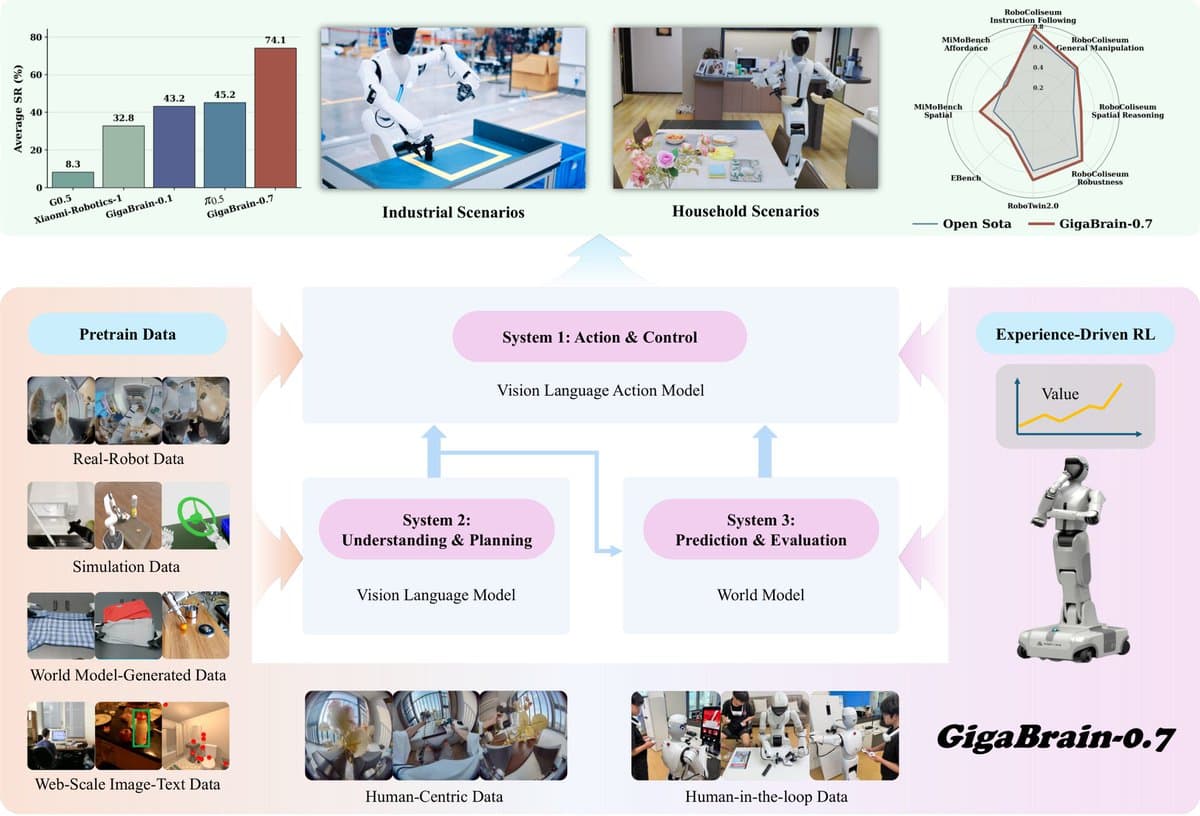
GigaBrain-0.7 hit 74.1% success on embodied tasks, beating pi0.5's 45.2% by 28.9 points. The model's three-system architecture and 37,000+ hours of heterogeneous robot data mark a structural shift in robotic foundation models.
Key facts
- 74.1% success rate for GigaBrain-0.7
- 45.2% success rate for pi0.5
- 28.9-point performance gap
- 37,000+ hours training data
- Three-system architecture
- Heterogeneous robot data
GigaBrain-0.7, an embodied foundation model, has posted a 74.1% success rate on robot manipulation benchmarks, versus pi0.5's 45.2% — a 28.9-point gap. According to @HuggingPapers, the model uses a three-system architecture, a departure from the monolithic policy networks that dominated prior work like pi0.5.
The training set is equally notable: 37,000+ hours of heterogeneous robot data, spanning multiple embodiments and task types. This breadth contrasts with the narrower, single-robot datasets used in earlier embodied models, suggesting that data diversity — not just scale — drives the performance jump. The company did not disclose the exact compute budget or the number of parameters, leaving open questions about reproducibility.
Three-system architecture: a cognitive split
The three-system design separates perception, planning, and motor control into distinct modules, rather than end-to-end policy learning. This mirrors cognitive architectures in neuroscience, where hierarchical processing improves robustness. In practice, it likely allows each system to specialize — perception handles noisy sensor inputs, planning reasons over long horizons, and motor control executes precise actions. The 28.9-point margin over pi0.5 suggests this modularity is not just theoretical; it translates to measurable gains on real-world tasks.
What the gap means for the field
Pi0.5, developed by Physical Intelligence, was the prior state-of-the-art in open-world manipulation. A 28.9-point improvement is not incremental — it's a step change. If GigaBrain-0.7's results hold under independent evaluation, it redefines the ceiling for embodied AI. The heterogeneous training data is the likely differentiator: models trained on diverse robot morphologies generalize better to unseen configurations, a hypothesis now backed by this benchmark.
The source announcement is thin on methodology details — no parameter counts, no ablation studies, no evaluation protocol specifics. The 74.1% figure is self-reported, and the community should treat it with caution until a paper or open-source release appears. But the magnitude of the delta, even with a 10% measurement error, places GigaBrain-0.7 clearly ahead of pi0.5.
What to watch
Watch for the release of the GigaBrain-0.7 paper or open-source weights, which would allow independent replication. Also track whether Physical Intelligence responds with a pi0.6 or similar update in the next quarter. If the 74.1% figure holds under third-party evaluation, expect a surge of heterogeneous-data training runs across major robotics labs.