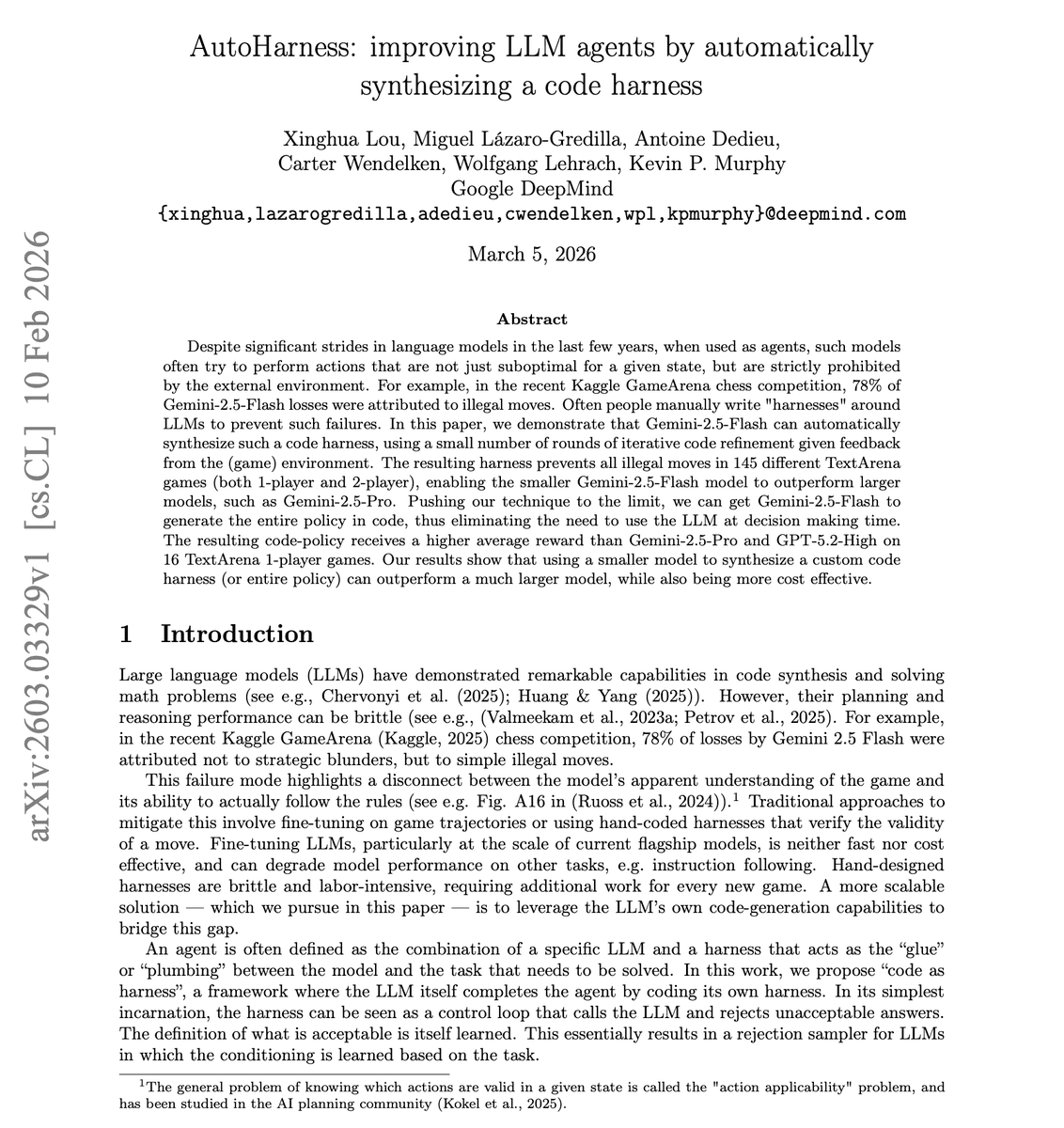
In a development that could fundamentally change how artificial intelligence systems are developed and deployed, Google DeepMind researchers have introduced AutoHarness, a framework that enables automatic testing and optimization of AI models without requiring expensive retraining. The approach has already demonstrated practical applications, with early adopters reporting success in creating functional AI agents for complex tasks like coding assistance.
What AutoHarness Actually Does
While the technical details of AutoHarness remain in the research paper referenced by AI researcher Omar Sar, the core innovation appears to be a system that can automatically identify weaknesses in AI models and generate targeted tests to improve performance. Unlike traditional fine-tuning approaches that require extensive computational resources and labeled data, AutoHarness operates without modifying the underlying model weights through retraining.
The framework likely works by analyzing model behavior across various inputs, identifying failure patterns, and then generating specific test cases or prompts that help the model overcome these limitations. This represents a significant departure from conventional AI development workflows, where improving model performance typically involves either collecting more training data or implementing complex architectural changes.
Early Applications and Results
According to Sar's testing, AutoHarness has already proven effective on models like MiniMax-2.5, where it delivered "good results" without any training process. Most notably, Sar reports that the framework "allowed me to synthesize an entire functional coding agent," suggesting that AutoHarness can help assemble specialized AI systems from existing models.
This capability could dramatically accelerate AI application development. Instead of building coding assistants from scratch or extensively fine-tuning general-purpose models, developers might use AutoHarness to automatically configure and optimize existing models for specific programming tasks. The "synthesis" aspect mentioned by Sar implies that AutoHarness might help coordinate multiple AI components or generate specialized workflows tailored to particular domains.
Implications for AI Development
The potential implications of this technology are substantial. First, accessibility: Smaller organizations and individual developers could leverage state-of-the-art AI capabilities without the resources needed for large-scale training. Second, efficiency: The elimination of retraining could reduce development cycles from weeks or months to days or even hours. Third, specialization: AutoHarness could enable highly customized AI solutions for niche applications that previously weren't economically viable.
For enterprise AI adoption, this could mean faster deployment of specialized assistants across various departments—from legal document analysis to customer service optimization—all without the traditional costs and delays associated with model customization.
The Broader Context of AI Testing Frameworks
AutoHarness emerges within a growing ecosystem of AI testing and evaluation tools. Traditional approaches to AI safety and performance evaluation have relied heavily on static benchmarks and human evaluation, both of which have limitations in capturing real-world performance. AutoHarness appears to represent a more dynamic, automated approach that continuously tests and improves models.
This development aligns with broader trends in AI reliability engineering, where researchers are developing systematic approaches to ensure AI systems behave as intended across diverse scenarios. What makes AutoHarness particularly interesting is its focus on improvement rather than just evaluation—it doesn't just identify problems but apparently helps fix them.
Looking Ahead: The Future of AI Development Tools
If AutoHarness proves broadly effective, it could signal a shift toward more automated AI development pipelines. Future tools might automatically diagnose model weaknesses, generate targeted improvements, and even synthesize complete AI applications from modular components.
However, important questions remain about the limitations of such approaches. How does AutoHarness handle complex reasoning tasks versus more pattern-based applications? What are the boundaries of what can be improved without retraining? And how does this approach interact with emerging concerns about AI safety and alignment?
As Sar notes, more details about his implementation and results are forthcoming. The AI community will be watching closely to see whether AutoHarness represents a fundamental advance in how we build intelligent systems or a more specialized tool with limited applicability.
Source: Based on testing and analysis shared by AI researcher Omar Sar (@omarsar0) regarding Google DeepMind's AutoHarness framework.