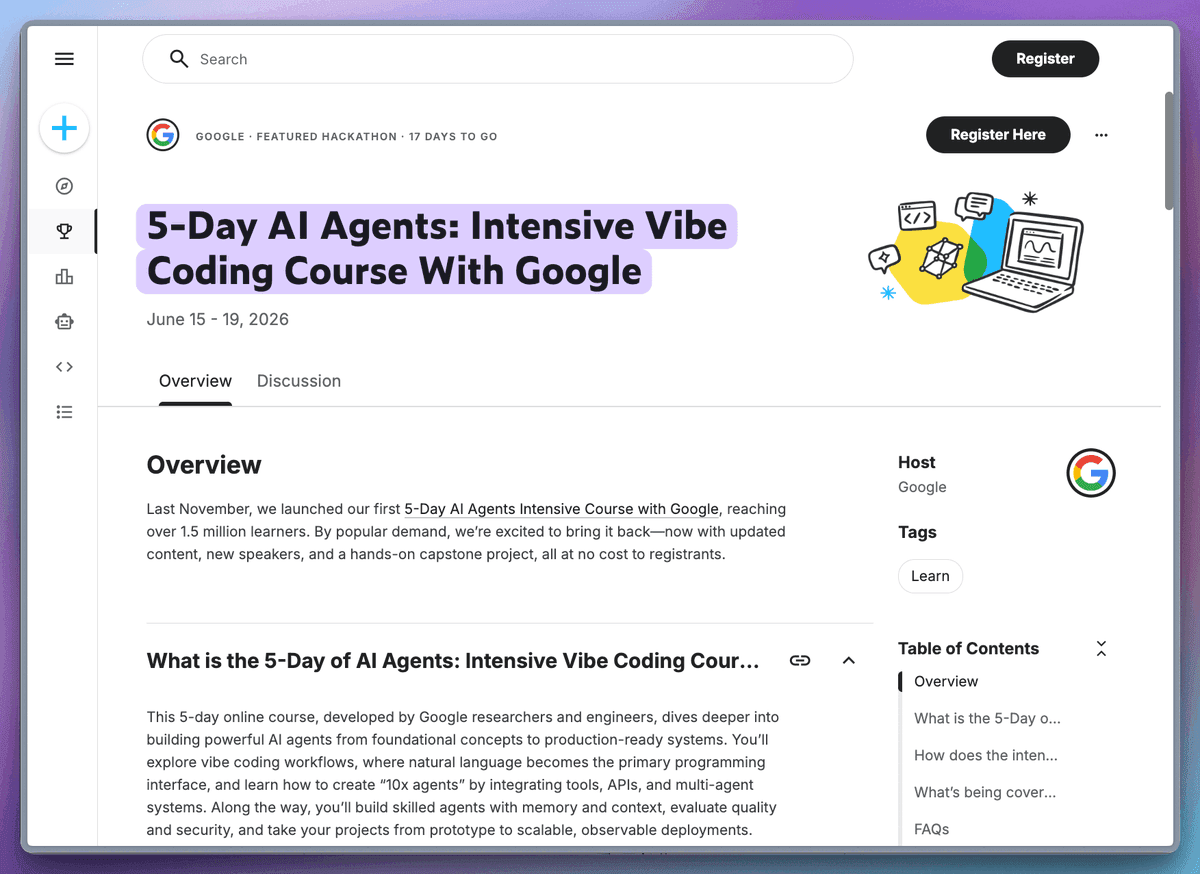
Google launched a free 5-day AI Agents course, following a prior edition that enrolled 1.5 million learners. The new curriculum emphasizes "vibe coding" and multi-agent coordination, running on Kaggle notebooks.
Key facts
- Free 5-day AI Agents course by Google.
- Prior edition had 1.5 million learners.
- Registration deadline: June 2nd.
- Daily 1-2 hours, run on Kaggle notebooks.
- Covers vibe coding, tools, evals, deployment.
Google is offering a free 5-day AI Agents course, building on the success of a previous edition that attracted 1.5 million learners, according to a post by @akshay_pachaar. The course, which runs on Kaggle notebooks with daily livestreams taught by Google's ML engineers, requires 1-2 hours per day and is free. Registration closes June 2nd.
The curriculum progresses from fundamentals to production deployment. Day 1 covers agent fundamentals and "vibe coding" — building agents using natural language as the primary interface. Day 2 focuses on tool integration and multi-agent systems, wiring agents to external APIs and coordinating multiple agents. Day 3 addresses context engineering, including short-term recall, long-term memory, and persistent state. Day 4 covers evals and security, with guardrails and observability for real tool access. Day 5 concludes with prototype-to-production deployment and a capstone project where participants ship their own agent end-to-end.
Key Takeaways
- Google launched a free 5-day AI Agents course, following 1.5M learners in the prior edition.
- The curriculum covers vibe coding, multi-agent systems, and production deployment on Kaggle.
Unique Take: Google's bet on agent education signals a platform shift
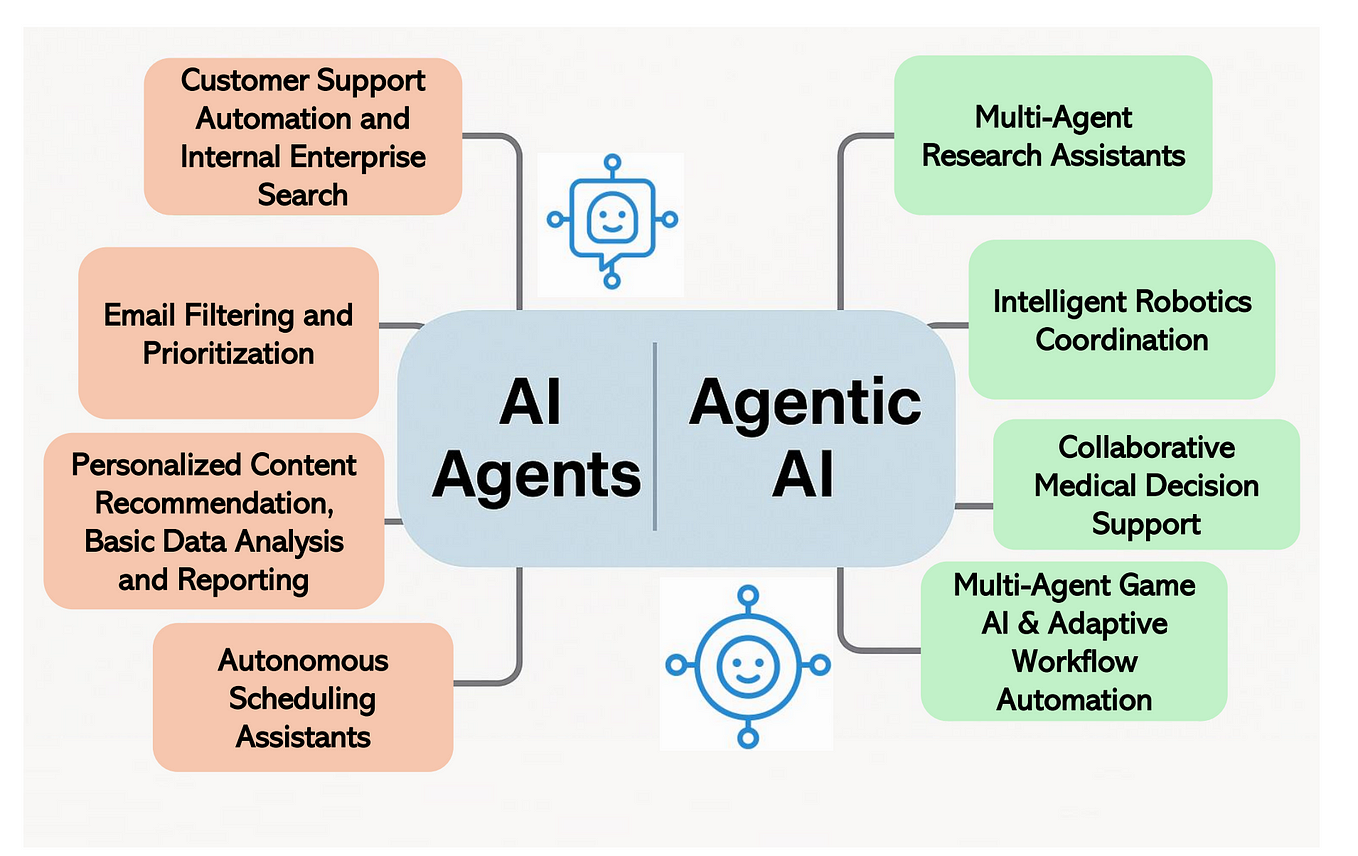
Google's investment in a free, structured agent course — now with a "vibe coding" bent — suggests the company views agent development as the next major onboarding funnel for its cloud ecosystem. The previous edition's 1.5 million learners represents a massive audience that Google can convert into Kaggle users, Vertex AI customers, and Google Cloud consumers. Unlike isolated model releases, this course teaches a workflow that ties directly to Google's infrastructure: Kaggle for compute, Google Cloud for deployment. The "vibe coding" addition, which emphasizes natural language interfaces, lowers the barrier further, potentially expanding the developer pool beyond traditional coders. This mirrors the strategy behind Google's earlier free ML courses, which helped drive TensorFlow adoption.
What's missing
Google has not disclosed specific instructor names, completion rates from the prior edition, or how many learners progressed to paid Google Cloud services. The course materials' depth — particularly around multi-agent coordination and production security — will determine whether it produces capable builders or just curious dabblers.
What to watch
Watch for post-course metrics: how many of the 1.5 million prior learners adopted Google Cloud services, and whether this new cohort's capstone projects show multi-agent coordination beyond toy demos. Google's Q3 cloud earnings will reveal if agent education converts to revenue.