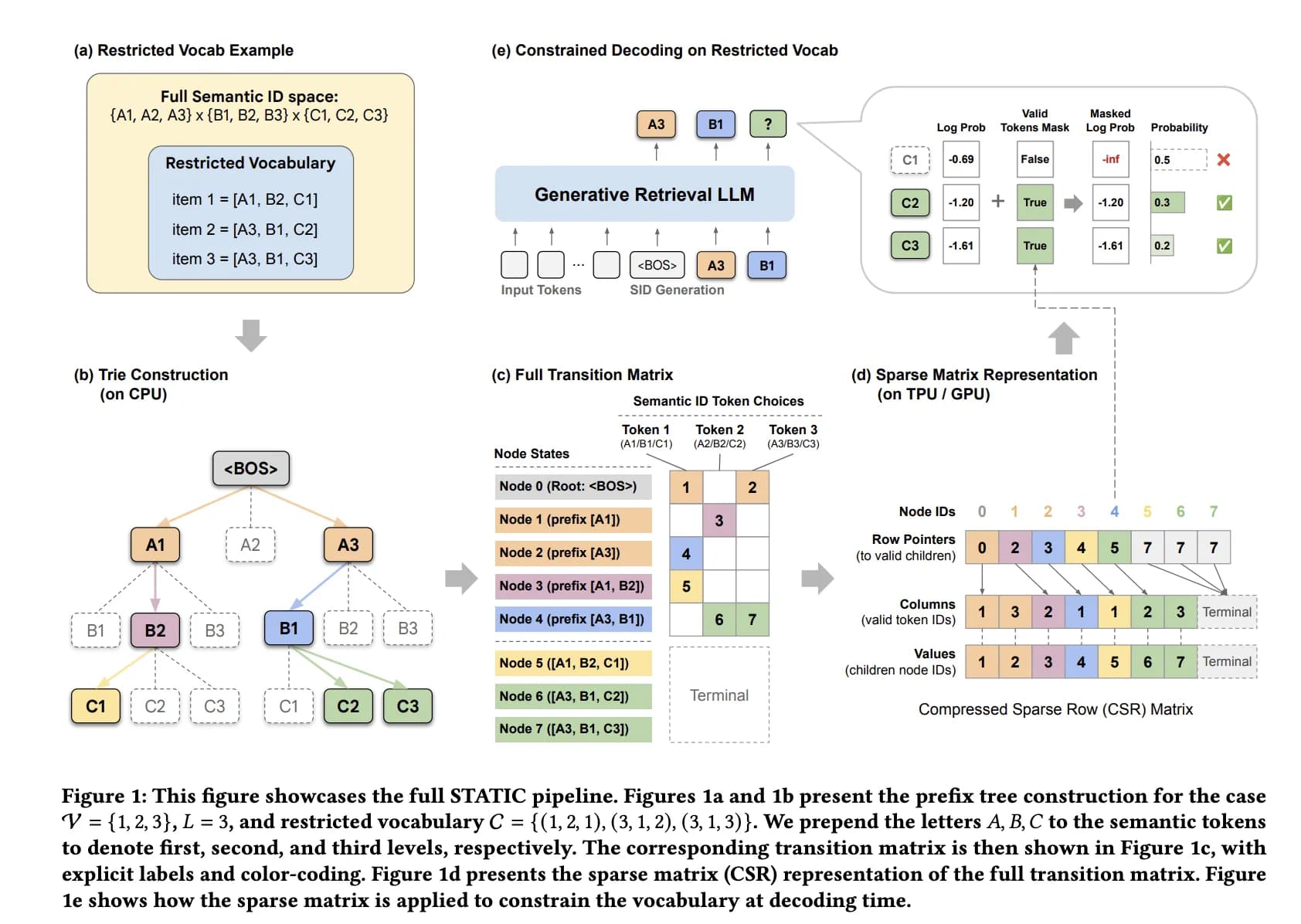
In a significant advancement for industrial AI systems, Google AI researchers have introduced STATIC (Sparse Tiling for Accelerated Token Indexing and Constrained decoding), a novel framework that achieves up to 948x faster constrained decoding for Large Language Model (LLM) based generative retrieval. This development addresses a critical bottleneck in deploying LLMs for real-world recommendation systems where business logic constraints must be strictly enforced.
The Generative Retrieval Challenge
Traditional recommendation systems have relied on embedding-based nearest neighbor search, where items are represented as dense vectors in high-dimensional space. The emerging paradigm of Generative Retrieval (GR) replaces this approach with LLMs that represent items as Semantic IDs (SIDs)—discrete token sequences—and treat retrieval as an autoregressive decoding task.
While GR offers superior semantic understanding and flexibility, it faces a fundamental challenge in industrial applications: enforcing business constraints. Real-world systems must adhere to requirements like content freshness, inventory availability, regional restrictions, or compliance policies. These constraints create what researchers call "constrained decoding" problems, where the LLM must generate outputs that satisfy specific logical conditions.
Previous solutions involved CPU-offloaded tries or hardware-accelerated binary search, but these approaches introduced unacceptable latency—often making real-time applications impractical. The STATIC framework fundamentally rethinks this problem through sparse matrix computation.
How STATIC Works: Sparse Matrix Innovation
STATIC's breakthrough lies in its sparse matrix representation of constraint relationships. Instead of treating constraints as separate logical checks that interrupt the decoding process, STATIC encodes all valid token transitions as a sparse matrix that can be processed efficiently on modern hardware.
The framework operates through three key innovations:
Constraint Encoding: Business logic rules are compiled into a sparse matrix where rows represent current states and columns represent possible next tokens. Valid transitions are marked with non-zero values.
Sparse Tiling: The constraint matrix is partitioned into tiles that optimize for memory access patterns and parallel processing capabilities of contemporary accelerators.
Hardware-Aware Optimization: STATIC is designed specifically for the memory hierarchies and compute capabilities of modern GPUs and TPUs, minimizing data movement and maximizing computational efficiency.
This approach achieves remarkable performance metrics: 0.033ms per-step latency, representing a 948x speedup over CPU-offloaded tries and 47–1033x improvements over hardware-accelerated binary-search baselines.
Industrial Implications
The STATIC framework has immediate applications across multiple domains:
- E-commerce Recommendations: Enforcing inventory availability, regional shipping restrictions, and promotional eligibility in real-time
- Content Platforms: Ensuring age-appropriate content filtering, regional licensing compliance, and freshness requirements
- Financial Services: Implementing regulatory compliance, risk constraints, and customer-specific limitations
- Healthcare Systems: Maintaining privacy regulations, clinical guidelines, and patient-specific considerations
Google's development of STATIC aligns with their broader strategic initiatives, including their recent pivot toward edge computing for generative AI and partnerships like the Massachusetts AI Hub for statewide AI literacy. The framework represents a practical implementation of their research into making AI systems more efficient and deployable in constrained environments.
Technical Architecture and Performance
STATIC's architecture demonstrates several sophisticated design choices:
- Memory Efficiency: By leveraging sparse representations, STATIC reduces memory requirements by orders of magnitude compared to dense constraint representations
- Parallel Processing: The tiling approach enables massive parallelism across GPU/TPU cores
- Deterministic Performance: Unlike heuristic-based constraint satisfaction methods, STATIC provides guaranteed constraint adherence with predictable latency
- Scalability: The framework maintains performance even as constraint complexity grows, addressing a key limitation of previous approaches
Performance benchmarks show STATIC maintaining sub-millisecond latency even with constraint sets representing millions of business rules—a requirement for large-scale industrial systems.
Future Directions and Industry Impact
The STATIC framework represents more than just a performance optimization; it enables new classes of applications that were previously impractical due to latency constraints. By making constrained decoding nearly as fast as unconstrained generation, STATIC bridges the gap between research prototypes and production systems.
This development comes alongside Google's other recent AI advancements, including Gemini 3.1 Flash Image for on-device 4K image generation and their participation in the White House pledge for self-generating power in AI data centers. Together, these initiatives demonstrate Google's comprehensive approach to making AI more efficient, deployable, and sustainable.
Looking forward, STATIC's sparse matrix approach may influence other areas of AI system design, particularly in real-time decision systems and interactive AI applications where constraint satisfaction is critical. The framework's success also validates the importance of hardware-aware algorithm design in the era of specialized AI accelerators.
Conclusion
Google's STATIC framework addresses a fundamental challenge in deploying LLMs for industrial recommendation systems: how to enforce business constraints without sacrificing real-time performance. By reimagining constraint satisfaction as a sparse matrix computation problem optimized for modern hardware, STATIC achieves speed improvements of up to 948x over previous approaches.
This breakthrough has immediate practical implications for e-commerce, content platforms, financial services, and any domain where AI systems must operate within defined business rules. As generative AI continues to transform recommendation systems, frameworks like STATIC will be essential for bridging the gap between research capabilities and production requirements.
Source: MarkTechPost (2026-03-01)