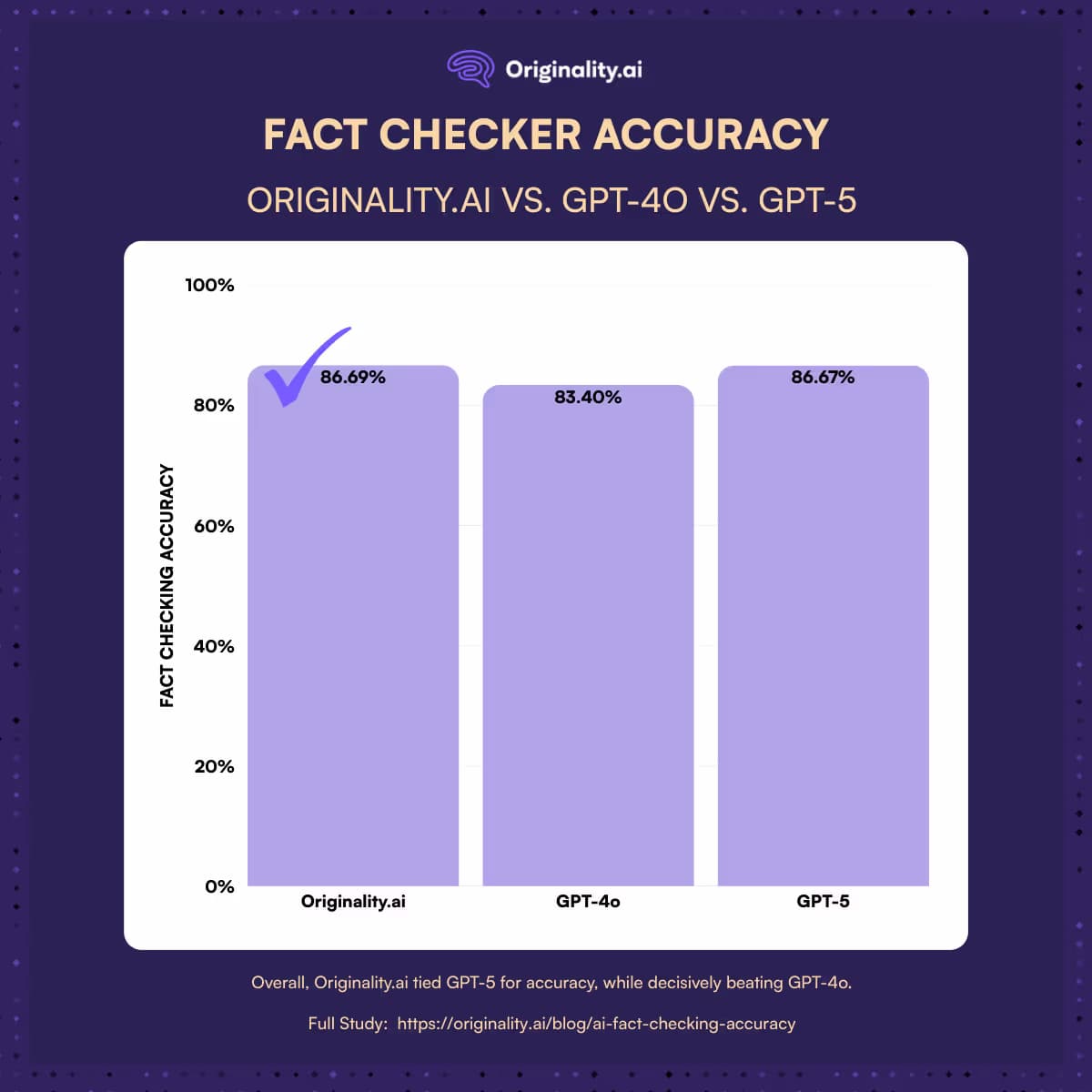
A recent demonstration by Wharton professor and AI researcher Ethan Mollick has revealed that OpenAI's GPT-5.2 Pro model possesses surprisingly robust fact-checking capabilities that could fundamentally change how writers, researchers, and professionals verify their work. According to Mollick's observations on X, the model "hums away and gives you objections & caveats & 'well, actually' qualifications" when presented with written content, while also checking mathematical accuracy.
The Fact-Checking Breakthrough
Mollick's testing indicates that GPT-5.2 Pro can analyze various types of content and automatically identify potential factual errors, logical inconsistencies, and mathematical mistakes. Unlike previous AI systems that might simply generate content, this model appears to have been specifically optimized for critical analysis and verification tasks.
"Put in anything you write into it and it hums away," Mollick noted, suggesting the process is both efficient and thorough. The model doesn't just flag potential issues but provides nuanced feedback including objections, caveats, and those familiar "well, actually" qualifications that characterize thorough fact-checking.
Historical Context and Limitations
Mollick contextualized this development by noting that "outside of narrow areas (Academic pubs, New Yorker articles) this was not possible pre-AI." Historically, comprehensive fact-checking has been labor-intensive, requiring specialized human expertise and significant time investment. While some automated tools existed for specific domains like academic plagiarism detection or basic fact verification, they lacked the contextual understanding and nuanced analysis that GPT-5.2 Pro appears to demonstrate.
The reference to academic publications and New Yorker articles highlights how thorough fact-checking has traditionally been reserved for elite publications with dedicated resources. Most writing—whether business reports, blog posts, or general content—has historically gone without this level of verification due to resource constraints.
Technical Implications
The fact-checking capability likely represents several technical advancements working in concert:
Improved reasoning capabilities: The model must understand context, detect inconsistencies, and apply logical reasoning across domains
Enhanced mathematical processing: The ability to "check your math" suggests improved numerical reasoning and calculation verification
Better source integration: While not explicitly mentioned, effective fact-checking would require either extensive internal knowledge or the ability to verify against external sources
Nuanced communication: Providing objections and caveats rather than binary right/wrong judgments indicates sophisticated natural language understanding
Practical Applications
This development has immediate practical implications across multiple domains:
Journalism and Publishing: News organizations could implement AI-assisted verification workflows, potentially reducing errors while maintaining human oversight.
Academic Research: Researchers could use the tool to pre-check papers for factual accuracy and mathematical correctness before submission.
Business and Legal Writing: Contracts, reports, and business communications could be verified for accuracy and consistency.
Education: Students could learn critical thinking by comparing their work against AI-generated feedback on factual accuracy.
Content Creation: Bloggers, marketers, and creators could ensure their content is factually sound before publication.
Limitations and Ethical Considerations
Despite the promising capabilities, several important limitations and considerations remain:
Source Transparency: The model doesn't explicitly cite its sources for verification, raising questions about how conclusions are reached.
Domain Expertise: While potentially broad, the model may have limitations in highly specialized fields requiring deep domain knowledge.
False Confidence Risk: Users might develop overreliance on AI verification without maintaining critical human oversight.
Bias and Perspective: The model's "objections" and "caveats" necessarily reflect certain perspectives and priorities that may not be universally applicable.
Verification of Verification: There's a meta-problem of verifying whether the AI's fact-checking is itself accurate and comprehensive.
The Future of AI-Assisted Verification
GPT-5.2 Pro's fact-checking capabilities represent a significant step toward what might be called "AI co-piloting" for knowledge work. Rather than simply generating content, advanced AI systems are increasingly capable of critical analysis, verification, and improvement of human-generated work.
This development suggests several future directions:
Specialized fact-checking models: We may see models specifically trained and optimized for verification tasks in particular domains
Integration with writing tools: Fact-checking capabilities could become standard features in word processors and content management systems
Real-time verification: Future systems might provide live feedback during the writing process rather than post-hoc analysis
Source citation integration: Advanced systems might not only identify potential issues but suggest or retrieve supporting sources
Conclusion
The emergence of robust fact-checking capabilities in GPT-5.2 Pro represents more than just another incremental AI improvement. It signals a shift toward AI systems that can critically engage with human-generated content rather than merely generating their own. This has profound implications for information quality, professional workflows, and how we approach verification in an increasingly complex information environment.
As Mollick's observations suggest, what was once the exclusive domain of specialized human experts in elite publications may soon become accessible to anyone with access to advanced AI tools. The challenge moving forward will be integrating these capabilities responsibly while maintaining appropriate human oversight and critical thinking.
Source: Ethan Mollick's observations on GPT-5.2 Pro's fact-checking capabilities via X/Twitter