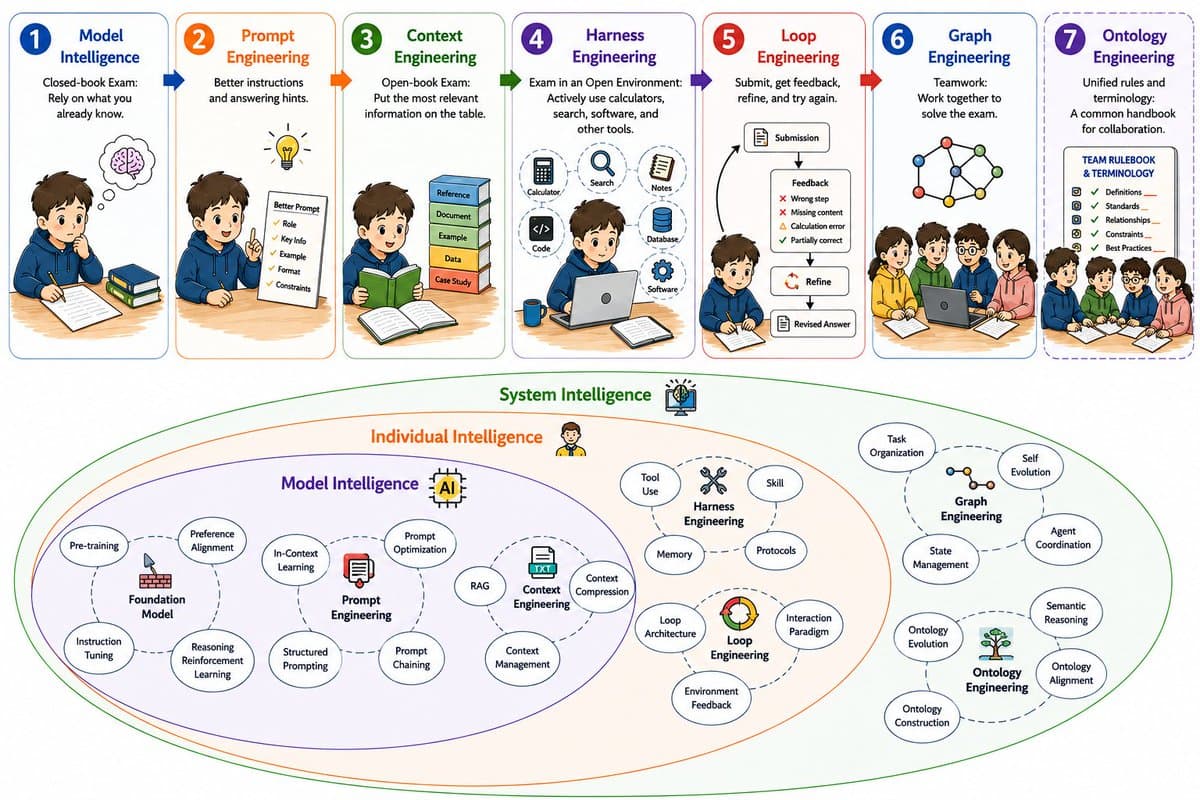
A new survey from @HuggingPapers introduces Graph Engineering, a paradigm using dynamic graph structures to orchestrate LLM agents. The approach targets System Intelligence beyond individual agent capabilities.
Key facts
- Survey introduced by @HuggingPapers on X
- Graph Engineering uses dynamic graph structures
- Organizes tasks, agents, and system states
- Claims System Intelligence beyond individual agents
- No benchmark results provided in source
The survey, highlighted by @HuggingPapers, proposes Graph Engineering as a framework for next-generation LLM agent systems. Instead of treating agents as isolated units, it uses explicit, dynamic graph structures to organize tasks, agents, and system states.
This structural approach enables what the authors call System Intelligence — emergent coordination that individual agents cannot achieve alone. The paradigm shift mirrors earlier moves from monolithic models to modular architectures, but applied at the orchestration layer.
Key Takeaways
- Survey proposes Graph Engineering using dynamic graphs to coordinate LLM agents, targeting System Intelligence beyond individual agents.
- No empirical benchmarks yet.
Why graphs beat flat orchestration

Current agent frameworks rely on linear pipelines or hierarchical task decomposition. Graph Engineering generalizes this: nodes represent tasks or states, edges encode dependencies and data flow, and the graph mutates as the system executes. This allows for dynamic re-planning, parallel execution branches, and explicit state tracking across the agent network.
The survey positions this as a response to the reliability ceiling of single-agent systems. When one agent must handle long-horizon tasks, error compounding limits performance. A graph structure distributes responsibility, isolates failures, and enables targeted retries without restarting the whole pipeline.
System Intelligence as a measurable claim

The central claim — System Intelligence beyond individual agents — is conceptually appealing but the source does not provide benchmark results. No specific accuracy numbers, task-completion rates, or latency comparisons are offered. This is a survey, not an empirical study, so the value lies in the framework's descriptive power.
That said, the pattern is visible in production. Frameworks like LangGraph and AutoGen already implement graph-like orchestration. This survey formalizes what those tools do ad hoc, potentially giving researchers a common vocabulary and a research agenda for testing whether explicit graph structures outperform implicit ones.
The missing piece is evidence. Until the authors or others publish head-to-head comparisons against non-graph baselines, the System Intelligence claim remains a hypothesis. The survey's contribution is framing the problem correctly, not solving it.
What to watch
Watch for follow-up empirical papers from this survey group that benchmark Graph Engineering against linear agent pipelines. Specific metrics to track: task-completion rates on long-horizon benchmarks like GAIA or WebArena, and whether dynamic graph re-planning reduces error-compounding compared to static decomposition. Also monitor LangGraph and AutoGen releases for explicit adoption of the survey's vocabulary.