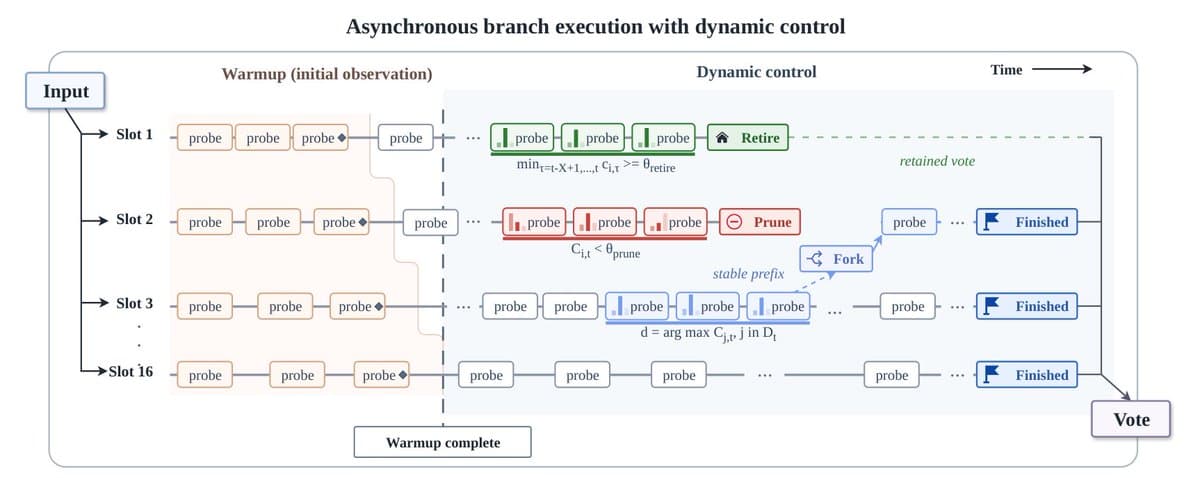
ParaTempo, a training-free framework from @HuggingPapers, cuts parallel reasoning latency by up to 32% and token usage by 30% while holding accuracy. It prunes, retires, and forks branches dynamically using temporal confidence.
Key facts
- Latency reduced by up to 32%
- Token usage cut by 30%
- Training-free framework
- Prunes, retires, and forks branches
- Uses temporal confidence scores
ParaTempo, a training-free framework introduced via @HuggingPapers, reduces latency by up to 32% and token usage by 30% in parallel reasoning tasks without sacrificing accuracy. The method prunes, retires, and forks reasoning branches based on temporal confidence—a measure of branch utility over time—rather than relying on static heuristics or retraining.
Key Takeaways
- ParaTempo, a training-free framework, cuts parallel reasoning latency by 32% and token usage 30%, per @HuggingPapers.
- Dynamic branch pruning via temporal confidence.
How temporal confidence changes branch management
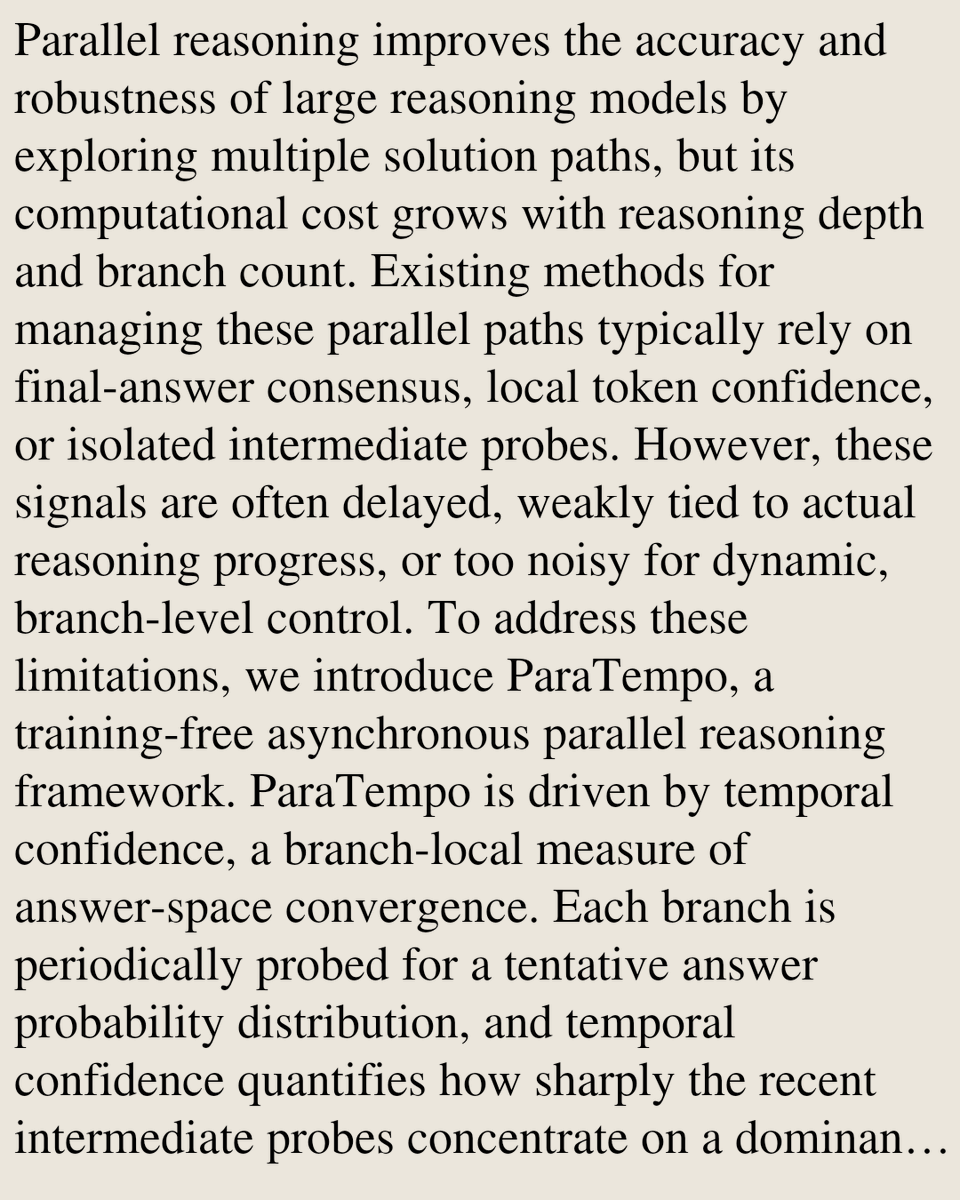
Parallel reasoning, where models explore multiple solution paths simultaneously, is compute-hungry; every active branch consumes tokens and latency. Prior approaches like self-consistency use fixed branch counts, while dynamic methods often require auxiliary models or fine-tuning. ParaTempo's temporal confidence score tracks how each branch's likelihood evolves during generation, letting the system kill low-confidence paths early, merge redundant ones, and spawn new branches when confidence diverges. This is training-free, meaning it drops into existing inference pipelines without gradient updates or dataset-specific tuning [according to @HuggingPapers].
The reported gains—32% latency reduction and 30% token savings—come from the pruning and retiring mechanism, which cuts wasted compute on branches that converge to the same answer or drift toward low-probability regions. The forking behavior preserves exploration where it matters, preventing premature convergence that would hurt accuracy.
Why this matters for inference economics

Parallel reasoning is a core component of chain-of-thought and self-consistency methods used in production systems, where token cost and time-to-first-token directly affect user experience and cloud bills. A 30% token reduction at the same accuracy level is the kind of win that compounds across high-throughput deployments. The training-free property is the key differentiator—most efficiency gains require retraining or distillation, which adds engineering overhead. ParaTempo sidesteps that entirely, making it a drop-in optimization for existing serving stacks [according to @HuggingPapers].
The framework is not yet peer-reviewed, and the source tweet does not disclose benchmark specifics, model families tested, or ablation details. The accuracy claim is stated without a quantitative baseline, so the 32%/30% figures should be treated as preliminary until a full paper or code release appears.
What to watch
Watch for a full arXiv paper or code release from the ParaTempo authors, which would provide benchmark details, model families tested, and ablation studies. If the 32%/30% figures hold across standard reasoning benchmarks like GSM8K or MATH, expect adoption in serving frameworks and a follow-up comparison against other dynamic pruning methods.