What Happened
An article on Medium, titled "How Reinforcement Learning quietly runs your Recommender Systems!", provides an introductory yet practical overview of a specific class of reinforcement learning (RL) algorithms that are foundational to modern recommendation engines. The core focus is on multi-armed bandits and their more advanced variant, contextual bandits.
The article's snippet explicitly names Netflix, Spotify, Stitch Fix, and DoorDash as companies utilizing these algorithms. The central problem these algorithms solve is the exploration-exploitation trade-off: the need to sometimes recommend new or less-certain items (exploration) to gather data, while mostly recommending items predicted to have the highest engagement (exploitation). A pure exploitation model can lead to a feedback loop where novel or niche products are never surfaced.
Technical Details
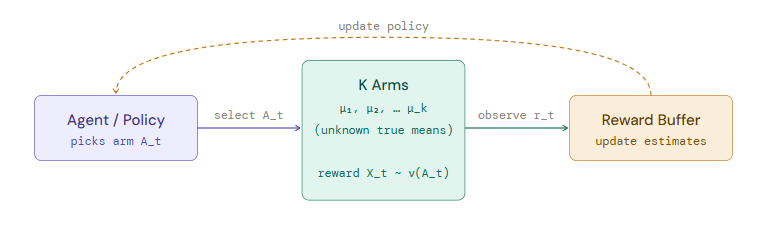
Multi-Armed Bandits (MAB) frame the recommendation problem as a gambler facing a row of slot machines ("one-armed bandits"). Each machine has an unknown probability of payout. The gambler must decide which machines to play to maximize total payout over time. In a recommender system, each "arm" is a potential item (e.g., a movie, song, or product). The system must choose which item to recommend, observe the user's response (click, watch time, purchase), and update its belief about that item's value.
Key algorithms include:
- ε-Greedy: With probability ε, explore a random arm; otherwise, exploit the arm with the highest estimated value. Simple but inefficient.
- Upper Confidence Bound (UCB): Selects the arm with the highest statistical upper confidence bound on its value, naturally balancing items with high estimated value and high uncertainty.
- Thompson Sampling: A Bayesian approach that maintains a probability distribution for each arm's value. It samples a value from each distribution and selects the arm with the highest sampled value. This elegantly integrates uncertainty.
Contextual Bandits enhance this model by incorporating user and context features (e.g., time of day, device, past behavior). Instead of learning a single value per item, the algorithm learns a function that predicts reward based on the context. This allows for true personalization—the same item may be a good recommendation for one user context but not another.
The article positions these bandit algorithms as a pragmatic subset of full reinforcement learning. While full RL considers long-term sequential decision-making (where each action affects future states), bandits typically treat each recommendation as an independent or loosely connected trial, which is often a sufficient and more tractable model for many real-world recommendation scenarios.
Retail & Luxury Implications
The direct mention of Stitch Fix, a personal styling service, is a clear signal of this technology's applicability in the retail and luxury domain. The implications are significant for any business with a digital touchpoint where sequential decision-making is key to user experience and commercial outcomes.
1. Dynamic Product Discovery & Merchandising:
Static "customers also bought" widgets are being superseded by adaptive systems. A contextual bandit can learn, for example, that showing high-end leather goods performs best for a user browsing in the evening from a metropolitan IP address, while showcasing new-season runway highlights works better on weekend mornings. It can also intelligently explore—introducing a new, lesser-known designer to a segment of users with a proven affinity for similar styles, measuring engagement to validate its hypothesis.
2. Personalized Content & Campaign Sequencing:
Beyond product recommendations, this applies to content (lookbooks, articles, brand films) and marketing campaigns. An RL system can sequence a customer's journey: an initial email campaign arm might be "brand heritage story," followed by a "behind-the-scenes craftsmanship" video, culminating in a personalized product drop notification. The system learns which sequences drive the highest lifetime value, moving beyond A/B testing single touchpoints to optimizing pathways.
3. Inventory & Demand Sensing:
While less direct, bandit algorithms can inform inventory decisions. By treating different product placements or promotional strategies as "arms," a system can explore which items have latent demand when given visibility, helping to identify slow-moving stock that might resonate with a different audience segment.
The core value proposition is moving from batch-and-blast personalization (based on stale segmentation) to real-time, adaptive personalization that learns from every single customer interaction. For luxury brands, where customer relationship and perceived exclusivity are paramount, the ability to finely tune which product, story, or experience is presented at the perfect moment is a powerful lever for enhancing brand affinity and conversion.