What Happened
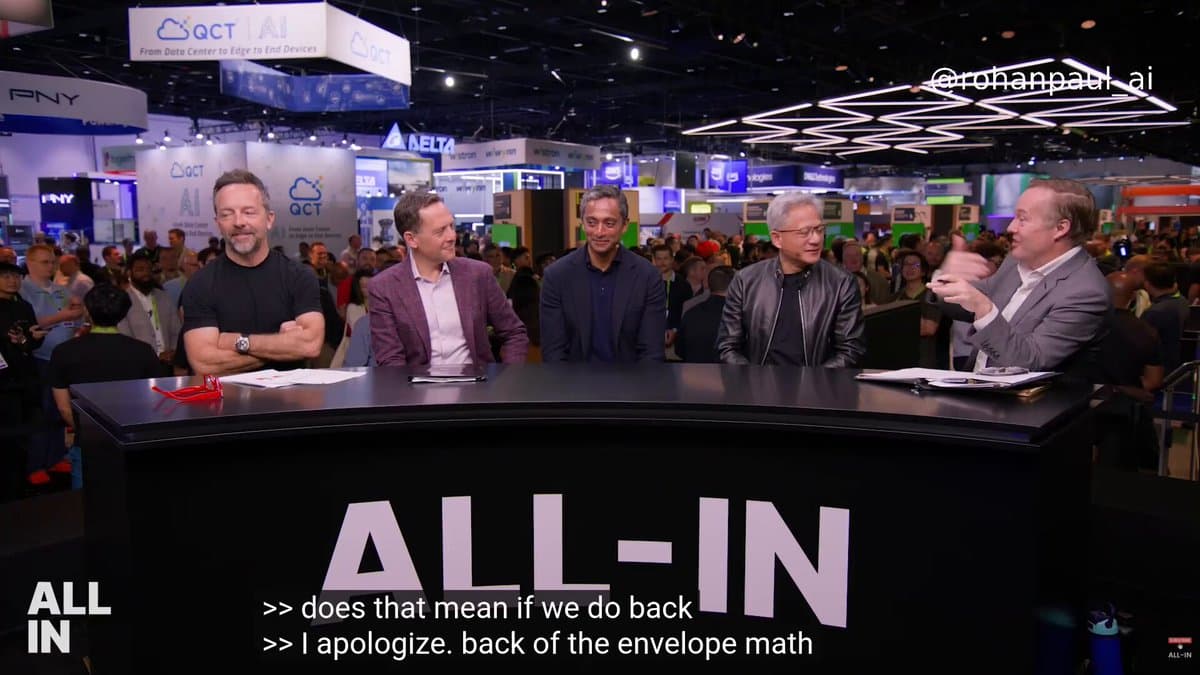
In a recent appearance on The All-In Podcast, NVIDIA CEO Jensen Huang made a direct economic argument for aggressive AI adoption within technical teams. His central thesis: high-value engineers should be spending a significant portion of their compensation on AI inference.
Huang stated: "Let’s say you have a software engineer or AI researcher and you pay them $500,000 a year; At the end of the year, I’m going to ask that $500,000 engineer, 'How much did you spend in tokens?' If that $500,000 engineer did not consume at least $250,000 worth of tokens, I am going to be deeply alarmed."
He framed the refusal to use AI tools as fundamentally irrational for a technical professional, drawing a direct analogy to chip design: "This is no different than one of our chip designers saying, 'Guess what? I'm just going to use paper and pencil; I don't think I'm going to need any CAD tools.'"
The Productivity Argument
Huang's comments extend beyond a simple cost-benefit analysis. He positioned heavy AI token usage as a catalyst for a fundamental shift in problem-solving mindset. According to Huang, consistent reliance on AI tools removes three key psychological barriers:
- "This is too hard" – AI assistance lowers the perceived complexity of tasks.
- "This is going to take a long time" – AI accelerates iteration and prototyping.
- "We’re going to need a lot of people" – AI augments individual capability, reducing perceived headcount requirements.
Context: The "Elite Investment" Analogy
Podcast host Jason Calacanis provided additional context, comparing the mandate to investments made by elite athletes. He noted that LeBron James spends millions annually on physical maintenance, nutrition, and recovery to sustain peak performance. Calacanis extrapolated this to knowledge work, arguing that modern professionals must similarly "spend" on AI tokens to achieve and maintain a "superhuman" level of productivity and ensure their professional longevity in a rapidly evolving field.
The underlying message is that AI inference is not an optional expense but a core, non-negotiable input for high-value technical work, as integral as development environments, cloud compute, or specialized software licenses.