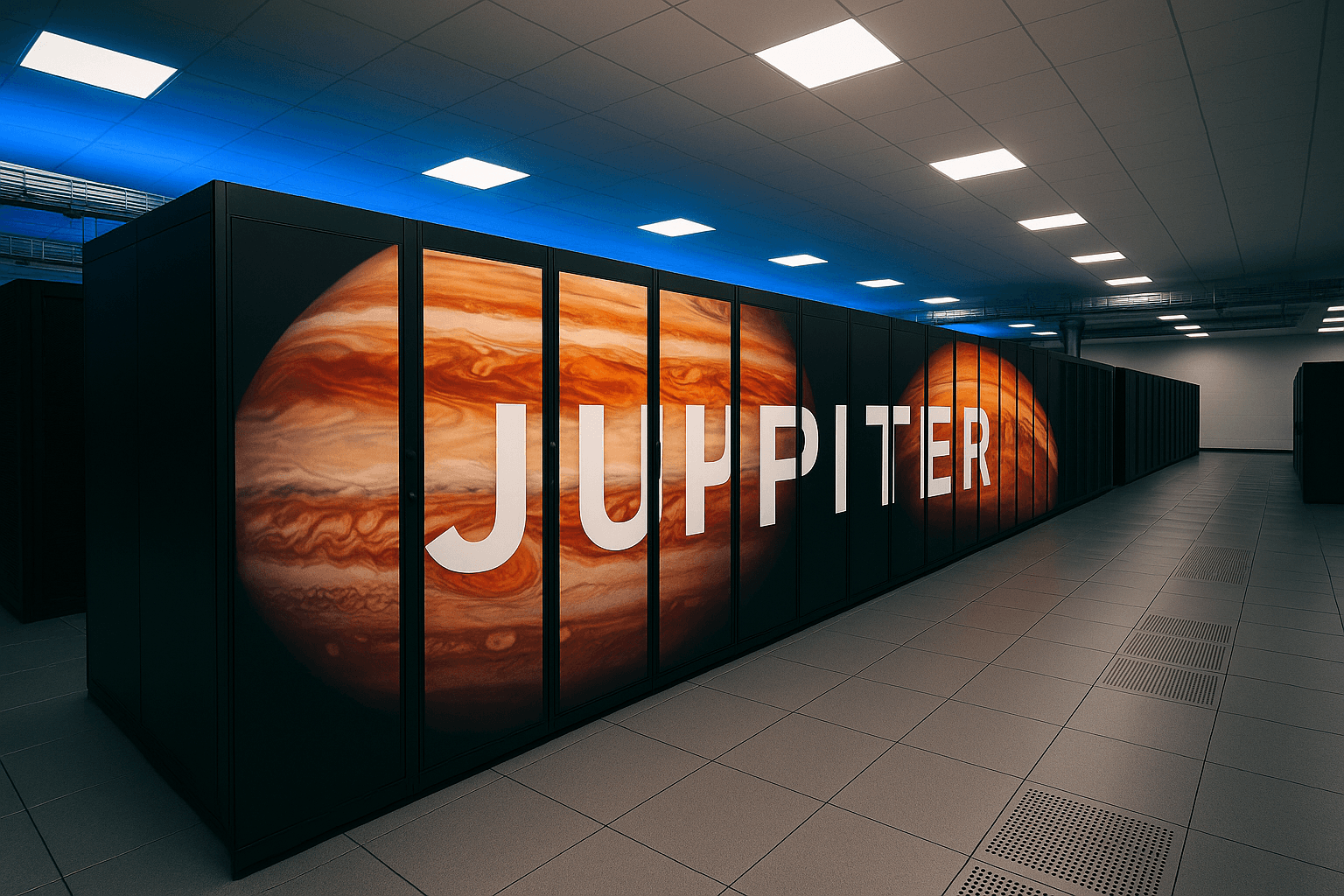
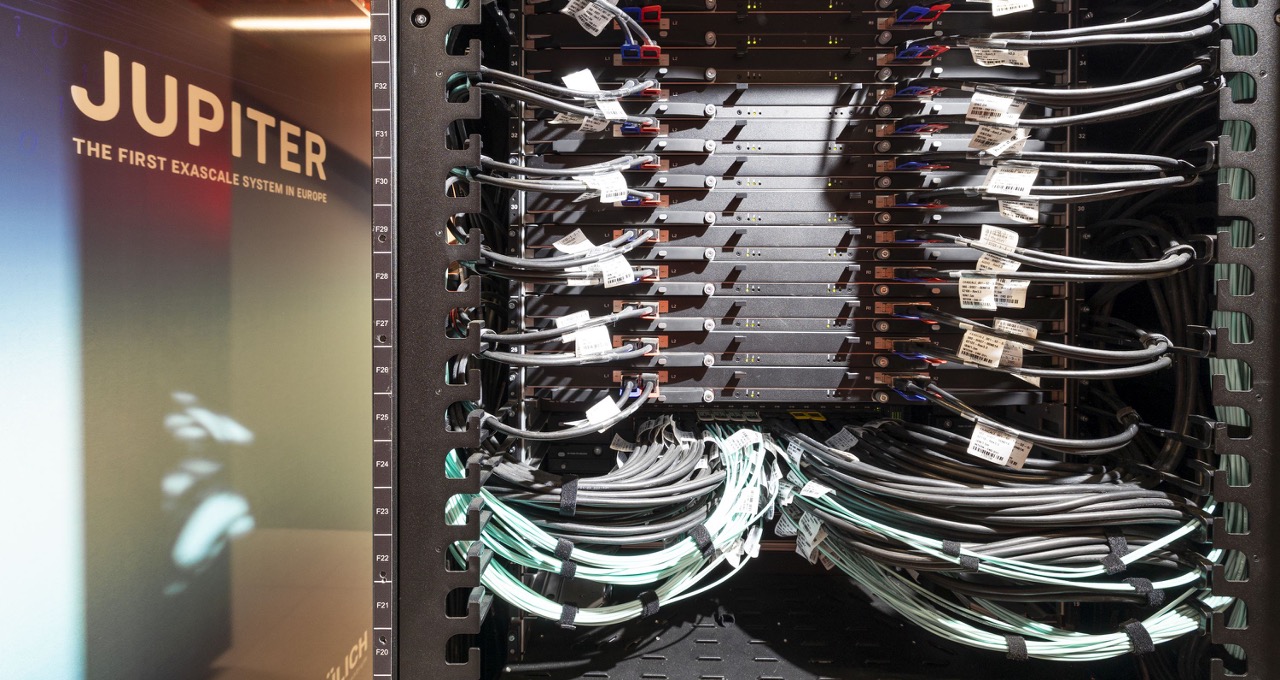
JUPITER, Europe's first exascale supercomputer at Forschungszentrum Jülich, trained a brain foundation model on 6.5 PB of data in under five days using 4,096 NVIDIA Grace Hopper Superchips. The system, detailed at ISC 2026 in Hamburg, runs four projects that were previously intractable: brain mapping, kilometer-resolution climate simulation, 6G AI, and 50-qubit quantum simulation.
Key facts
- JUPITER is Europe's first exascale supercomputer, located at Forschungszentrum Jülich, Germany.
- CytoNet trained on 6.5 PB of data from 21 post-mortem brains in under five days.
- Training used 4,096 NVIDIA Grace Hopper Superchips.
- JUPITER simulates Earth's climate at 1-kilometer resolution.
- The system can simulate a universal 50-qubit quantum computer.
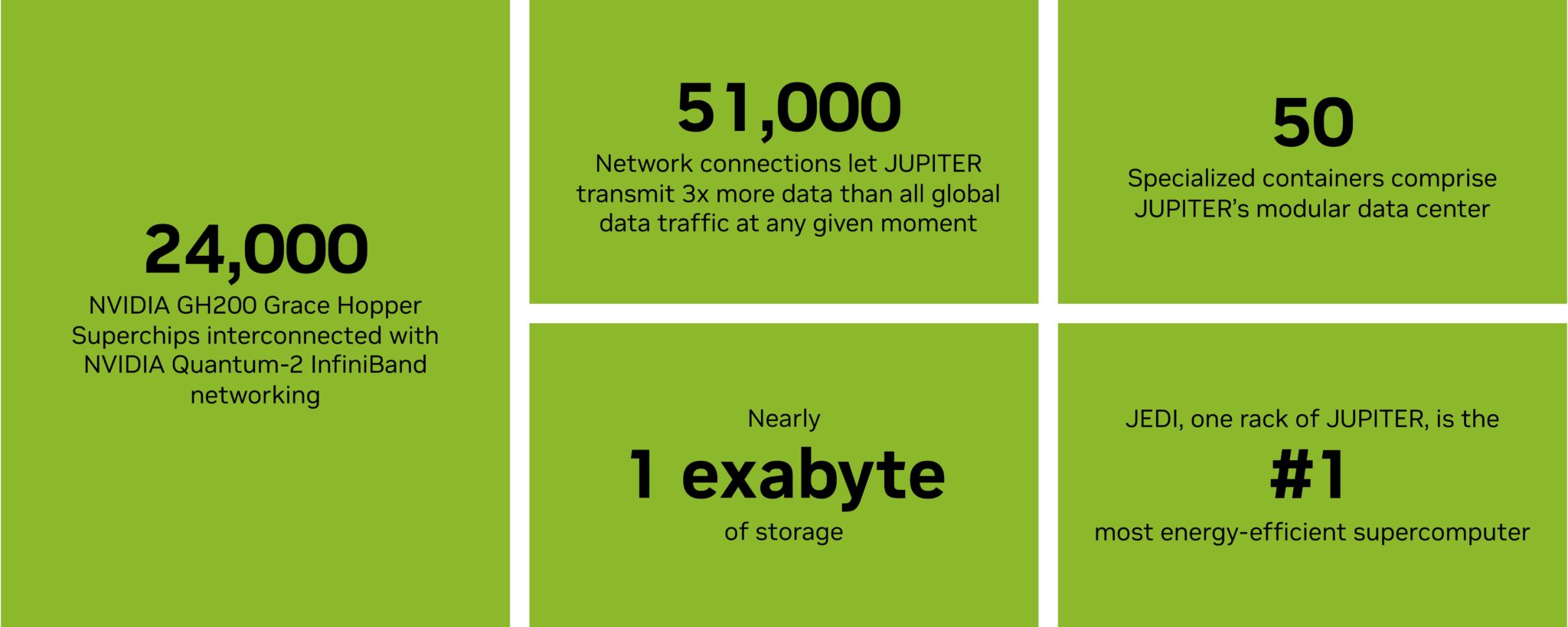
At ISC 2026 in Hamburg, the Jülich Supercomputing Centre showcased what Europe's first exascale machine can actually do. JUPITER, powered by NVIDIA Grace Hopper Superchips and Quantum-X800 InfiniBand networking, has been running four flagship projects that share a single throughline: scientific problems that were out of reach on previous hardware are now tractable at exascale.
CytoNet: A Foundation Model for the Brain
The Jülich Brain Atlas project produced CytoNet, a foundation model for brain microarchitecture analysis. Led by neuroscientist Katrin Amunts and computer scientist Christian Schiffer at INM-1, the model learns from brain imaging data at cellular scale, linking individual cell structures to broader patterns of brain organization and function. Training ran on JUPITER in under five days, using 6.5 petabytes of data from 21 post-mortem brains on 4,096 NVIDIA Grace Hopper Superchips. A paper describing the work is available on arXiv.
"For the first time, we're not just using AI to analyze the brain — we're building an agent that can think through the experiment itself," said Katrin Amunts, director of INM-1 at Forschungszentrum Jülich. The team's next step is an AI agent for brain researchers that integrates multimodal reasoning, language interfaces, and Q&A capabilities using open models, including NVIDIA Nemotron 3 120B.
Climate at Kilometer Resolution
A novel ICON configuration, developed by researchers at Jülich and partner institutions, simulates the entire Earth's climate at 1-kilometer resolution. This resolution captures fine-grained phenomena like cloud convection and urban heat islands that global climate models typically parameterize. The simulation leverages JUPITER's exascale throughput to run at speeds that enable multi-year projections.
6G AI and Quantum Simulation
JUPITER also hosts projects advancing AI for next-generation wireless networks and simulating a universal 50-qubit quantum computer. The quantum simulation, in particular, breaks records for classical emulation of quantum circuits, providing a testbed for quantum algorithm development without requiring actual quantum hardware.
"With JUPITER, Europe doesn't just join the exascale era — it leads it, across the widest range of science and AI of any system worldwide," said Thomas Lippert, director of the Jülich Supercomputing Centre.
Unique Take: Exascale's Real Yield Is Scientific Throughput, Not Benchmark Scores
While much of the exascale conversation centers on peak FLOPS and MLPerf scores, JUPITER's value proposition is different: it collapses training time for foundation models from months to days and enables simulations at resolutions that were previously infeasible. The CytoNet training run — 6.5 PB of data in under five days — would have taken weeks on previous-generation hardware. This is the first demonstration that exascale systems can serve as general-purpose scientific instruments, not just specialized HPC or AI clusters.
What to Watch
The team's next step — an AI agent for brain researchers using Nemotron 3 120B — will test whether foundation models trained at exascale can generalize to interactive scientific discovery. Watch for the arXiv paper's acceptance and any follow-up benchmarks comparing CytoNet's mapping accuracy against traditional histological methods.
Source: hpcwire.com