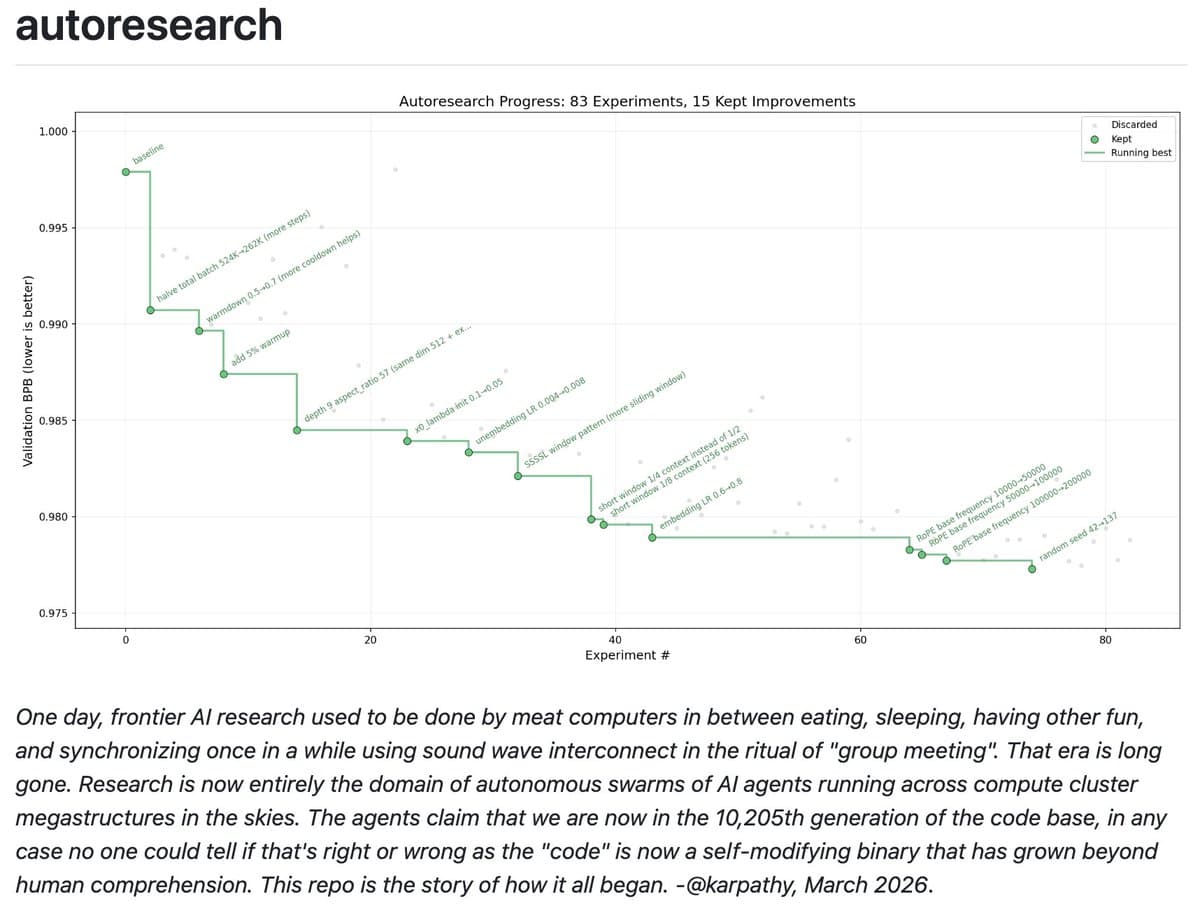
Former Tesla AI director and OpenAI founding member Andrej Karpathy has released what he describes as an "absurdly insane" open-source project: an AI research agent that autonomously conducts machine learning experiments while requiring minimal human intervention. The repository, which has sparked immediate excitement across the AI community, demonstrates a fully automated research loop where an AI agent iteratively improves neural network designs through continuous experimentation.
The Autonomous Research Loop
The core innovation lies in the agent's ability to execute a complete machine learning research cycle independently. According to Karpathy's implementation, the system operates on a remarkably simple setup: approximately 630 lines of code running on a single GPU, with each training experiment taking just five minutes to complete. This efficiency makes the technology accessible to individual researchers and small teams who lack the computational resources of major AI labs.
What makes this approach particularly compelling is the division of labor between human and machine. While the human researcher focuses on refining the initial prompt and overall research direction, the AI agent handles the technical implementation details. Each iteration follows a systematic process where the agent modifies the neural network architecture, tunes the optimizer parameters, adjusts hyperparameters, runs a complete training experiment, evaluates validation loss, and—if improvements are detected—commits the changes to a Git repository before starting the next cycle.
Technical Architecture and Workflow
The agent's workflow represents a significant departure from traditional machine learning research methodologies. Rather than requiring researchers to manually test architectural variations and parameter combinations, the system autonomously explores the design space through continuous experimentation. This creates what Karpathy describes as a "co-evolutionary" process where human intuition guides the research direction while machine efficiency handles the implementation details.
The repository's minimalist design—just 630 lines of code—suggests that the underlying principles are both elegant and potentially generalizable. By keeping the implementation lean, Karpathy has created a framework that other researchers can easily understand, modify, and extend for their own purposes. The single-GPU requirement further democratizes access, allowing individual researchers to run automated experiments without needing expensive computing clusters.
Implications for AI Research
This development arrives at a critical moment in artificial intelligence research, where the field faces increasing computational demands and growing complexity in model architectures. Karpathy's agent addresses both challenges simultaneously by automating the experimental process while maintaining resource efficiency. The system's ability to run continuously—"while you sleep," as noted in the original announcement—means research progress can continue around the clock without direct human supervision.
The Git integration represents another subtle but important innovation. By automatically committing successful improvements to version control, the system creates a transparent audit trail of the research process. This allows researchers to track how architectural decisions evolved over time and understand which modifications led to performance gains—valuable insights that are often lost in traditional research workflows.
Future Directions and Community Impact
As an open-source project, Karpathy's research agent is positioned to accelerate innovation across the AI community. Researchers can now build upon this foundation to create specialized agents for different domains, from computer vision to natural language processing. The modular design suggests potential extensions could include multi-objective optimization, transfer learning between tasks, or even meta-learning capabilities where the agent improves its own research strategies over time.
The timing of this release is particularly significant given growing concerns about the concentration of AI research capabilities within well-funded corporate labs. By demonstrating that sophisticated automated research can be achieved with minimal resources, Karpathy has potentially leveled the playing field for independent researchers and academic institutions. This democratization effect could lead to more diverse research directions and innovation pathways than would emerge from centralized research organizations alone.
Challenges and Considerations
While the technology shows remarkable promise, several questions remain about its long-term implications. The quality of research outputs will depend heavily on the initial prompts and evaluation metrics provided by human researchers. There's also the question of whether automated systems might converge on local optima or miss unconventional but valuable architectural innovations that require more creative human insight.
Additionally, as these systems become more sophisticated, they may raise questions about research attribution and intellectual property. If an AI agent independently discovers a novel architecture that leads to breakthrough performance, how should credit be allocated between the human researchers who designed the system and the autonomous agent that executed the discovery?
Despite these considerations, Karpathy's project represents a significant milestone in the evolution of AI research methodologies. By automating the experimental loop while maintaining human oversight of research direction, it creates a powerful synergy between human creativity and machine efficiency—a combination that could dramatically accelerate progress in artificial intelligence.
Source: Andrej Karpathy's open-source repository as reported by @kimmonismus on X/Twitter