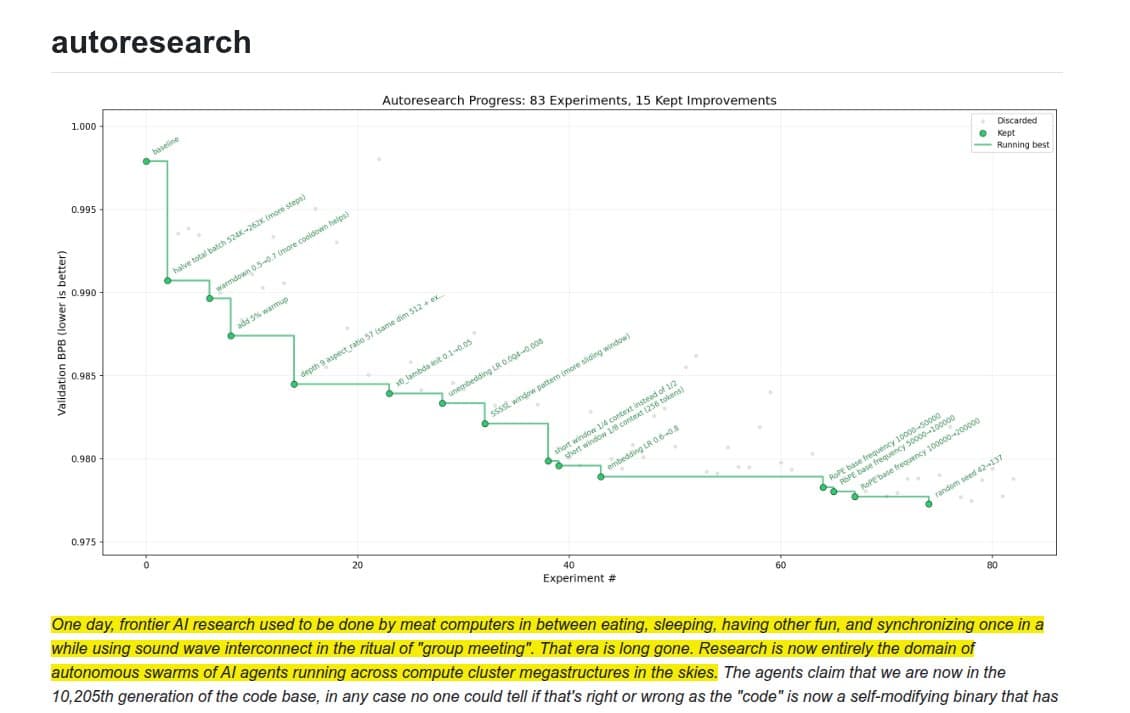
In a move that could fundamentally reshape how artificial intelligence research is conducted, renowned AI researcher Andrej Karpathy has open-sourced a groundbreaking tool called "autoresearch." This innovative system enables AI to autonomously improve its own training code, dramatically accelerating the experimental process and potentially democratizing access to cutting-edge AI research capabilities.
How Autoresearch Works: Programming the Programmer
The autoresearch system operates on a beautifully simple yet powerful premise: humans write instructions, and AI executes the research. Researchers interact with the system by writing plain instructions in a Markdown file—basic directives like "try bigger models," "test new optimizers," or "experiment with different learning rates." These prompts serve as the high-level research direction, while the AI agent handles all the implementation details.
Once the human provides the initial prompt, the AI agent takes over completely. It edits the actual training code, runs training for exactly five minutes on a single GPU, evaluates the results by checking the validation loss, and decides whether to keep the improved version or discard the unsuccessful attempt. This creates a continuous optimization loop where the AI systematically explores the parameter space defined by the human's instructions.
The Five-Minute Fairness Principle
One of the most innovative aspects of autoresearch is its fixed five-minute time budget for each experiment. This constraint serves as a great equalizer in the research process. Whether testing a conservative tweak to existing architecture or exploring a radically different approach, every idea gets exactly the same computational resources and time to prove its worth.
This five-minute limitation transforms how research is conducted. Instead of researchers needing to predict which approaches are most promising before investing significant computational resources, they can let the AI explore dozens or hundreds of possibilities with equal opportunity. The system evaluates success purely on which code achieves the lowest validation loss within the time constraint, removing human bias from the evaluation process.
Overnight Research Revolution
The practical implications of autoresearch are staggering. According to Karpathy's implementation, the system can execute approximately 12 experiments per hour on a single GPU. This means that while a researcher sleeps, the system can complete about 100 complete experimental runs overnight. What previously might have taken weeks of manual coding, testing, and evaluation can now be accomplished in a single night.
This acceleration isn't just about speed—it's about scale and accessibility. Suddenly, individual researchers or small teams with limited computational resources can conduct research at a scale previously reserved for well-funded laboratories with massive GPU clusters. The barrier to entry for meaningful AI research has been dramatically lowered.
The New Research Paradigm: Prompt Engineering as Programming
Autoresearch represents a fundamental shift in how researchers interact with AI systems. Instead of writing detailed code for each experiment, researchers now "program the programmer" by crafting better prompts. This elevates prompt quality to the primary determinant of research success. The researcher's role transforms from implementer to strategist, focusing on asking the right questions rather than writing the right code.
This paradigm shift has profound implications for AI education and skill development. Traditional programming skills remain valuable, but they're complemented by a new skill: effective prompt engineering for research direction. Researchers must learn to frame problems in ways that guide the AI agent toward productive exploration while avoiding dead ends or unproductive search spaces.
Implications for the AI Research Community
The open-sourcing of autoresearch could trigger significant changes across the AI research landscape. First, it democratizes access to experimental research, allowing independent researchers, academic institutions with limited budgets, and researchers in developing regions to participate more fully in AI advancement. This could lead to more diverse perspectives and approaches in the field.
Second, the tool could accelerate the pace of innovation across multiple AI domains. With the ability to run hundreds of experiments overnight, researchers can explore more ambitious ideas, test more combinations of parameters, and iterate more rapidly on promising approaches. This could compress development timelines for everything from model architecture improvements to training optimization techniques.
Third, autoresearch changes the economics of AI research. The dramatic increase in experimental throughput means that computational resources are used more efficiently. Ideas that might have been deemed too speculative for expensive GPU time can now be tested with minimal resource commitment, potentially uncovering unexpected breakthroughs that would have otherwise remained unexplored.
Challenges and Considerations
While autoresearch offers tremendous potential, it also presents new challenges. The quality of research outcomes becomes heavily dependent on prompt engineering—researchers must learn to craft instructions that guide the AI effectively without overly constraining its exploration. There's also the question of how to design prompts that encourage truly novel approaches rather than incremental improvements.
Additionally, the five-minute constraint, while democratizing, may favor certain types of improvements over others. Architectural changes that show benefits quickly might be favored over those that require longer training to demonstrate superiority. Researchers will need to develop strategies to work within and around these constraints.
The Future of AI-Assisted Research
Karpathy's autoresearch tool represents more than just a productivity enhancement—it signals a broader trend toward AI systems that can participate in their own improvement. As these tools evolve, we may see increasingly sophisticated research loops where AI not only implements experiments but also analyzes results, generates new hypotheses, and designs follow-up experiments.
The tool also raises interesting questions about the nature of scientific discovery in the age of AI. When AI systems can autonomously explore thousands of experimental variations, how do we ensure that the resulting knowledge is interpretable and generalizable? How do we maintain the human understanding of why certain approaches work while benefiting from AI's ability to discover what works?
Conclusion
Andrej Karpathy's open-sourcing of autoresearch marks a significant milestone in the evolution of AI research methodology. By enabling AI to autonomously improve its own training code through simple human prompts, the tool dramatically accelerates the experimental process while making sophisticated research accessible to a much broader community.
As researchers begin to adopt and build upon this approach, we can expect to see faster iteration cycles, more diverse exploration of the AI design space, and potentially unexpected breakthroughs discovered through systematic, automated experimentation. The era of AI-assisted AI research has arrived, and it promises to make the field more accessible, efficient, and innovative than ever before.
Source: Based on Andrej Karpathy's open-sourcing of the "autoresearch" tool as reported by @rohanpaul_ai on X/Twitter.