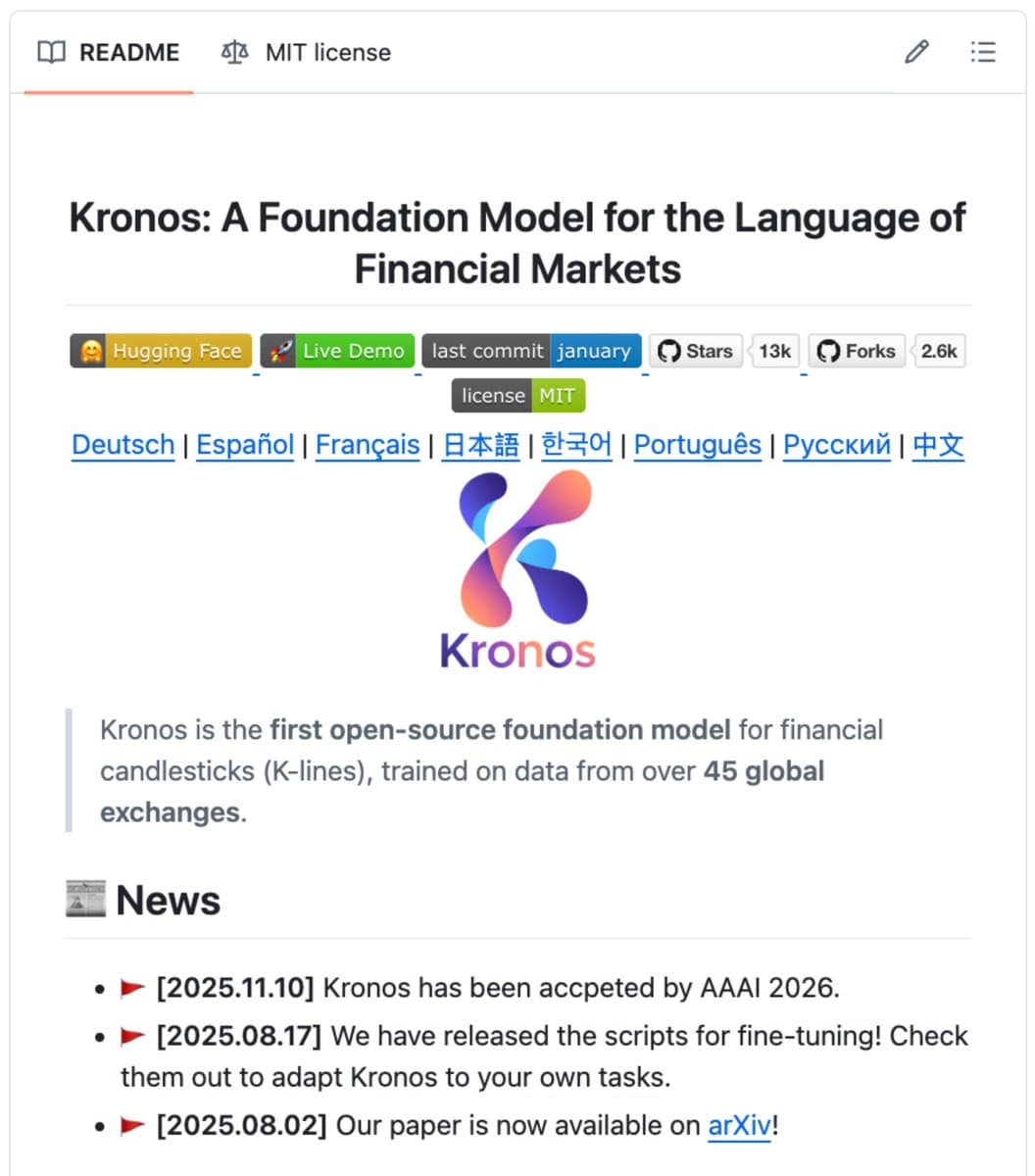
Researchers from Tsinghua University have open-sourced Kronos, a foundation model specifically architected to interpret financial candlestick charts. Trained on a massive dataset of 12 billion records spanning 45 global exchanges, the model is designed for zero-shot price and volatility forecasting, claiming a 93% accuracy improvement over leading time series models. The project, accepted at AAAI 2026, is fully open-source under an MIT license and available on Hugging Face.
Key Takeaways
- Researchers from Tsinghua University released Kronos, an open-source foundation model trained on 12 billion candlestick records from 45 exchanges.
- It reportedly achieves 93% higher accuracy than leading time series models for price and volatility forecasting, requiring no fine-tuning.
What Kronos Does
Kronos is positioned as a native financial AI, distinct from repurposed general models. Its core function is to process raw candlestick charts (Open, High, Low, Close, Volume data) as its primary input modality.
Key Capabilities:
- Price Forecasting: Predicts future price movements based on historical candlestick sequences.
- Volatility Prediction: Forecasts the expected volatility of an asset.
- Zero-Shot Operation: Works on any asset, market, or timeframe without task-specific fine-tuning.
- Multi-Exchange Training: Trained on data from 45 exchanges including Binance, NYSE, NASDAQ, and LSE.
Technical Details & Performance
The model family comes in four sizes, from a 4-million parameter version that can run on a laptop to a 499-million parameter model for maximum accuracy. According to the announcement, Kronos was benchmarked against established baselines with striking results:
vs. Leading Time Series Model +93% more accurate vs. Best Non-Pretrained Baseline +87% more accurateThese gains are attributed to its specialized architecture and pretraining. The team argues that most models treat financial data as generic time series, akin to weather data, while Kronos is built to understand the specific "language" of market microstructure and candlestick patterns.
A live demo forecasting BTC/USDT on a 24-hour horizon is available and updates hourly. The model can be integrated with a few lines of Python.
Market Context & Accessibility
The release challenges the high-cost barrier to sophisticated financial modeling. The announcement contrasts Kronos's free, open-source nature with hedge funds' multi-million dollar proprietary systems and the $24,000/year Bloomberg Terminal. With 11.6K GitHub stars and 2.4K forks at launch, it has garnered significant immediate interest from the developer community.
gentic.news Analysis
This release from Tsinghua University is a direct shot across the bow of both proprietary quantitative finance firms and general-purpose AI labs attempting to pivot their models to financial tasks. The core claim—that treating financial data as a native modality yields drastic accuracy improvements—is compelling and, if independently verified, could shift how the ML community approaches market prediction. The 93% accuracy claim is extraordinary and demands rigorous reproduction; the field is littered with financial forecasting models that fail to generalize out-of-sample or live trading.
The trend of vertical foundation models is accelerating. Just as we've seen models specifically for biology (AlphaFold), code (Codex), and chemistry, Kronos represents a decisive move toward finance-specific AI infrastructure. This aligns with a broader industry pattern we noted in our coverage of Bloomberg's launch of BloombergGPT in 2023—large financial institutions building domain-specific LLMs. Kronos flips that script by being open-source and academia-led.
Practitioners should note a critical caveat: superior forecasting accuracy does not equate to guaranteed trading profitability. Market impact, transaction costs, and execution latency remain monumental hurdles. However, as a feature extraction and pattern recognition engine for quantitative research, an open-source model of this scale is a significant new tool. Its success will hinge on the reproducibility of its benchmarks and its performance in live, forward-walking tests beyond the provided BTC demo.
Frequently Asked Questions
How does Kronos differ from using GPT-4 for financial analysis?
Kronos is a foundation model pretrained from scratch on a dataset of 12 billion candlestick records, treating chart data as its native input modality. In contrast, GPT-4 is a general-purpose large language model trained primarily on text. While GPT-4 can analyze textual financial reports, it is not architecturally designed to process raw, high-frequency OHLCV (Open, High, Low, Close, Volume) time-series data directly. Kronos is built specifically for this task.
Is Kronos truly free for commercial use?
Yes. The model is released under the MIT License, which is a permissive open-source license allowing for commercial use, modification, and distribution with minimal restrictions. This makes it legally viable for integration into both personal projects and commercial trading systems without licensing fees.
What are the hardware requirements to run Kronos?
The Kronos model family is scaled for different hardware capabilities. The smallest variant with 4 million parameters is designed to run on a standard laptop. The largest 499-million parameter model would require more significant computational resources, likely a machine with a modern GPU, for inference at low latency. Users can choose the model size that balances their accuracy needs and hardware constraints.
Has Kronos's performance been independently verified?
As of this announcement, the performance claims (93% more accurate than leading time series models) are based on the research team's own benchmarking, as detailed in their forthcoming AAAI 2026 paper. Independent verification by third-party researchers and practitioners in the open-source community will be the critical next step to validate these results across different market conditions and asset classes.