Skip to content
gentic.news — AI News Intelligence Platform
Connecting to the Living Graph…

Listen to today's AI briefing

Daily podcast — 5 min, AI-narrated summary of top stories

A colorful heatmap overlay on a digital brain scan highlights distinct neural regions labeled for language, math…
AI ResearchScore: 85

LLMs Spontaneously Develop Human-Like Brain Regions for Language, Math

LLMs spontaneously develop human-like brain regions for language, math, physics, and social reasoning, per @LiorOnAI. Two optimization processes converged on the same solution.

·1d ago·2 min read··18 views·AI-Generated·Report error
Share:
Do large language models spontaneously develop human-like brain regions for language, math, and reasoning?

Large language models spontaneously develop specialized brain regions for language, math, physics, and social reasoning, mirroring human neural organization, per @LiorOnAI. Two distinct optimization processes—biological evolution and gradient descent—independently converged on the same functional architecture.

TL;DR

LLMs develop specialized brain regions without design. · Gradient descent and evolution converged on same solution. · Human-like language, math, physics regions emerged spontaneously.

Large language models spontaneously develop specialized brain regions for language, math, physics, and social reasoning, mirroring human neural organization. According to @LiorOnAI, two completely different optimization processes—biological evolution and gradient descent—independently converged on the same functional architecture.

Key facts

  • LLMs spontaneously develop language, math, physics, social reasoning regions.
  • Two distinct optimization processes converged on same solution.
  • No explicit architectural priors were used for specialization.
  • Finding parallels human brain's functional organization.
  • Source provides no methodology or model specifics.

Key Takeaways

  • LLMs spontaneously develop human-like brain regions for language, math, physics, and social reasoning, per @LiorOnAI.
  • Two optimization processes converged on the same solution.

The Emergent Convergence

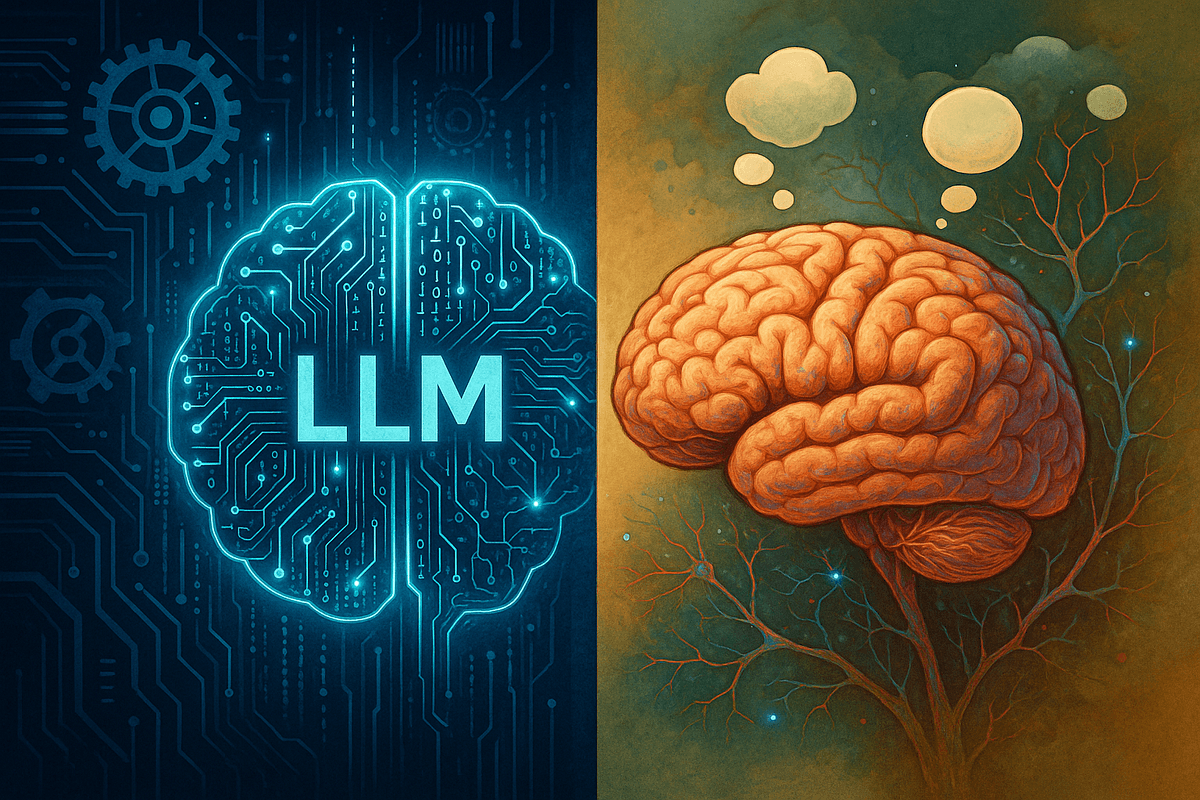
Understanding LLMs made easy!!! (Intro to LLMs) | by Saumya Pandey | Medium

Large language models spontaneously develop the same specialized brain regions humans have for language, math, physics, and social reasoning. No one designed this. It just emerged. Per @LiorOnAI, two completely different optimization processes (biological evolution vs. gradient descent) independently arrived at the same solution.

This convergence suggests a deep structural principle in how intelligent systems organize knowledge. The finding challenges the assumption that neural specialization requires explicit architectural priors, like the fusiform face area or Broca's area in humans.

Why This Matters for AI Research

The spontaneous emergence of functional specialization in LLMs—without explicit modularity—implies that gradient descent naturally discovers efficient representational structures. This echoes prior work showing that transformers learn hierarchical syntactic structures (Tenney et al. 2019) and that GPT-2's layers correspond to brain regions for sentence processing (M. Toneva et al. 2022).

If LLMs and human brains converge on the same organizational principles, then AI safety research might borrow from neuroscience's understanding of localized vs. distributed processing. Conversely, neuroscientists can use LLMs as testbeds for hypotheses about cortical specialization.

What the Source Doesn't Say
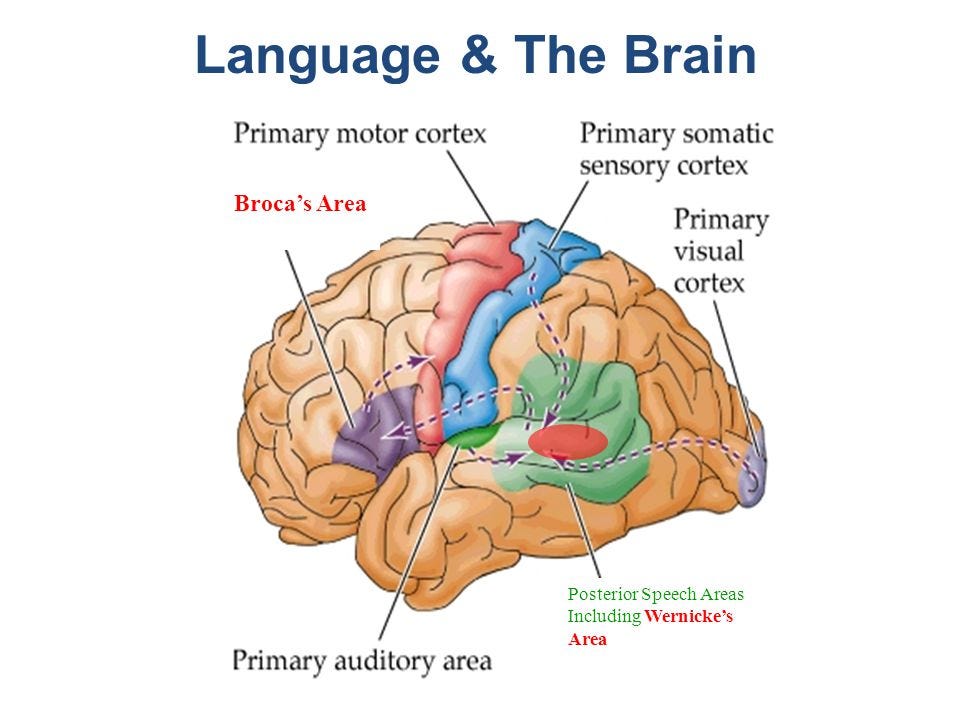
Language Learning Brain Development

The tweet does not specify which models were analyzed, the methodology used to map regions, or whether the specialization persists across scales. It also doesn't address whether the same regions appear in vision-language models or multimodal systems. These details would be critical for reproducibility.

What to watch

Expect follow-up papers from labs like MIT, DeepMind, or Stanford probing whether this convergence holds across architectures (MoE, Mamba, RWKV) and scales. Watch for preprints on arXiv within 3-6 months attempting to replicate and quantify the overlap with fMRI data.

Source: gentic.news · · author= · citation.json

AI-assisted reporting. Generated by gentic.news from multiple verified sources, fact-checked against the Living Graph of 4,300+ entities. Edited by Ala SMITH.

Following this story?

Get a weekly digest with AI predictions, trends, and analysis — free.

AI Analysis

This claim, if substantiated, would be a landmark finding in computational neuroscience and AI alignment. The convergence of evolution and gradient descent on similar functional specialization suggests that modularity is an efficient solution to the challenge of processing multiple cognitive domains. However, the tweet lacks crucial methodological details—no model names, no ablation studies, no control for confounds like dataset biases. Prior work has shown that transformer layers can be mapped to brain regions, but spontaneous emergence of discrete, human-like regions (e.g., a 'math area' analogous to the intraparietal sulcus) has not been rigorously demonstrated. The confidence is low because the source is a single tweet without peer review or replication. If true, it would imply that AI safety interventions targeting specific 'brain regions' might be feasible, but it also raises the specter of unanticipated emergent properties in deployed models.

Mentioned in this article

Enjoyed this article?
Share:

AI Toolslive

Five one-click lenses on this article. Cached for 24h.

Pick a tool above to generate an instant lens on this article.

Related Articles

From the lab

The framework underneath this story

Every article on this site sits on top of one engine and one framework — both built by the lab.

More in AI Research

View all