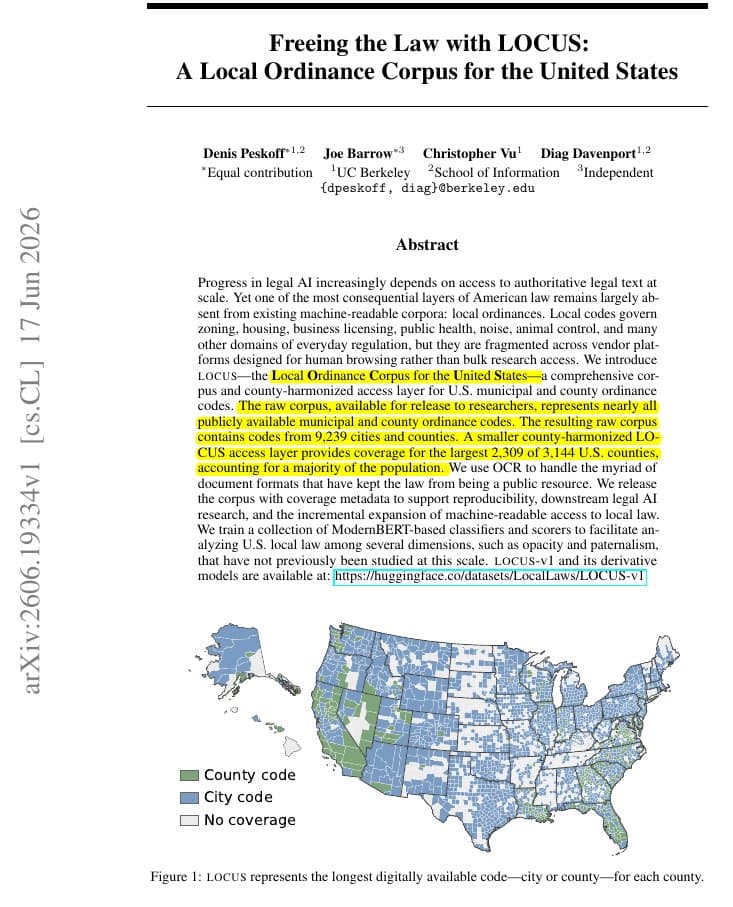
A dataset of 2.2M US laws, dubbed LOCUS-v1, just dropped on HuggingFace. Researchers used an AI pipeline to gather, OCR, process, and compile every law in America for the first time.
Key facts
- 2.2M laws in LOCUS-v1 dataset
- First AI-pipeline-built comprehensive US legal database
- Hosted on HuggingFace as LocalLaws/LOCUS-v1
- Covers all American jurisdictions
- No benchmark or validation metrics released yet
A dataset of 2.2M US laws, dubbed LOCUS-v1, just dropped on HuggingFace. Researchers used an AI pipeline to gather, OCR, process, and compile every law in America for the first time. According to @rohanpaul_ai, the dataset represents the first time AI was employed end-to-end to build a comprehensive legal database across all American jurisdictions.
Key Takeaways
- LOCUS-v1, a dataset of 2.2M US laws built via AI pipeline, released on HuggingFace.
- First comprehensive legal database of its kind, but quality and validation metrics remain undisclosed.
What the Dataset Contains
LOCUS-v1 includes 2.2M laws, though the exact breakdown by jurisdiction (federal, state, local) and format (statutes, ordinances, regulations) was not detailed in the source tweet. The dataset is hosted on HuggingFace under the identifier LocalLaws/LOCUS-v1, making it freely accessible for researchers and developers. The company behind the dataset did not disclose the computational cost of the pipeline or the specific models used for OCR and processing.
Why It Matters
Prior legal datasets like CaseLaw (from CourtListener) or the Harvard Law School case corpus focus on judicial opinions, not statutes. LOCUS-v1 fills a gap: statutory text is often scattered across city, county, state, and federal websites, with inconsistent formatting and quality. An AI pipeline that can ingest, clean, and normalize this data at scale could enable training legal retrieval-augmented generation (RAG) systems, compliance automation tools, and legislative analysis models that span all layers of US law. The dataset's release on HuggingFace lowers the barrier for startups and researchers who previously had to scrape and clean this data themselves.
Limitations and Open Questions
The source tweet does not specify the quality of the OCR, the date range of the laws, or whether updates will be released. Legal texts often require high fidelity—a single misread comma can change statutory meaning. The dataset's utility hinges on whether the AI pipeline achieved error rates comparable to human-curated legal databases (e.g., Westlaw, LexisNexis). As of now, no benchmark results or validation metrics have been published.
What to Watch
Watch for follow-up papers or blog posts detailing the AI pipeline architecture, OCR accuracy benchmarks against gold-standard legal databases, and whether the dataset receives versioned updates as new laws pass. If the researchers release a validation set with human-verified transcriptions, that would signal production-grade quality and likely spur a wave of legal AI applications.