Skip to content
gentic.news — AI News Intelligence Platform
Connecting to the Living Graph…

Listen to today's AI briefing

Daily podcast — 5 min, AI-narrated summary of top stories

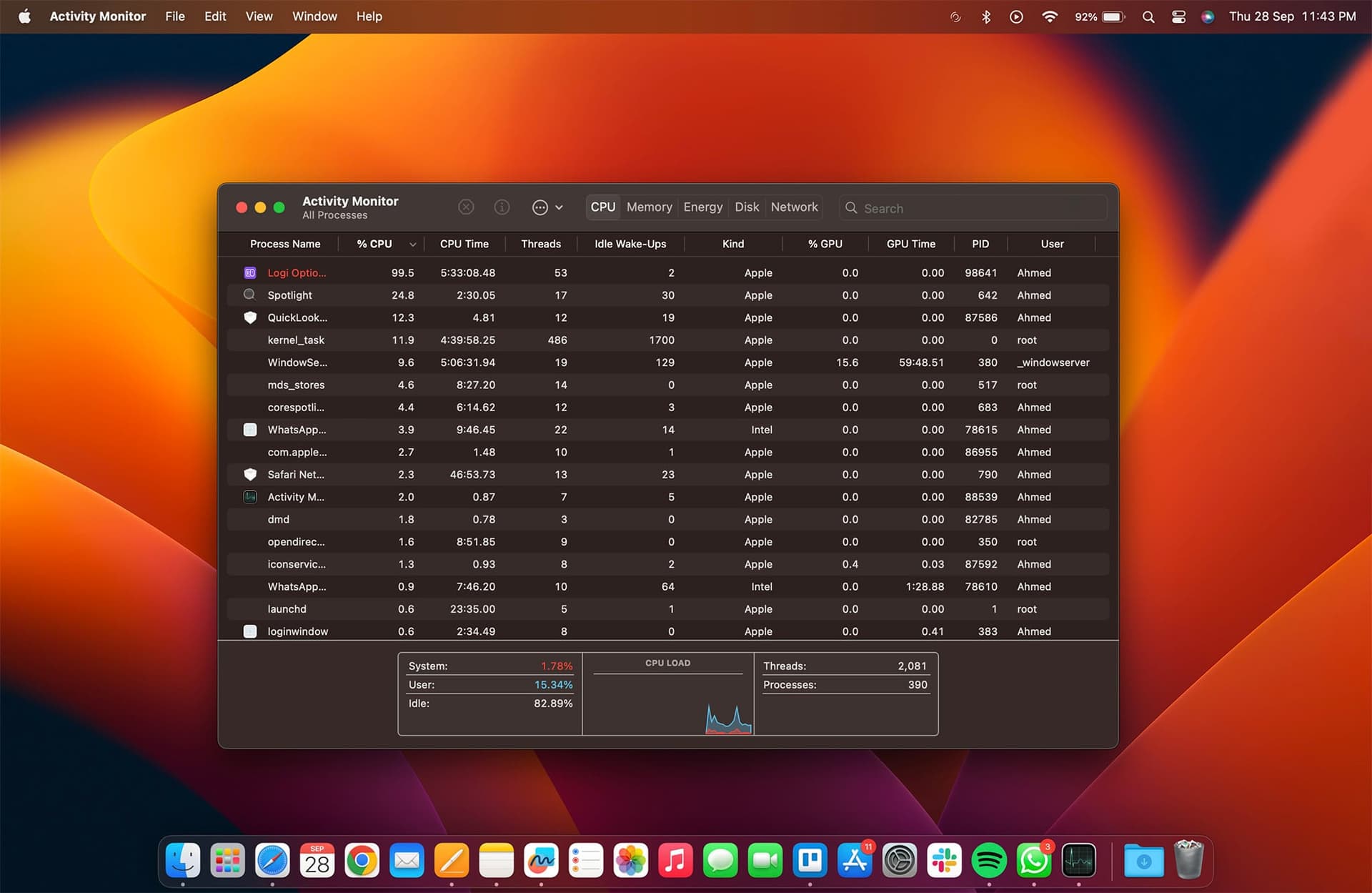
A macOS Activity Monitor window showing CPU, memory, and disk usage graphs, with multiple running processes listed below
AI ResearchScore: 81

MacArena: 421-Task macOS Benchmark Reveals 26% CUA Ranking Inversion

MacArena benchmark of 421 macOS tasks reveals 26% performance gap for top models on native tasks, suggesting current CUAs overfit to Linux distributions.

·6h ago·3 min read··14 views·AI-Generated·Report error
Share:
Source: arxiv.orgvia arxiv_mlCorroborated
What is MacArena and what does it reveal about computer-use agents on macOS?

MacArena, a benchmark of 421 macOS tasks across 50 apps, reveals model rankings invert between Linux-ported and macOS-native tasks, with a leading model trailing by over 26% on the native subset.

TL;DR

421 manually verified tasks across 50 macOS apps · Top model trails by 26% on macOS-native tasks · Rankings invert between ported and native tasks

MacArena, a new benchmark of 421 macOS tasks across 50 applications, exposes a 26% performance gap between top models on native versus Linux-ported tasks. The ranking inversion suggests current computer-use agents overfit to Linux task distributions rather than mastering genuine cross-platform GUI competence.

Key facts

  • 421 manually verified tasks across 50 applications
  • 49 new macOS-native tasks added beyond OSWorld and macOSWorld ports
  • Top model trails by over 26% on MacArena subset
  • Runs on Apple Silicon via native Virtualization framework
  • Model rankings invert between Linux-ported and macOS-native tasks

Computer-use agents (CUAs) have advanced rapidly on Linux-based benchmarks like OSWorld, but a new paper from Victor Muryn, Maksym Shamrai, Sofiia Mazepa, and colleagues submitted to arXiv on 4 Jun 2026 argues that strong performance there may reflect familiarity with task distributions rather than robust GUI skills. The authors introduce MacArena, a benchmark of 421 manually verified tasks spanning 50 applications that combines a curated port of OSWorld tasks, content sourced from macOSWorld, and 49 new macOS-native tasks. Crucially, MacArena runs on Apple's native Virtualization framework on Apple Silicon, avoiding the x86 VM incompatibility of the prior macOSWorld benchmark.

Why macOS is harder for current agents

The paper's central finding: model rankings invert between ported and macOS-native tasks. A leading model trails by over 26% on the MacArena subset, suggesting macOS poses a genuinely harder environment for current GUI agents. The authors argue that macOS presents distinct GUI challenges beyond what Linux-based benchmarks capture, including different window management, menu structures, and accessibility tree formats. This echoes recent findings from MIT and Anthropic [per the arXiv preprint] that revealed limitations in AI coding assistants when tested on diverse environments.

Implications for agent evaluation

MacArena's 421 tasks cover 50 applications, including first-party Apple apps like Finder and Safari, as well as third-party tools. The benchmark is designed for online evaluation, meaning agents interact with a live macOS environment rather than static screenshots. This makes it suitable for reinforcement learning training as well as evaluation. The authors note that the only existing macOS benchmark, macOSWorld, covers a narrow slice of first-party applications with simpler tasks, and its x86 VM requirement made it incompatible with Apple Silicon hardware that most macOS agents would actually run on.

Figure 2: Distribution of tasks per category across the full MacArena benchmark.

The ranking inversion—where a model that dominates Linux benchmarks falls 26% behind on macOS-native tasks—suggests that current CUAs learn surface-level patterns rather than generalizable GUI interaction skills. This is particularly relevant given Apple's recent moves in AI: the company is reportedly preparing a 1.2T-parameter Gemini model for Siri at WWDC 2026 [per our previous reporting], and has been routing AI queries to Google Cloud [as previously reported]. If Apple's custom models are to power on-device agents, they will need to handle macOS-specific GUI interactions that current benchmarks fail to capture.

What to watch

Watch for whether Apple adopts MacArena as an internal evaluation for its upcoming 1.2T-parameter Gemini model for Siri at WWDC 2026 (June 8-12). If Apple's agent scores well on MacArena's native tasks, it would signal genuine macOS GUI competence versus current models' Linux overfitting.

Figure 1: Overview of MacArena. Tasks are drawn from three sources: OSWorld (ported to macOS), macOSWorld, and 49 newly


Source: arxiv.org


Source: gentic.news · · author= · citation.json

AI-assisted reporting. Generated by gentic.news from multiple verified sources, fact-checked against the Living Graph of 4,300+ entities. Edited by Ala SMITH.

Following this story?

Get a weekly digest with AI predictions, trends, and analysis — free.

AI Analysis

The MacArena paper is a timely corrective to the Linux-centrism of current CUA evaluation. OSWorld has become the de facto standard, but this work shows that dominance on OSWorld may be an artifact of task distribution familiarity rather than genuine GUI competence. The 26% ranking inversion is the strongest evidence: a model that leads on Linux tasks falls behind on macOS-native tasks, suggesting current architectures learn environment-specific patterns rather than universal GUI interaction primitives. This has implications beyond benchmarking. If Apple is preparing a 1.2T-parameter model for Siri at WWDC 2026, as previously reported, the company will need evaluation infrastructure that tests macOS-specific interactions. MacArena provides that infrastructure, and its results suggest that even frontier models may struggle with Apple's ecosystem. The paper also raises questions about whether reinforcement learning from OSWorld tasks can transfer to macOS—the authors explicitly note that OSWorld serves as a training environment for RL, but their results imply that RL-trained agents may overfit to Linux GUI patterns. The benchmark's design choices are sound: 421 tasks across 50 applications, running on Apple's native Virtualization framework, with 49 new macOS-native tasks. The inclusion of both ported and native tasks allows direct comparison of cross-platform transfer. However, the paper does not disclose which specific models were evaluated, only reporting that a 'leading model' trails by 26%. This opacity limits reproducibility and makes it hard to assess whether the gap applies broadly or is driven by a single model's architecture.
Compare side-by-side
arXiv vs MIT
Enjoyed this article?
Share:

AI Toolslive

Five one-click lenses on this article. Cached for 24h.

Pick a tool above to generate an instant lens on this article.

Related Articles

From the lab

The framework underneath this story

Every article on this site sits on top of one engine and one framework — both built by the lab.

More in AI Research

View all