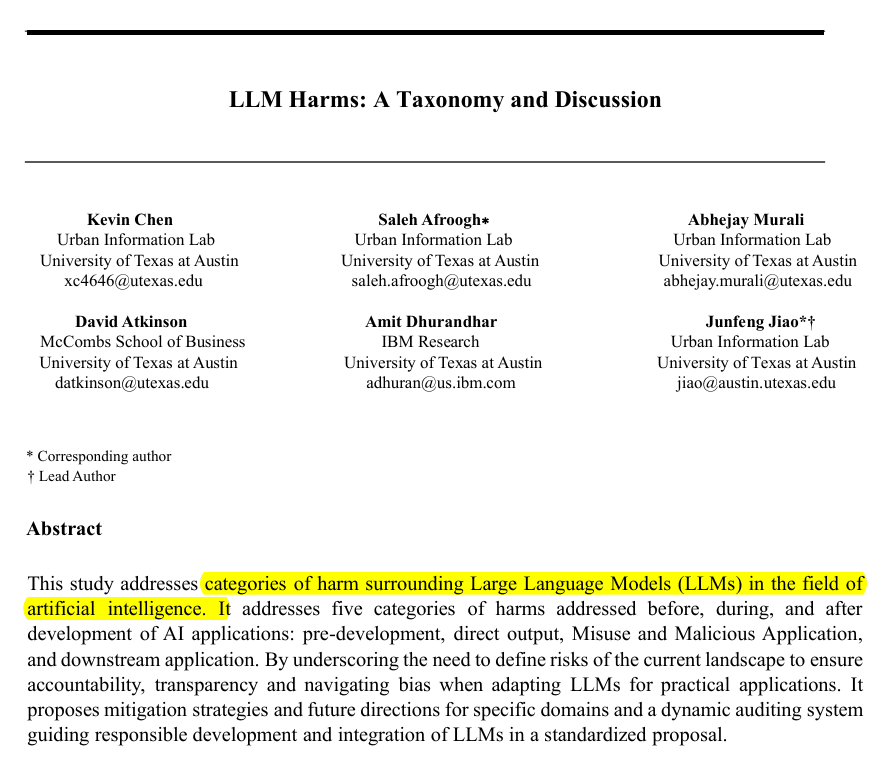
As large language models (LLMs) become increasingly embedded in our digital infrastructure, a pressing question has emerged: How do we systematically understand and mitigate the wide array of potential harms they can cause? A new research paper, "LLM Harm: A Taxonomy and Discussion," provides a crucial framework by mapping these risks across the entire lifecycle of a model. The study, available on arXiv, moves beyond isolated examples to present a holistic, five-stage map of vulnerabilities, arguing that effective defense requires coordinated safeguards at every point.
The Five-Stage Lifecycle of Harm
The core contribution of the paper is its structured taxonomy, which groups potential harms into five distinct phases of a model's existence. This lifecycle approach underscores that risks are not confined to a model's output but are woven into its creation, application, and societal integration.
1. Pre-Release & Training Harms
Before a model even generates its first token, harms can originate in its foundational processes. The study highlights:
- Data Scraping & Consent: The widespread practice of training on vast datasets scraped from the web, often containing personal data and creative work without explicit consent.
- Environmental Impact: The substantial energy consumption and carbon footprint associated with training massive models.
- Labor Exploitation: The reliance on often low-paid and psychologically taxing annotation work to create training datasets and safety filters.
2. Intrinsic Output Harms
This category covers harms that emerge directly from what the model generates, regardless of user intent.
- Bias & Stereotyping: Perpetuating and amplifying societal biases present in training data.
- Toxicity & Misinformation: Generating hateful, abusive, or factually false content.
- Hallucinations: Producing confident, plausible-sounding fabrications, which are particularly dangerous due to their deceptive appearance of authority.
3. Harms from Intentional Misuse
Here, the model is used as a tool by malicious actors to cause harm.
- Scams & Fraud: Automating phishing emails, fake reviews, or financial fraud at scale.
- Targeted Abuse: Generating personalized harassment or hate speech.
- Propaganda & Disinformation: Creating and disseminating coordinated influence campaigns.
- Prompt-Based Attacks: Using carefully crafted prompts to jailbreak model safeguards or attack connected systems and APIs.
4. Broader Systemic & Societal Harms
These are second-order effects that ripple through economies and political systems.
- Labor Market Disruption: The potential for automating cognitive tasks to displace jobs.
- Political Manipulation: Undermining democratic processes through hyper-targeted messaging or synthetic media.
- Concentration of Power: The risk of advanced AI capabilities becoming centralized in a few corporations or nations due to immense computational and data requirements.
- Access Inequality: The deepening of the digital divide, where advanced models are unavailable or perform poorly for less-resourced languages and regions.
5. Harms from Integrated Deployment
When models are baked into high-stakes tools, errors become consequential.
- Healthcare: Diagnostic errors or biased treatment recommendations.
- Finance: Unfair loan denials or flawed risk assessments.
- Education: Personalized tutoring systems that reinforce misconceptions.
- Creative Work: Subtly shaping cultural output and artistic expression through bias in generative tools.
The paper emphasizes that in these embedded contexts, model failures are no longer mere "output errors" but become real-world decisions affecting lives, often operating opaquely within larger systems.
The Case for Layered Defenses
A key conclusion of the research is that no single solution is sufficient. The authors systematically line up existing technical mitigations (like reinforcement learning from human feedback, watermarking, and robustness testing) and policy approaches (such as auditing, transparency requirements, and use-case restrictions) against each category of harm.
Their central argument is that risks can only be kept manageable through "many layered safeguards together." This defense-in-depth philosophy suggests that safety must be addressed at the data level, the model architecture level, the deployment level, and the regulatory level simultaneously. Relying solely on post-training alignment or content filters, for example, leaves systems vulnerable to upstream data poisoning or downstream misuse.
Why This Taxonomy Matters Now
This research arrives at a critical juncture. As LLMs transition from research prototypes to ubiquitous utilities, a fragmented understanding of their risks is a major liability for developers, regulators, and the public. This paper's structured taxonomy provides a shared language and a comprehensive checklist for risk assessment. It makes clear that addressing AI safety is not just about preventing toxic chat responses; it's about auditing supply chains, considering environmental justice, planning for labor transitions, and preventing the entrenchment of new global inequalities.
The lifecycle model also challenges the industry's often narrow focus on post-hoc alignment and misuse. It forces a consideration of ethical debts incurred long before deployment—debts related to privacy, consent, and labor—and of responsibilities that extend far beyond a model's API endpoint into its societal impact. By mapping the entire minefield, the study provides an essential guide for navigating the responsible development of a transformative technology.