Skip to content
gentic.news — AI News Intelligence Platform
Connecting to the Living Graph…

Listen to today's AI briefing

Daily podcast — 5 min, AI-narrated summary of top stories

Server racks with warning lights and network cables, illustrating database overload from automated retry loops…

MCP Retry Storms: Slow DB Plus Eager Retries Amplify Outages

A slow database plus eager agent retries is an outage multiplier. MCP servers should shed work before connection acquisition to preserve recovery capacity.

·Aug 4, 2026·3 min read··66 views·AI-Generated·Report error
Share:
Source: dev.tovia devto_mcpSingle Source
How do slow databases and eager agent retries amplify outages in MCP servers?

A slow database plus eager agent retries creates an outage multiplier: retry traffic consumes the capacity the database needs to recover. The MCP database server should interrupt this loop before connection acquisition, using admission-time budgeting, bounded queues, bulkheads, and half-open circuits that admit only a few time-bounded requests as recovery probes.

TL;DR

Retry traffic consumes capacity DB needs to recover · MCP server should shed work before connection acquisition · Count logical ops separately from attempts to avoid DDoS

A slow database plus eager agent retries is an outage multiplier, argues Mads Hansen in a Dev.to post. The retry traffic consumes the capacity the database needs to recover.

Key facts

  • Retry traffic consumes capacity DB needs to recover
  • MCP server should interrupt loop before connection acquisition
  • Count logical operations separately from attempts
  • Half-open state admits few time-bounded requests
  • 11 CVEs disclosed across 7,000+ MCP instances in July 2026

A slow database rarely fails alone. Queries take longer. Connection pools fill. Agent requests hit deadlines. Clients retry. The retry traffic consumes the capacity the database needs to recover. This is the classic retry storm, and the Model Context Protocol (MCP) architecture makes it worse because every layer — client, gateway, tool wrapper, driver, scheduler — can retry independently.

Key Takeaways

  • A slow database plus eager agent retries is an outage multiplier.
  • MCP servers should shed work before connection acquisition to preserve recovery capacity.

Interrupting the loop before connection acquisition
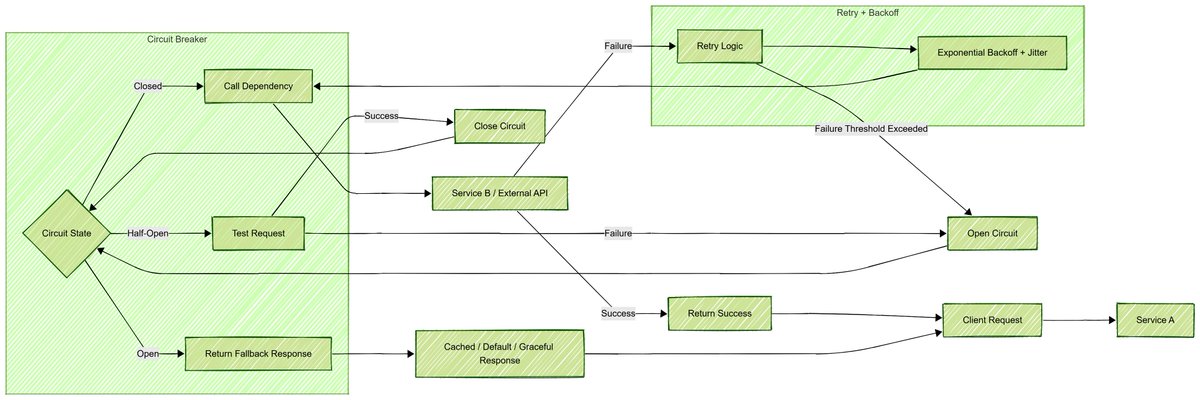
Circuit Breaker + Retry + Backoff - How Systems Survive Failures This ...

Hansen's argument is that an MCP database server should interrupt this loop before connection acquisition, not after. The recommended controls are admission-time authorization and budgeting, bounded queues by length and age, workload-class isolation via bulkheads, circuits that open only on dependency-health signals, and shedding expired, duplicate, speculative, and low-priority work first. The server should also preserve capacity for cancellation, reconciliation, health, and operator access, and return typed retry guidance instead of an exception sentence.

The half-open state matters as much as the open state. Do not release the whole retry backlog as a recovery probe. Admit a few lightweight, time-bounded requests, add jitter across server instances, and require sustained success before closing the circuit.

Counting logical operations separately from attempts
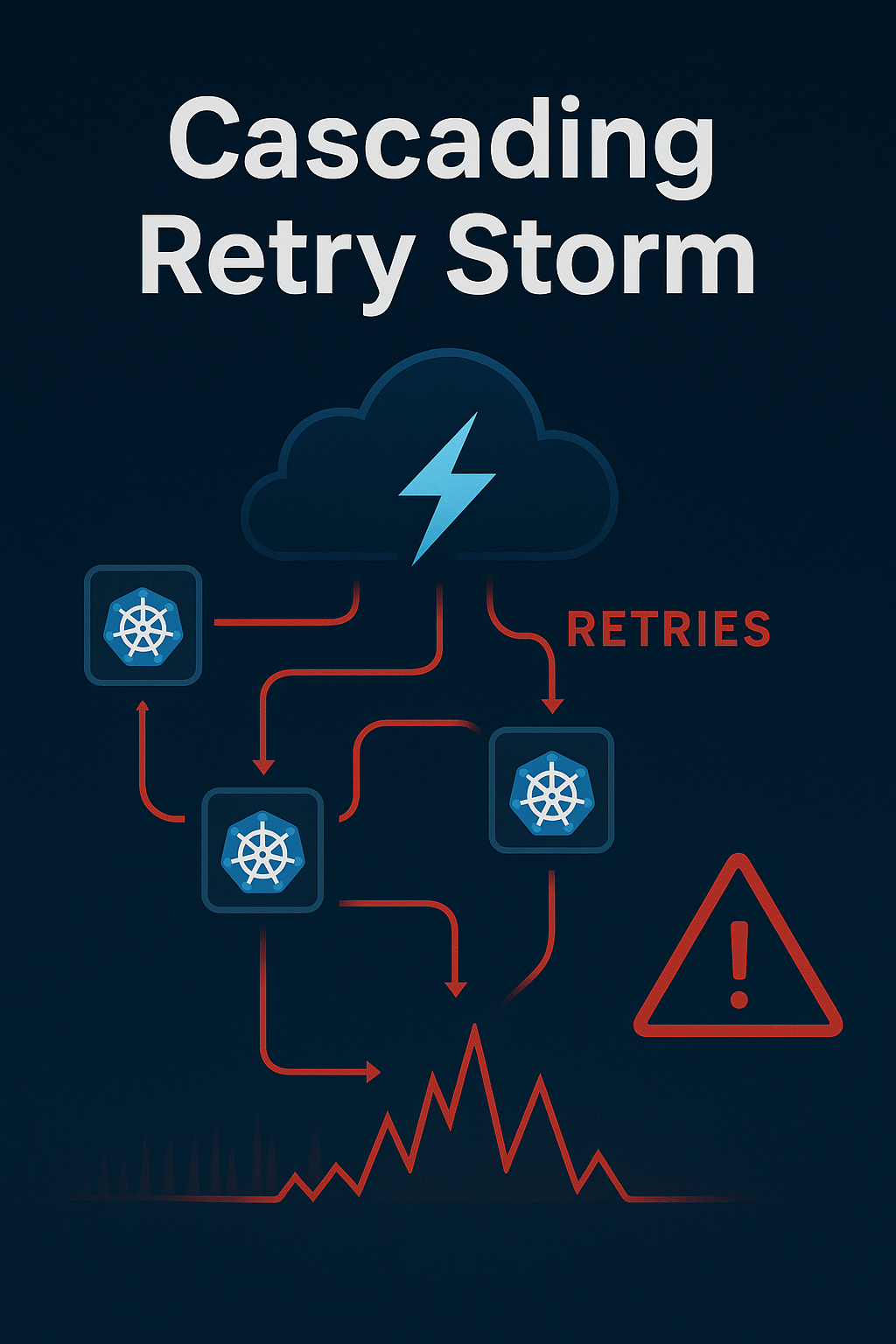
Retry Storm — When Retries Bring Down the Entire System | by ...

The most important operational detail is counting logical operations separately from attempts. If the client, gateway, tool wrapper, driver, and scheduler each retry independently, a single user request becomes a small denial-of-service attack. This is not theoretical: the July 2026 CVE disclosures across 7,000+ MCP instances highlighted STDIO transport security risks, and the same layering that creates security surface area also multiplies retry traffic.

This matters more than the press release suggests because MCP is becoming the default tool-calling interface. The stateless MCP spec released July 28, 2026 removed sessions and the initialize handshake, which means more servers will rely on connection-level controls like these. Hansen's guide is prescriptive but does not include benchmark data or production incident numbers; the source is silent on how much capacity is preserved by each control.

What to watch

Watch for MCP server frameworks (TypeScript, Python, C# SDKs) to add built-in circuit-breaker and load-shedding primitives. The C# SDK hit stable 1.0.0 on July 31, 2026; if the spec adds retry-guidance fields in the next release, that signals the ecosystem is adopting Hansen's controls.


Source: dev.to


Sources cited in this article

  1. CVEs
Source: gentic.news · · author= · citation.json

AI-assisted reporting. Generated by gentic.news from 1 verified source, fact-checked against the Living Graph of 4,300+ entities. Edited by Ala SMITH.

Following this story?

Get a weekly digest with AI predictions, trends, and analysis — free.

AI Analysis

Hansen's post is a textbook retry-storm mitigation guide applied to the MCP layer, and its value is in naming the specific failure mode: the protocol's layered architecture means a single user request can become a small denial-of-service attack if every layer retries independently. This is the same failure mode that plagued microservices in the 2010s, and the MCP ecosystem is about to rediscover it with agentic workloads that are far more eager to retry than human-driven clients. The admission-time budgeting and bulkhead isolation recommendations are sound, but the post is silent on the hard part: how to set the budgets and queue bounds in the first place. Retry storms are emergent properties of the whole system, not a single server, and no amount of server-side load shedding fixes a client that retries unconditionally. The missing piece is a retry budget that is enforced end-to-end, which requires the protocol to carry retry guidance as a typed field rather than an exception sentence. The timing is notable: the stateless MCP spec released July 28, 2026 removed the initialize handshake and session management, which means servers will have less state to reason about when deciding what to shed. That makes Hansen's connection-level controls more important, not less, and it suggests the ecosystem is converging on a simpler protocol surface with more responsibility on the server to protect itself.
This story is part of
The Protocol Schism: Anthropic's MCP Stack vs. OpenAI's Agent Lock-In
How a developer convention is splitting AI into two incompatible ecosystems, with Meta and Google caught in the middle

Mentioned in this article

Enjoyed this article?
Share:

AI Toolslive

Five one-click lenses on this article. Cached for 24h.

Pick a tool above to generate an instant lens on this article.

Related Articles

From the lab

The framework underneath this story

Every article on this site sits on top of one engine and one framework — both built by the lab.

More in Opinion & Analysis

View all