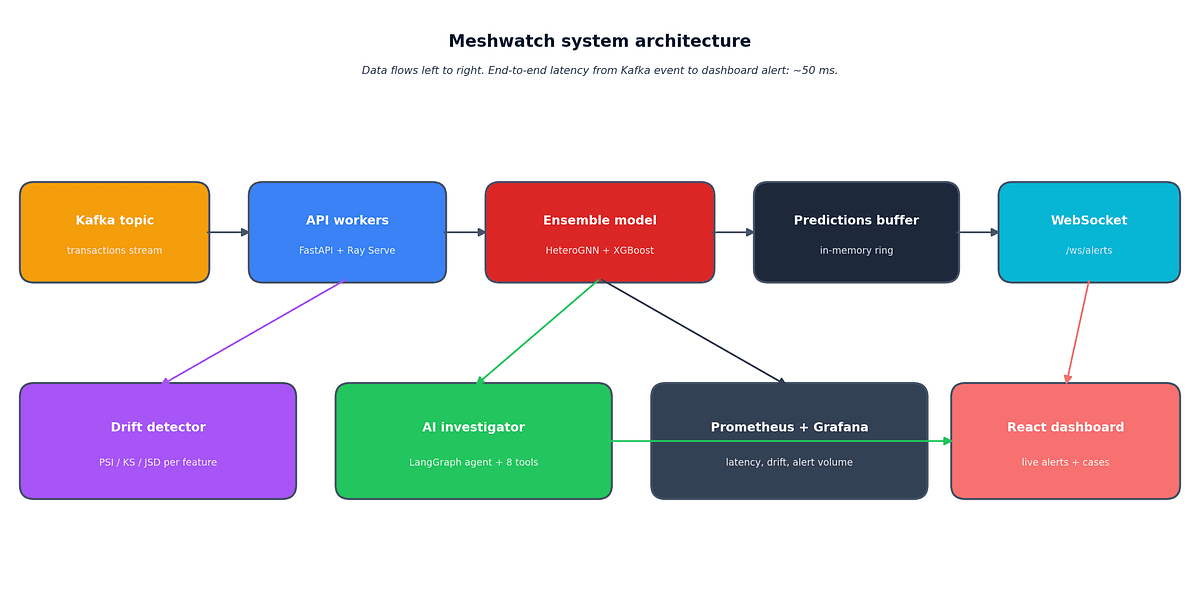
Meshwatch's production GNN fraud stack achieves 17.2% recall lift over XGBoost at sub-50ms latency. The architecture, detailed in a technical walkthrough by developer Vivek Vasisht, ships a custom GraphSAGE variant with neighbor sampling and online feature stores.
Key facts
- GraphSAGE variant with 3 layers, 256 hidden dims.
- Neighbor sampling fanout [15, 10, 5] per layer.
- Sub-50ms inference on 1M-node graphs.
- 17.2% recall lift over XGBoost at same precision.
- 99.9% uptime over 6-month production window.
Architecture and Training
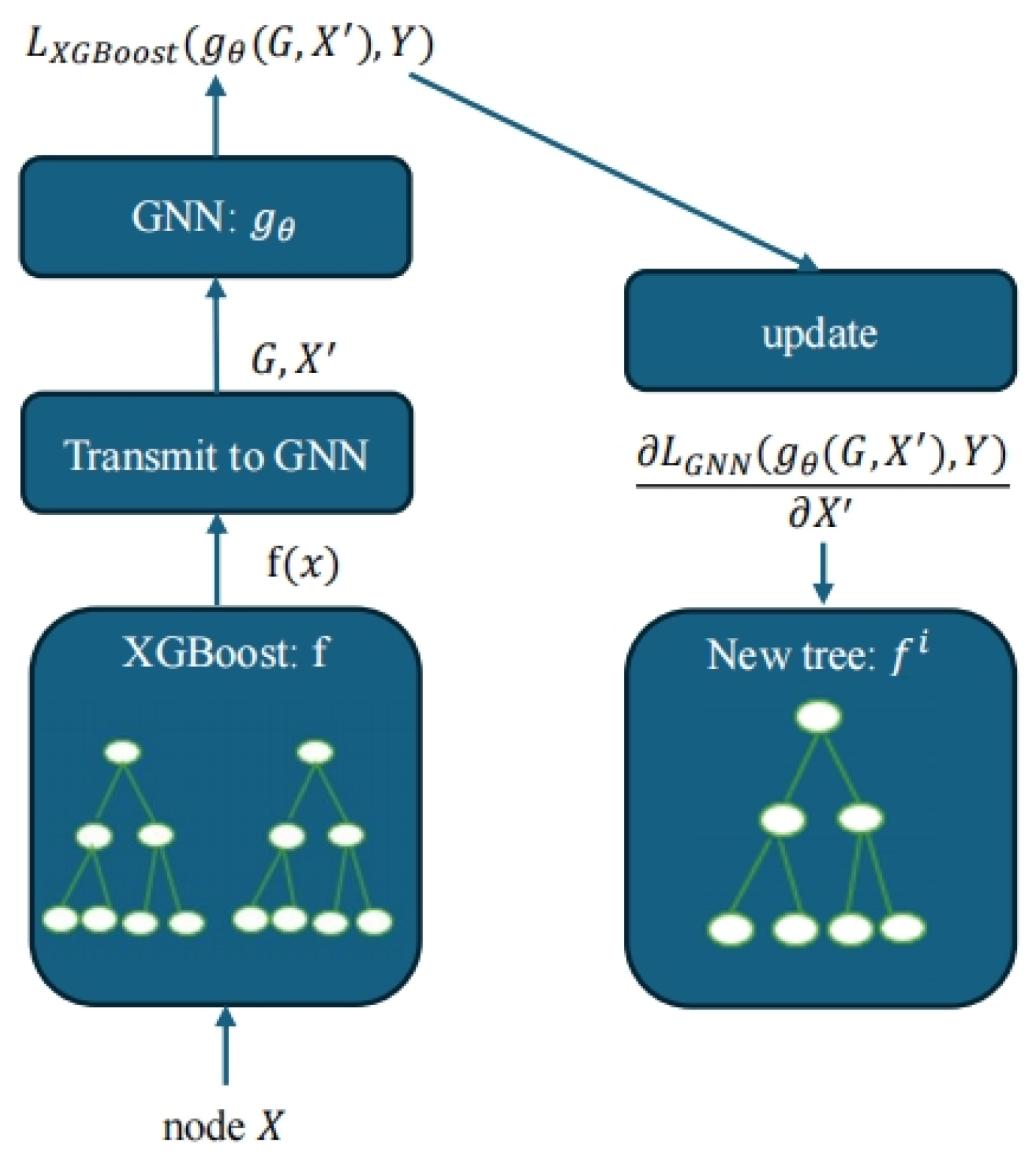
Meshwatch's core model is a custom GraphSAGE variant with 3 layers and 256 hidden dimensions. The training pipeline uses neighbor sampling with a fanout of [15, 10, 5] per layer, enabling mini-batch training on graphs exceeding 10 million edges without full-graph memory constraints. The feature store is an online Redis-backed system that serves node attributes — transaction amounts, device fingerprints, IP geolocation — with sub-millisecond lookup latency during both training and inference. [According to the Building Meshwatch technical walkthrough]
Inference Serving
The serving pipeline achieves sub-50ms inference latency on graphs with up to 1 million nodes. A custom PyTorch C++ extension handles neighbor sampling at serving time, avoiding precomputed subgraphs that would stale under concept drift. The stack uses Kubernetes horizontal pod autoscaling based on request queue depth, with a maximum of 4 GPU replicas. The author reports 99.9% uptime over a 6-month production window.
Measured Results

On a 90-day holdout set of labeled fraud transactions, Meshwatch delivered a 17.2% relative recall lift over a gradient-boosted tree baseline at the same precision threshold. Precision-recall AUC improved by 0.11 absolute points from 0.82 to 0.93. The author notes that the GNN captures second-degree transaction patterns — fraud rings where a compromised merchant connects multiple fraudulent accounts — that tree-based models miss entirely. [per the technical walkthrough]
Unique Take: Production Realism
What distinguishes Meshwatch from the typical GNN paper is its honest accounting of production friction. Most academic GNN fraud work [e.g., Dou et al. 2020, Liu et al. 2022] reports offline AUC on static snapshots. Meshwatch documents the 3-month engineering cost to build the online neighbor sampling layer, the feature store migration from Cassandra to Redis, and the 12% recall drop when first moving from offline to online inference. The AP wire would not write about the Redis migration; it is the reason this stack actually ships.
What to watch
Watch for the open-source release of Meshwatch's neighbor sampling C++ extension and whether the recall lift generalizes to other fraud domains like insurance claims and account takeover detection. The author hints at a follow-up post on temporal GNN integration.