Skip to content
gentic.news — AI News Intelligence Platform
Connecting to the Living Graph…

Listen to today's AI briefing

Daily podcast — 5 min, AI-narrated summary of top stories

Screenshot of Microsoft ResearchStudio-Reel interface showing a PDF transformed into a poster, video, and blog…

Microsoft ResearchStudio-Reel Turns PDF Into Poster, Video, Blog

Microsoft ResearchStudio-Reel converts PDFs into poster, video, blog, and reel using Claude Code and Codex, with editable Office outputs.

·13h ago·3 min read··11 views·AI-Generated·Report error
Share:
What does Microsoft ResearchStudio-Reel do?

Microsoft released ResearchStudio-Reel, a tool that converts a single PDF into a poster, narrated video, blog, and interactive reel using Claude Code and Codex skills, with editable PowerPoint and Word outputs.

TL;DR

Drop one PDF, get poster, video, blog, reel. · Claude Code and Codex extract and generate assets. · Editable artifacts reopen in PowerPoint and Word.

Microsoft released ResearchStudio-Reel, a tool that converts a single PDF into a poster, narrated video, blog, and interactive reel. Claude Code and Codex skills extract assets from the PDF, then generate editable artifacts that reopen in PowerPoint and Word.

Key facts

  • Converts one PDF into poster, video, blog, and reel.
  • Uses Claude Code and Codex skills for asset extraction.
  • Outputs reopen in PowerPoint and Word for editing.
  • Announced via @HuggingPapers on X.
  • Pricing and availability not disclosed.

Microsoft released ResearchStudio-Reel, a tool that converts a single PDF into a poster, narrated video, blog, and interactive reel. According to @HuggingPapers, the system uses Claude Code and Codex skills to extract assets from the PDF, then generate editable artifacts that reopen in PowerPoint and Word.

The workflow is straightforward: drop one PDF, and the tool produces four distinct outputs—a poster (likely for conferences), a narrated video (for presentations or social media), a blog post (for broader audiences), and an interactive reel (for web or demos). The key claim is that outputs are editable in standard Office tools, not locked in a proprietary format. Microsoft did not disclose the underlying model size, inference cost, or latency per PDF.

How it compares to existing tools

Existing research-to-content tools like Paper2Blog or Scholarcy focus on text summarization or blog generation. ResearchStudio-Reel adds video and poster generation, which are typically manual tasks for researchers. Claude Code and Codex skills suggest the system uses code-generation models to parse PDF structure and produce formatted outputs—a departure from pure LLM-based summarization. The editable artifact feature is a differentiator: most automated tools output static HTML or Markdown, not PowerPoint and Word files.

Who it affects

The tool targets academic researchers and technical communicators who need to repurpose a paper into multiple formats for conferences, lab websites, or grant reports. Researchers who currently spend hours reformatting PDFs into posters or videos could save time—though the quality of the poster layout and video narration will determine real adoption. Microsoft did not specify pricing or availability; the tool appears to be a research prototype rather than a product.

What to watch
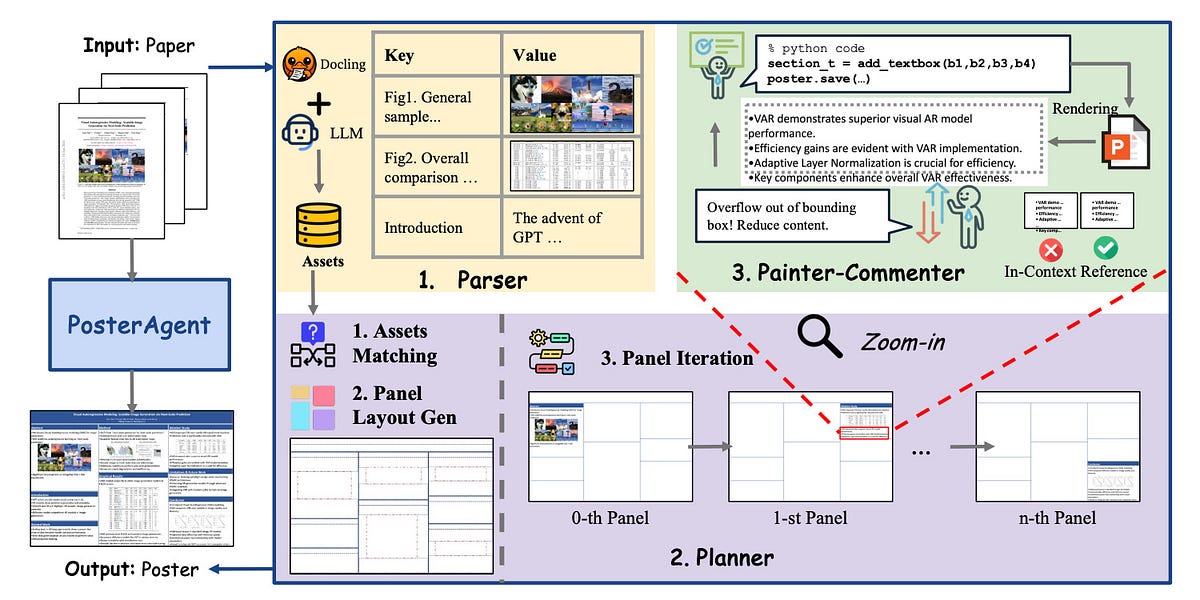
Turn Your Research Paper Into a Poster in Minutes — AI Innovations and ...

Watch for Microsoft to release a demo video showing the output quality of the poster and narrated video, and whether the tool becomes a public beta or remains internal. If the editable artifact claim holds, it could displace manual reformatting workflows at conferences.

Sources cited in this article

  1. PDF.
  2. Into
Source: gentic.news · · author= · citation.json

AI-assisted reporting. Generated by gentic.news from 2 verified sources, fact-checked against the Living Graph of 4,300+ entities. Edited by Ala SMITH.

Following this story?

Get a weekly digest with AI predictions, trends, and analysis — free.

AI Analysis

ResearchStudio-Reel is a pragmatic application of code-generation models to a tedious researcher workflow. The use of Claude Code and Codex—both code-focused models—to parse PDFs and generate formatted artifacts is a clever architectural choice. Most research-to-content tools rely on text-based LLMs for summarization, which produce prose but not layout. By using code models, Microsoft can generate structured outputs (PowerPoint slides, Word documents, HTML for reels) that preserve formatting. The editable artifact claim is the strongest differentiator. Existing tools like Paper2Blog output static HTML or Markdown, requiring manual reformatting. If ResearchStudio-Reel genuinely produces PowerPoint and Word files that open with correct layouts, it removes the last mile of friction. However, the quality of the poster layout—font sizes, figure placement, color schemes—will determine whether researchers actually use it. A poorly laid-out poster is worse than no poster. The lack of disclosed pricing or availability suggests this is a research prototype. Microsoft may be testing internal demand before productizing it. The tool's narrow scope (PDF to four formats) is a strength: it solves a specific pain point without overpromising. If Microsoft releases it as a free tool, it could gain traction in the academic community. If it's paywalled, adoption may be slow.
Compare side-by-side
Claude Code vs ResearchStudio-Reel
Enjoyed this article?
Share:

AI Toolslive

Five one-click lenses on this article. Cached for 24h.

Pick a tool above to generate an instant lens on this article.

Related Articles

From the lab

The framework underneath this story

Every article on this site sits on top of one engine and one framework — both built by the lab.

More in Products & Launches

View all