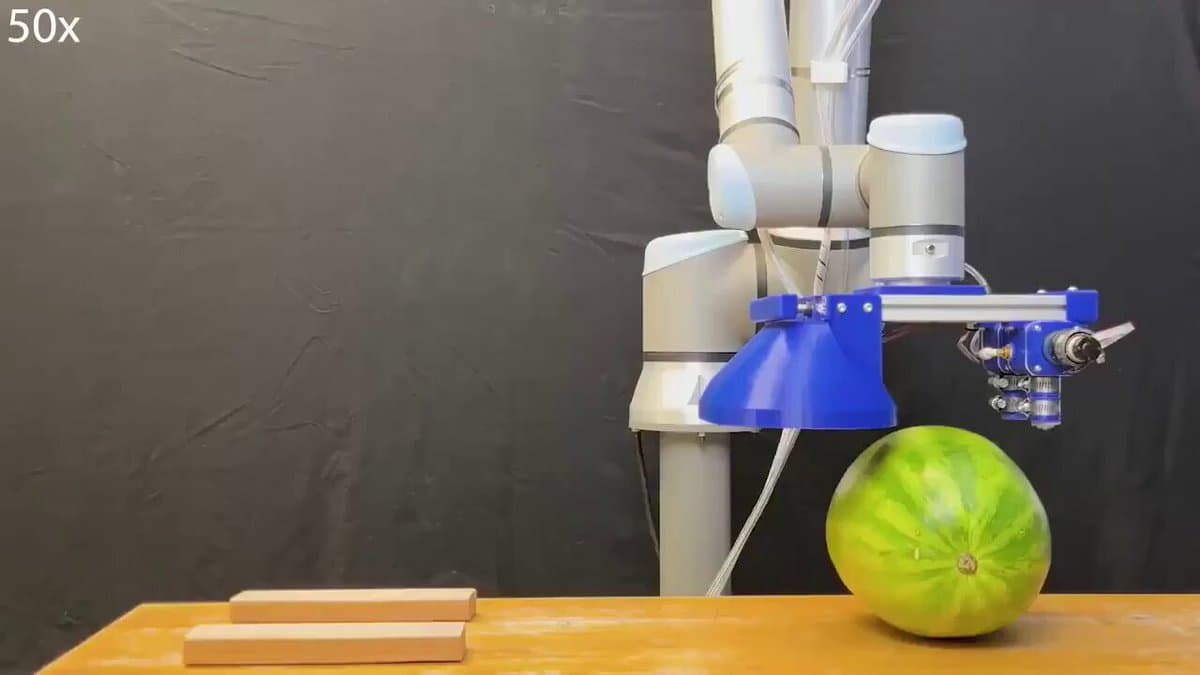
MIT researchers have developed a new robotic grasping technique called "loop closure grasping" that enables robots to lift heavy yet delicate objects—like a 6.8kg (15lb) kettlebell—without crushing or dropping them. The method, detailed in a paper published in Science Advances, fundamentally rethinks how robotic grippers manage the conflicting requirements of manipulation and secure holding.
The Core Problem: The Stiffness Trade-off
Traditional robotic grasping faces a fundamental mechanical trade-off. To securely hold a heavy object, a gripper needs structural stiffness to resist the load. However, this same stiffness creates high-pressure contact points that can crush fragile items. Conversely, soft grippers can distribute pressure gently but often buckle or slip under significant weight, failing at the holding stage.
Open-ended grippers (like tentacles or soft fingers) can snake around clutter to achieve a good initial wrap, but they typically rely on stiffness or continuous actuator pressure to maintain the grasp, reintroducing the point-load problem.
How Loop Closure Grasping Works
Loop closure grasping decouples the manipulation phase from the load-bearing phase by changing the gripper's structural configuration.
Open-Loop Phase (Manipulation): The gripper begins as an open-ended structure. Using an inflatable, everting "vine" beam that grows from its tip, it can snake through cluttered environments, wrap around a target object, and find an optimal grasping geometry. During this phase, the structure remains compliant and low-pressure.
Closure & Locking Phase: Once a complete wrap is achieved, the free tip of the gripper is mechanically locked back onto its base. This action transforms the open loop into a closed loop that fully encircles the object.
Closed-Loop Phase (Load-Bearing): In the closed-loop configuration, the primary load path shifts. Instead of relying on the bending stiffness of the gripper material to pinch or clamp the object, the weight is borne through tension along the loop's length—much like a fabric sling. This allows the loop material itself to remain very soft and compliant, distributing pressure evenly over a large surface area and eliminating high-pressure points. In the MIT prototype, the inflatable beam is actually deflated after locking to maximize softness during holding.
The prototype system uses a winch and clamp mechanism to secure the tip and apply tension to the loop after closure.
Key Demonstrated Results
The research team demonstrated the system's capability with several challenging tasks:
- Lifting a 6.8kg Kettlebell from a Bin: The gripper navigated the rim of a metal kettlebell in a cluttered container, formed a loop around the handle, locked, and lifted it. The soft, tension-based hold prevented damage to both the kettlebell and the bin.
- Long-Reach Retrieval: The system retrieved an object from a distance of 3 meters away, showcasing the snaking manipulation capability of the inflatable beam.
- Handling Fragile, Irregular Items: The method was shown to be effective for awkward, delicate objects where traditional pinching or enveloping grasps would fail or cause damage.
The paper, "Loop Closure Grasping," is available via Science Advances (DOI: 10.1126/sciadv.ady9581).
What This Enables
This approach is particularly suited for unstructured environments where robots must handle a wide variety of object shapes, weights, and fragilities without pre-programmed grasps. Potential applications include:
- Warehouse Logistics: Handling heavy but easily-dented items or irregularly shaped packages.
- Agricultural Robotics: Harvesting fruits without bruising.
- Disaster Response: Moving debris to extract items without causing further collapse.
- Home Assistance: Enabling robots to perform tasks like retrieving a full pot from a crowded cabinet.
By separating the search-and-wrap maneuver from the load-bearing function, loop closure grasping provides a distinct alternative to the prevailing paradigm of building grippers that must be universally stiff or strong.