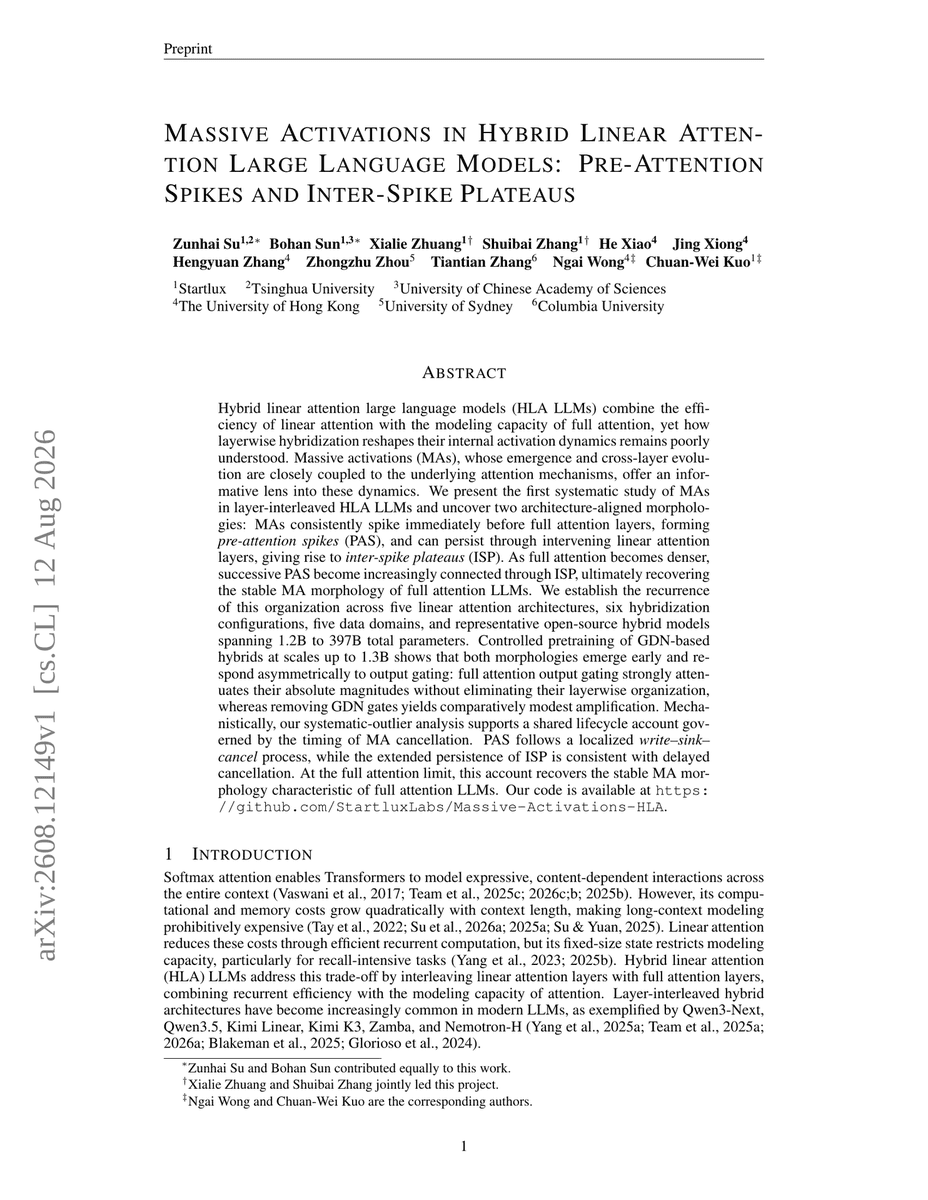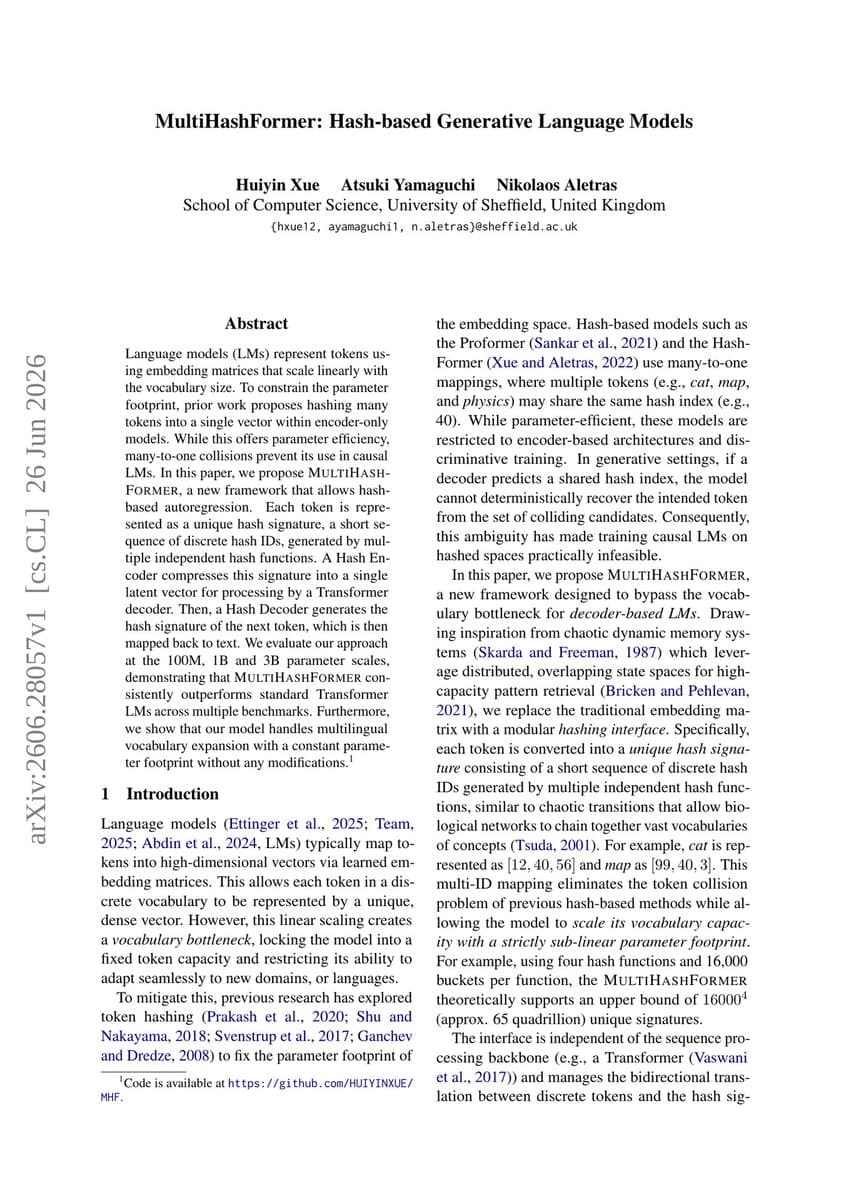
MultiHashFormer replaces token embeddings with multi-ID hash signatures for causal LMs. The method reduces memory while outperforming standard Transformers from 100M to 3B parameters, per a new preprint.
Key facts
- MultiHashFormer tested from 100M to 3B parameters.
- Reduces embedding memory from O(Vd) to O(HK*d).
- First hash-based autoregressive method for causal LMs.
- Consistent perplexity and downstream gains reported.
Token hashing is no longer just for encoders. MultiHashFormer brings hash-based autoregression to causal LMs via unique multi-ID signatures, slashing embedding memory and outperforming standard Transformers from 100M to 3B parameters According to @HuggingPapers.
The method uses multiple hash functions per token to generate a set of IDs, which are combined into a single representation via learned aggregation. This reduces the embedding lookup table from O(V * d) to O(H * K * d), where H is the number of hash functions, K is the number of IDs per token, and V is vocabulary size. The paper reports consistent gains over standard Transformers on language modeling perplexity and downstream tasks across all tested scales.
Why This Matters for LLM Efficiency
Embedding tables dominate memory in large vocabulary models—especially for multilingual or domain-specific LMs. MultiHashFormer's approach compresses this without sacrificing quality, offering a path to smaller memory footprints for deployment. The technique builds on prior hash-based methods for encoders (e.g., Bloom embeddings, hash embeddings) but is the first to demonstrate viability for autoregressive decoding.
The paper does not disclose exact perplexity numbers or downstream task results, nor does it compare against other memory-efficient embedding methods like adaptive embeddings or factorized embeddings. The claim of outperforming standard Transformers is broad—details on the baseline architecture, training setup, and evaluation tasks are absent from the tweet. Independent reproduction and ablation studies are needed to validate the gains.
What to Watch
Watch for the full arXiv paper release to see detailed benchmark tables, ablation studies on hash function count (H) and ID count (K), and comparisons to other embedding compression methods. The key test will be whether MultiHashFormer scales beyond 3B parameters and maintains gains at larger sizes where embedding memory is a smaller fraction of total parameters.