Nemotron 3 Ultra matched GPT-5.5 on an HTML5 canvas physics benchmark while costing 10X less per inference. The MoE model used 11.3k tokens at $0.051 versus GPT-5.5's 11.0k tokens at $0.57.
Key facts
- Nemotron 3 Ultra: 11.3k tokens at $0.051
- GPT-5.5: 11.0k tokens at $0.57
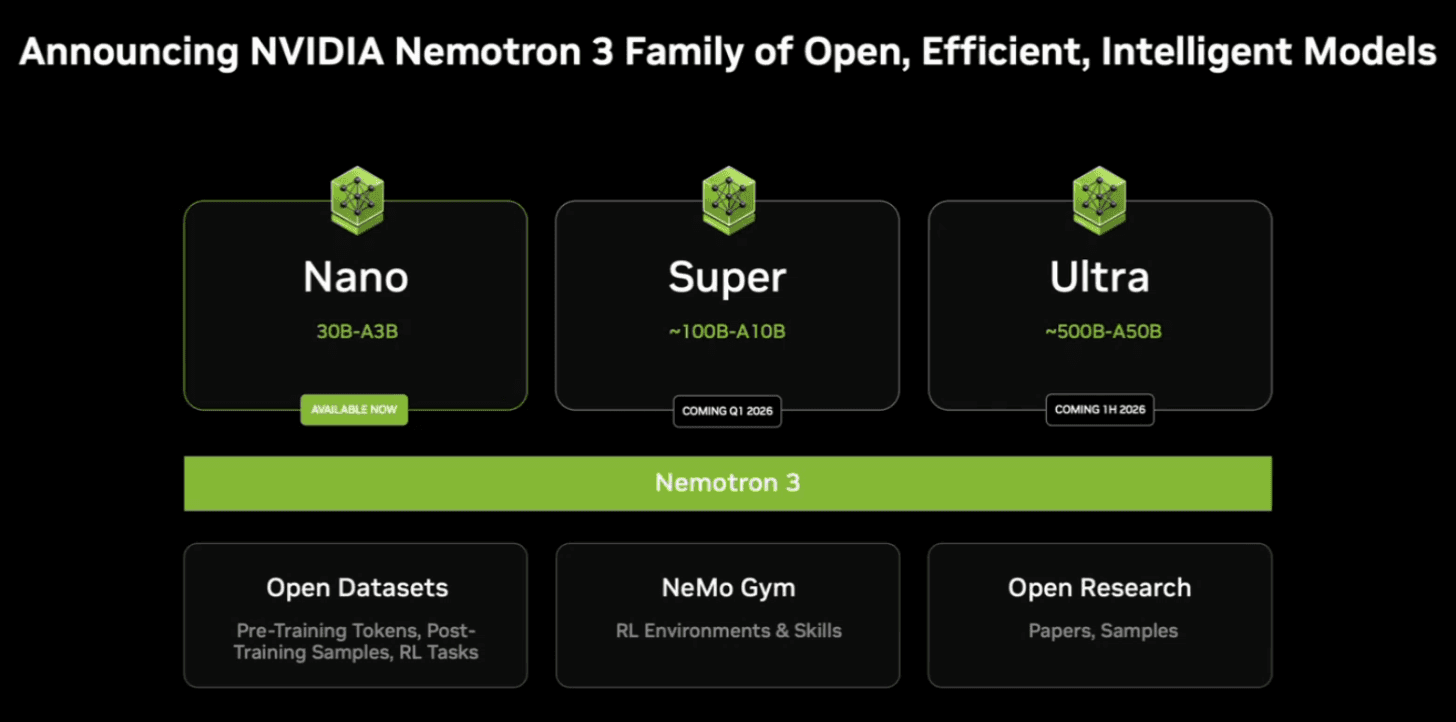
- 550B total parameters, 55B active per token
- 10X cost advantage on physics test
- Mixture-of-Experts architecture
A side-by-side comparison on atomic.chat, a desktop app that runs LLMs locally, shows Nemotron 3 Ultra producing nearly identical results to GPT-5.5 on a test requiring HTML5 canvas with real physics simulation. According to @rohanpaul_ai, the cost gap is stark: Nemotron 3 Ultra processed 11.3k tokens for $0.051, while GPT-5.5 used 11.0k tokens at $0.57 — a 10X price difference.
Nemotron 3 Ultra achieves this efficiency through its Mixture-of-Experts architecture: 550 billion total parameters but only 55 billion active per token. That means each forward pass activates roughly 10% of the full parameter count, dramatically reducing compute cost versus a dense model like GPT-5.5, which likely activates all its parameters on every token.
Why this matters more than a single test
The cost-per-token delta is not just a pricing curiosity — it changes deployment math. For applications running thousands of daily inferences, switching from GPT-5.5 to Nemotron 3 Ultra could cut inference spend by 90% with no visible quality regression on this specific task. The caveat: this is one test on one benchmark. Broader evaluations (e.g., MMLU, HumanEval, MATH) are needed to confirm parity across domains. But the pattern is real: MoE models are making dense frontier models look expensive.
The MoE advantage in practice
Nemotron 3 Ultra's 55B active parameters per token places it in the same compute class as a medium-sized dense model, yet it draws on a knowledge base of 550B parameters. This sparse activation is the same trick used by Mixtral 8x7B (47B total, 13B active) and GPT-4 (reportedly 1.7T total, ~200B active). The cost savings compound when serving many concurrent users, because the MoE router can allocate different experts to different requests.
What the source doesn't say
The tweet does not disclose the exact benchmark methodology, the specific physics test prompts, or whether the outputs were evaluated by a human or automated metric. It also doesn't specify which version of GPT-5.5 was used (e.g., GPT-5.5-turbo vs GPT-5.5-pro). These details matter for reproducibility. The comparison is also limited to a single desktop app — atomic.chat may use different quantization or serving configurations that affect both cost and quality.
What to watch
Watch for independent benchmark results on standard suites like MMLU, HumanEval, and MATH for Nemotron 3 Ultra. Also track pricing announcements from OpenAI: if GPT-5.5 API prices drop or a cheaper tier emerges, the cost advantage narrows. The Q3 inference pricing landscape will tell whether MoE models force a race to the bottom on per-token costs.