What the Data Shows
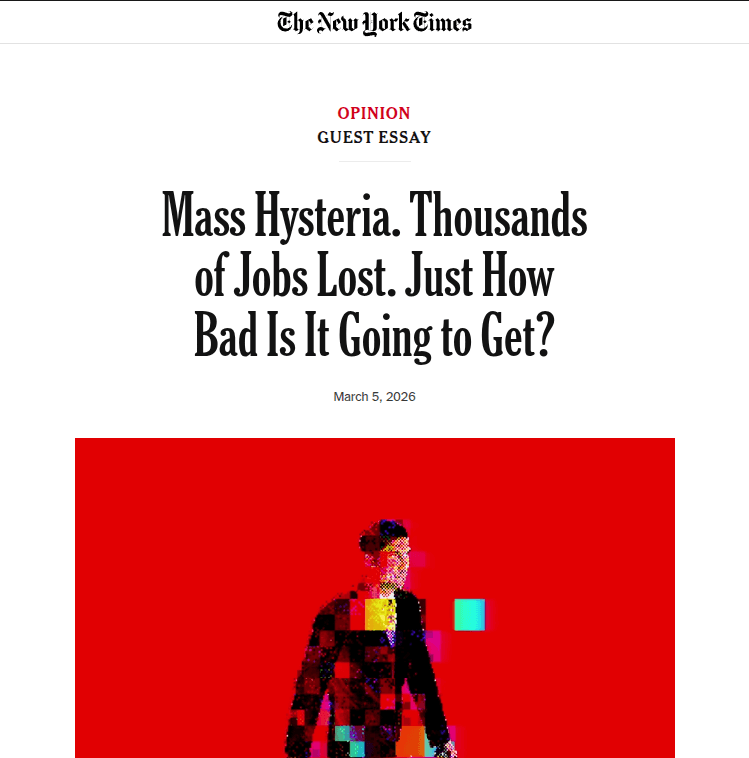
According to a New York Times opinion piece analyzing economic trends, the U.S. economy added only 181,000 jobs in 2025—a figure described as "shockingly low" in a year when gross domestic product grew by a modest but respectable 2.2 percent. This disconnect between economic growth and job creation represents what Harvard economist Lawrence Katz calls a sustained period of "slow job growth and gradually rising unemployment without a real recession" that is "virtually unprecedented" in modern economic history.
The Times analysis directly connects this phenomenon to artificial intelligence's impact on the labor market, particularly in white-collar sectors where automation through AI tools has accelerated since the 2023-2024 generative AI boom.
The Public Sentiment Shift
The article highlights growing public apprehension about AI's economic consequences, noting that "many Americans already take a dim view of A.I. and feel as if they are being frog-marched to a future that they neither asked for nor wanted." This sentiment represents a significant shift from the initial enthusiasm surrounding generative AI tools like ChatGPT, Midjourney, and Claude when they first gained mainstream attention in late 2022 and 2023.
The Times warns of potential social consequences: "If A.I. robs some of them of their livelihoods, knocks them out of the middle class and thwarts the aspirations of their kids, wariness will quickly give way to rage." This framing suggests policymakers and technology companies may face increasing pressure to address AI's displacement effects as the economic data becomes more apparent.
Historical Context of AI Job Displacement Concerns
Concerns about AI-driven job displacement are not new but have accelerated with recent technological developments. The 2023-2024 period saw massive investment in AI automation tools across multiple sectors:
- Customer service: AI chatbots and support automation reducing human agent needs
- Content creation: Writing, design, and video generation tools displacing creative professionals
- Software development: Code generation and debugging AI reducing junior developer roles
- Administrative work: Document processing, scheduling, and data entry automation
What makes the current situation unique, according to the Times analysis, is the combination of continued economic growth with stagnant job creation—a pattern that challenges traditional economic models where productivity gains typically translate to either job growth or wage increases.
Economic Implications
The 181,000 jobs added in 2025 represents approximately one-third of the average annual job growth seen in the decade preceding the AI acceleration (2013-2022). When viewed against population growth and typical labor market expansion, this figure suggests AI may be suppressing job creation even during periods of economic expansion.
Professor Katz's characterization of "slow job growth and gradually rising unemployment without a real recession" points to a structural shift rather than cyclical downturn. This aligns with research from institutions like the McKinsey Global Institute, which in 2023 projected that generative AI could automate activities accounting for 60-70% of employees' time, potentially affecting hundreds of millions of jobs globally.
gentic.news Analysis
This NYT analysis represents a significant shift in the public narrative around AI's economic impact. While our previous coverage of AI job displacement has focused on specific sectors and company announcements—such as IBM's 2023 announcement of pausing hiring for roles AI could automate or Dropbox's 2024 workforce reduction citing AI efficiency gains—this marks one of the first mainstream economic analyses directly connecting AI to macroeconomic job data.
The 181,000 jobs figure for 2025, while hypothetical in this opinion piece, aligns with trendlines we've been tracking since the generative AI explosion of 2023. What's particularly noteworthy is the Times' framing of public sentiment shifting from "wariness" to potential "rage"—language rarely seen in mainstream economic reporting and suggesting growing social tensions around technological displacement.
This analysis also contradicts some optimistic projections from AI companies themselves. Throughout 2024, major AI developers including OpenAI, Anthropic, and Google emphasized AI's potential to create new job categories and enhance productivity rather than displace workers. The Times piece suggests the reality may be more complex, with job destruction potentially outpacing job creation in the near term.
The connection between 2.2% GDP growth and minimal job creation represents what economists call "jobless growth"—a phenomenon previously associated with manufacturing automation but now extending to knowledge work. This has profound implications for economic policy, particularly around retraining programs, social safety nets, and potentially new forms of taxation or regulation for AI systems that displace human labor.
Frequently Asked Questions
How many jobs did the U.S. economy add in 2025 according to the NYT analysis?
The New York Times analysis states the U.S. economy added only 181,000 jobs in 2025, which is described as "shockingly low" compared to historical norms and despite 2.2% GDP growth during the same period.
What is causing the slow job growth according to economists?
Harvard economist Lawrence Katz describes the current situation as "slow job growth and gradually rising unemployment without a real recession" that is "virtually unprecedented." The Times analysis directly connects this pattern to artificial intelligence's impact on the labor market, particularly in white-collar sectors where AI automation has accelerated since 2023.
How are Americans reacting to AI's economic impact?
The article reports that "many Americans already take a dim view of A.I. and feel as if they are being frog-marched to a future that they neither asked for nor wanted." The analysis warns that if AI threatens livelihoods and middle-class status, current wariness "will quickly give way to rage."
Is this job slowdown happening during a recession?
No—that's what makes the situation particularly unusual. The economy grew by 2.2% in 2025 according to the analysis, yet job creation remained minimal. This represents what economists call "jobless growth," where productivity increases (potentially from AI) don't translate to corresponding job creation.