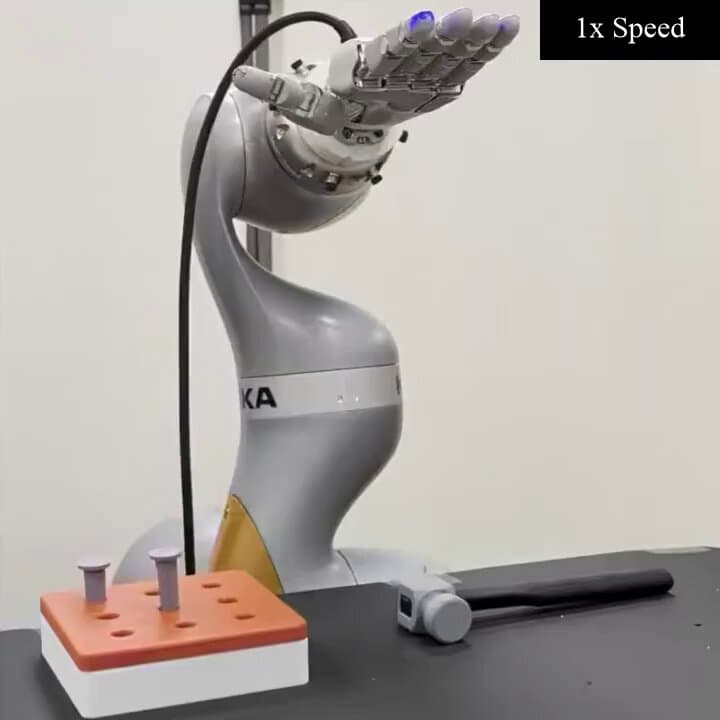
In a significant leap toward truly versatile robotic systems, researchers have unveiled SimToolReal—a single robot policy that can manipulate diverse tools it has never encountered before. This breakthrough, detailed in recent research, represents a fundamental shift from specialized robotic systems to general-purpose tool users capable of zero-shot generalization across multiple domains.
The Core Innovation: From Specialized to Generalized Tool Use
Traditional robotic systems typically require extensive training on specific tools and objects, limiting their practical application in dynamic, real-world environments where tools vary and new objects appear regularly. SimToolReal addresses this limitation head-on by employing sim-to-real reinforcement learning (RL) on procedurally generated tool primitives.
The system was trained entirely in simulation using a diverse set of procedurally generated tools, then transferred to physical robots without additional real-world training. This approach allows the policy to develop fundamental understanding of tool manipulation principles rather than memorizing specific tool-object interactions.
Technical Architecture: How SimToolReal Works
The researchers developed a sophisticated training pipeline that combines several advanced AI techniques:
Procedural Tool Generation: Instead of training on a fixed set of tools, the system generates thousands of tool variations during simulation training, creating a rich dataset of potential tool geometries and properties.
Sim-to-Real Transfer: The policy learns entirely in simulation but incorporates domain randomization techniques that prepare it for the inevitable differences between simulated and real-world physics.
Unified Policy Architecture: A single neural network policy handles all tool manipulation tasks, learning transferable skills that apply across different tool categories and objects.
Impressive Performance Metrics
SimToolReal demonstrates remarkable generalization capabilities:
- 24 distinct tasks including pushing, scooping, hammering, and cutting
- 12 different objects with varying physical properties
- 6 tool categories including spatulas, scoops, hammers, and scrapers
- Zero-shot generalization to completely new tool-object combinations
Perhaps most impressively, the system successfully manipulates tools it has never seen before—a capability that has eluded previous robotic systems. This represents a fundamental advance toward robots that can adapt to novel situations without retraining.
Real-World Applications and Implications
The implications of this research extend across multiple domains:
Manufacturing and Logistics: Robots that can adapt to new tools without reprogramming could revolutionize assembly lines and warehouses, where tool changes are frequent.
Healthcare and Assistive Robotics: Versatile robotic assistants could help with various tasks using whatever tools are available, making them more practical for home and clinical settings.
Disaster Response: Emergency robots could utilize whatever tools they find on-site rather than requiring specialized equipment.
Space Exploration: Robotic systems on distant planets could adapt to unexpected conditions and use found objects as tools.
Challenges and Limitations
While SimToolReal represents significant progress, challenges remain:
Physical Complexity: The current system handles relatively simple tool interactions; more complex manipulations requiring fine motor skills remain difficult.
Tool Recognition: The system assumes knowledge of tool properties; integrating visual tool recognition would be necessary for completely autonomous operation.
Safety Considerations: As robots become more versatile, ensuring safe interaction with humans and delicate objects becomes increasingly important.
The Future of General-Purpose Robotics
SimToolReal points toward a future where robots possess general tool-use intelligence similar to humans. Rather than being programmed for specific tasks, future robots might understand fundamental principles of tool manipulation that apply across countless scenarios.
This research aligns with broader trends in AI toward foundation models and general intelligence. Just as large language models can handle diverse language tasks, robotic foundation models may eventually handle diverse physical tasks.
Research Context and Methodology
The work builds on several key areas of robotics research:
Sim-to-Real Learning: Leveraging increasingly realistic simulations to train robots without expensive real-world trial-and-error
Procedural Content Generation: Creating diverse training data automatically rather than manually
Domain Generalization: Developing systems that perform well across different environments and conditions
Tool Affordance Learning: Understanding what actions tools enable rather than just their physical properties
Conclusion: Toward Truly Adaptable Robots
SimToolReal represents more than just another incremental improvement in robotic manipulation. It demonstrates that general tool-use capabilities are achievable with current AI techniques, pointing toward a future where robots can adapt to novel situations as flexibly as humans do.
As the research community continues to refine these approaches, we move closer to robots that can truly operate in unstructured environments—handling whatever tools and objects they encounter with human-like adaptability. This breakthrough brings us one step closer to the long-sought goal of general-purpose robotics that can assist humans across countless domains.
Source: Research on SimToolReal demonstrating zero-shot generalization in tool manipulation via sim-to-real reinforcement learning.