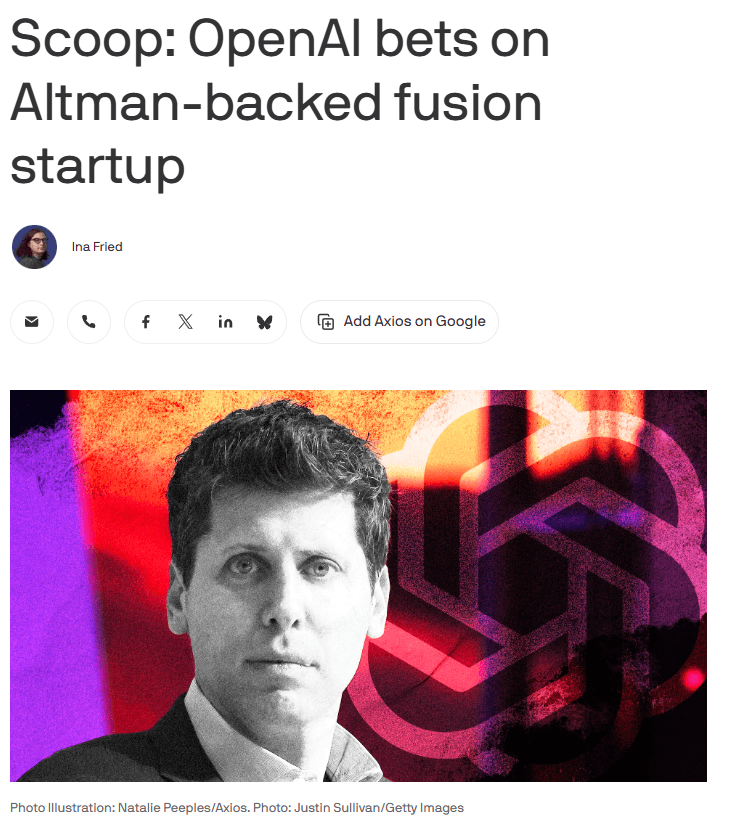
OpenAI is in advanced negotiations to purchase electricity from Helion Energy, a nuclear fusion startup backed by OpenAI CEO Sam Altman, according to a report from The Information cited by Bloomberg. The deal, if finalized, would see OpenAI secure a guaranteed portion of Helion's power production, initially amounting to 12.5% of its output.
What the Deal Entails
The reported talks center on a power purchase agreement (PPA), a common contract for large energy consumers to buy electricity directly from a generator. The key detail from the source is that OpenAI could lock in 12.5% of Helion's initial production capacity. This is not a minor pilot but a significant, forward-looking commitment for a portion of a first-of-its-kind commercial fusion plant's output.
The structure suggests OpenAI is seeking to pre-purchase baseload power for its future data center operations. For an AI company whose primary operational cost and scaling bottleneck is energy, securing a long-term, clean, and potentially price-stable electricity source is a core strategic imperative.
The Players: OpenAI and Helion Energy
OpenAI's energy consumption is already substantial and is projected to grow exponentially. Training models like GPT-4 and the ongoing inference for products like ChatGPT and the API require vast amounts of compute, directly translating to massive electricity use. CEO Sam Altman has repeatedly stated that the future of AI is constrained by energy and compute, not just algorithms.
Helion Energy, founded in 2013, is developing a pulsed, non-ignition fusion technology that aims to generate electricity directly from the fusion reaction, bypassing the traditional steam turbine cycle. The company has raised over $2.2 billion, with Sam Altman being its single largest investor. In 2021, Helion announced a deal to provide Microsoft with at least 50 megawatts of power from its first fusion plant, slated to come online by 2028. The OpenAI talks appear to be a similar style of agreement.
Why Fusion? The Strategic Calculus for AI
For a hyperscaler of AI compute, the ideal power source has four attributes: abundance, reliability, low cost, and carbon-free. Today's grid, often reliant on fossil fuels or intermittent renewables, struggles to meet all four at the scale AI companies will soon demand.
Fusion, if commercially realized, promises near-limitless, 24/7, carbon-free energy. By negotiating a PPA now, OpenAI is attempting to de-risk its future energy supply and potentially gain a cost advantage. It’s a hedge against volatile energy markets and a bet on a technology where its CEO has deep financial and technical conviction.
This move is part of a broader trend. Google, Microsoft, and Amazon have all pursued major clean energy PPAs for their data centers. OpenAI's direct negotiation with a specific, cutting-edge generator like Helion is a more aggressive, technology-specific version of this strategy.
Challenges and Timeline
The major caveat is that commercial fusion power does not yet exist. Helion's ambitious timeline targets generating electricity for Microsoft by 2028. Any deal with OpenAI would be contingent on Helion successfully building, licensing, and operating its first plant—a monumental engineering and regulatory challenge.
The 12.5% figure indicates OpenAI would be a major, but not exclusive, offtaker. The remaining capacity would likely be split between other pre-committed buyers (like Microsoft) and the grid.
gentic.news Analysis
This negotiation, while preliminary, is a stark signal of how AI leaders are planning for a post-Moore's Law world. When algorithmic efficiencies plateau, scaling intelligence becomes a brute-force problem of energy-in, compute-out. OpenAI isn't just thinking about next year's model; it's planning for the multi-exaflop, artificial general intelligence (AGI)-scale training runs that may be a decade away. Securing a dedicated fusion power stream is a move straight out of the hyperscaler playbook, but applied to a pre-commercial technology. It shows a willingness to make billion-dollar bets on the entire stack, from silicon to electrons.
Practically, this also tightens the relationship between Sam Altman's roles as CEO of OpenAI and lead investor in Helion. While not an outright conflict of interest—OpenAI would be a customer, not an investor—it does create a powerful aligned incentive. Success for Helion directly enables success for OpenAI. This vertical integration of energy and compute could become a new moat for leading AI companies, potentially leaving those reliant on the standard grid at a severe cost and scalability disadvantage.
Finally, this highlights that the true competition for AI supremacy may increasingly be fought on infrastructure battlegrounds far from GitHub: in power purchase agreements, nuclear licensing hearings, and chip fabrication plants. The company that controls the most efficient, lowest-cost joules will control the future of AI capability.
Frequently Asked Questions
Is Helion Energy close to producing commercial fusion power?
Helion Energy has not yet demonstrated net-positive electricity generation from fusion. Its stated goal is to build a plant capable of doing so and to supply power to Microsoft by 2028. This is an ambitious timeline, as fusion has yet to be proven as a commercially viable energy source. The deal with OpenAI is a forward-looking agreement contingent on Helion's future success.
Why would OpenAI buy power from a company its CEO invested in?
Sam Altman is a major personal investor in Helion, but the deal is reportedly between the companies. For OpenAI, Helion represents one of the most promising potential sources of the vast, clean, and reliable energy it will need to scale its AI systems. The strategic rationale exists independently of Altman's investment, though his belief in both companies certainly facilitates the discussion. Proper governance would require the deal to be negotiated at arm's length and judged on its commercial merits for OpenAI.
How much power is 12.5% of Helion's initial output?
The exact megawatt figure is not disclosed. For context, Helion's first plant for Microsoft is aimed at generating at least 50 megawatts. If the initial total capacity is in that range, 12.5% would represent a commitment of roughly 6-10 megawatts for OpenAI. This is enough to power a small data center or a significant portion of a large AI training cluster, representing a foundational block for future expansion.
What does this mean for the AI industry's energy consumption?
It confirms that industry leaders view today's energy infrastructure as inadequate for their projected growth. OpenAI's move is a canary in the coal mine, signaling an impending surge in demand for clean, firm power that will likely drive more AI companies to seek direct energy deals, accelerate nuclear (fission and fusion) development, and increase pressure on global grids and energy policies.