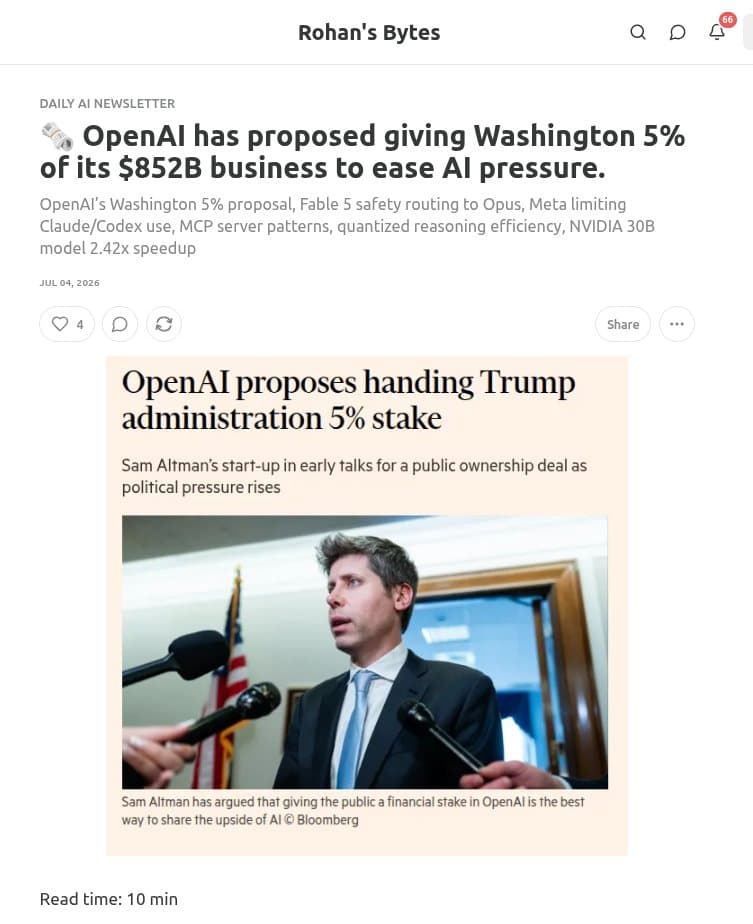
OpenAI proposed giving Washington 5% of its $852B business to ease AI pressure. The offer, reported in @rohanpaul_ai's newsletter, signals a strategic bet that equity stakes can preempt restrictive regulation.
Key facts
- OpenAI proposed 5% equity to Washington.
- Valuation pegged at $852 billion.
- Equity transfer valued at ~$42.6 billion.
- Offer targets federal oversight concerns.
- Meta limited Claude Code/Codex use same week.
OpenAI has proposed giving Washington 5% of its $852B business to ease AI pressure, according to @rohanpaul_ai's newsletter. The move comes as the company faces increasing federal scrutiny over safety, competition, and national security risks tied to its frontier AI models.
The valuation pegged at $852 billion is notable given OpenAI's recent fundraising rounds, which have pushed its private market valuation into the hundreds of billions. Offering a 5% stake would effectively transfer ~$42.6 billion in equity to the U.S. government, a figure that dwarfs typical corporate lobbying expenditures.
What the offer implies
This is not a standard lobbying play—it's an equity-for-regulatory-peace swap. By giving Washington a direct financial stake, OpenAI aligns federal incentives with its own success. If the government holds equity, it has less reason to impose caps on model training, export restrictions, or antitrust breakup orders that would depress the company's value.
The proposal also creates a precedent. If accepted, other frontier labs—Anthropic, Google DeepMind, xAI—could face pressure to offer similar stakes. The U.S. government would become a de facto shareholder in the AI industry, with all the conflicts that entails: oversight of safety while profiting from growth.
OpenAI's regulatory calculus
OpenAI has been navigating a thicket of regulatory threats. The FTC has investigated its data practices; the SEC has probed its internal communications; and Congress has debated multiple AI bills, including the SAFE Innovation Act and the AI Foundation Model Transparency Act. A 5% equity grant could buy goodwill across agencies without ceding operational control.
The offer is not yet public policy—it's a proposal. But it signals that OpenAI views regulatory risk as existential enough to warrant giving away tens of billions in equity. The company did not disclose whether the offer has been formally presented to any agency or congressional committee.
Broader industry context
Same week, Meta reportedly limited engineer use of Claude Code and Codex [per The Information], citing contamination risks to its own AI training data. Meanwhile, NVIDIA made a 30B language model write 2.42x faster with 98.7% retained quality, and a new paper "Quantized Reasoning Models Think They Need to Think Longer, but They Do Not" challenges assumptions about inference scaling. OpenAI's equity offer sits against this backdrop of intensifying competition and regulatory jockeying.
Key Takeaways
- OpenAI proposed 5% of its $852B business to Washington to ease AI regulatory pressure, per @rohanpaul_ai.
- The equity-for-peace swap could set a precedent.
What to watch
Watch for any congressional or executive branch response to the proposal, and whether Anthropic or Google DeepMind make parallel offers. Also monitor the FTC's ongoing investigation into OpenAI—if a settlement emerges referencing equity, the proposal has traction.