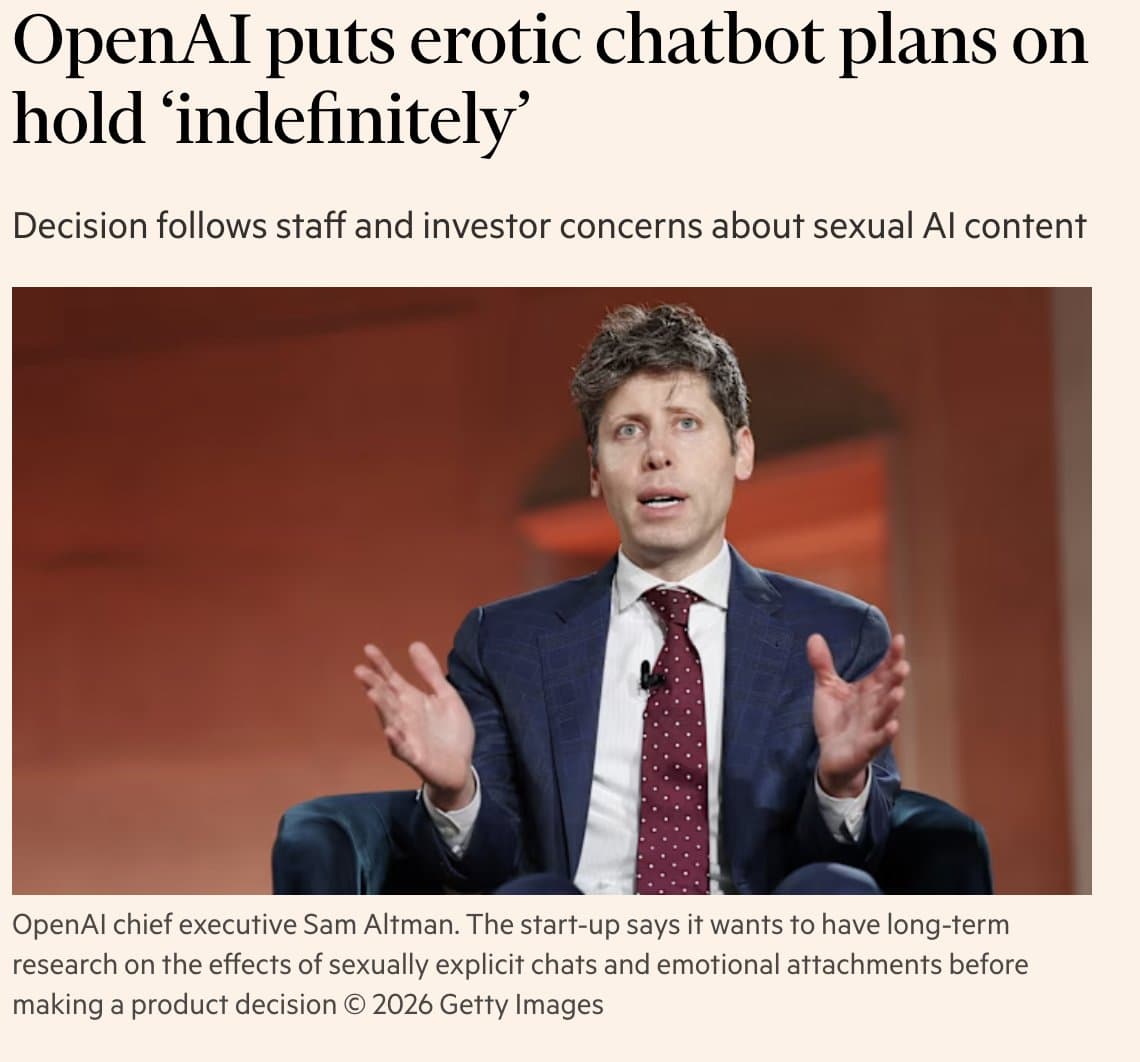
OpenAI has halted development on a planned "adult mode" for its chatbot products, shelving the project indefinitely. The decision follows significant internal pushback from staff and investors, who raised concerns about the risks the feature could pose to minors and the potential for encouraging unhealthy emotional attachments to AI.
According to a report, the shelving is part of a broader strategic refocusing within the company. OpenAI is reportedly moving away from experimental "side quests" and doubling down on its core mission of developing productivity tools. This shift has also led to the winding down of other projects, including Sora and a social app.
The technical challenges of creating such a feature were reportedly a major factor in the decision. Training safety-aligned models to generate explicit content while simultaneously filtering out illegal material proved to be a significant and complex engineering hurdle.
What Happened
OpenAI had been developing a feature that would allow its chatbot models to generate Not Safe For Work (NSFW) content, often referred to internally as an "adult mode." The project has now been officially shelved with no timeline for revival. The primary drivers for the cancellation were ethical and safety concerns raised by employees and investors, specifically regarding:
- Minors' Safety: The risk of the feature being accessed or exploited by underage users.
- Unhealthy Attachments: Concerns that erotic AI companions could foster damaging emotional dependencies.
- Technical Safety: The difficulty of reliably preventing the generation of illegal content (e.g., child sexual abuse material) while allowing other explicit material.
Context and Strategic Shift
This cancellation is framed as part of a larger strategic pivot. Under CEO Sam Altman, OpenAI has recently emphasized its focus on becoming a leading provider of enterprise and developer tools. Projects seen as distractions from this core goal—termed "side quests"—are being deprioritized or shut down. The reported winding down of Sora (a social app) aligns with this pattern of consolidating resources around flagship products like ChatGPT, the API platform, and enterprise solutions.
The technical barrier highlights a fundamental tension in AI safety engineering: building systems that can understand and navigate nuanced, context-dependent human concepts like "appropriate explicit content" versus "illegal material" remains an unsolved problem. A model trained to be helpful and harmless must be heavily constrained, making it difficult to then carve out a safe, permitted space for adult content without creating loopholes or brittle filters.
gentic.news Analysis
This decision is a significant, concrete example of the internal and external pressures shaping commercial AI development. It reflects a maturation phase where frontier labs like OpenAI are moving beyond pure capability expansion to grapple with the product-market fit and real-world liability of their technologies. The internal pushback is notable; it suggests that even within an organization known for its aggressive pursuit of AGI, there are strong voices advocating for caution on specific, high-risk applications.
Strategically, this aligns with the trend we've covered regarding OpenAI's enterprise push, such as the launch of ChatGPT Enterprise and custom model fine-tuning for businesses. Shelving an adult-content chatbot is a clear signal to enterprise clients and regulators that OpenAI is prioritizing stability, safety, and professional utility. It also avoids a direct clash with app store policies and payment processors, which often restrict adult content.
However, this creates a market vacuum. Other companies with less brand exposure or different risk tolerances—such as startups like NovelAI or open-source communities—are likely to continue exploring this niche. The technical challenge of safety-aligned NSFW generation remains, but the commercial and ethical onus is now off OpenAI. This move effectively outsources the risk and innovation in this domain to smaller players, while OpenAI consolidates its position in the safer, more lucrative enterprise and productivity arena.
Frequently Asked Questions
What was OpenAI's "adult mode"?
It was a planned feature that would have allowed OpenAI's chatbot models, like ChatGPT, to generate erotic or sexually explicit text content in response to user prompts. It was never released to the public and has now been canceled.
Why did OpenAI cancel the adult chatbot project?
OpenAI canceled the project due to a combination of factors: internal ethical concerns from staff and investors about risks to minors and unhealthy user attachments, the technical difficulty of reliably filtering illegal content, and a broader company strategy to focus on core productivity tools instead of experimental side projects.
Does this mean OpenAI will never allow NSFW content?
The project has been shelved "indefinitely," which means there is no plan to work on it in the foreseeable future. While never say never, this decision strongly indicates that enabling NSFW generation is not aligned with OpenAI's current product safety standards or strategic business goals.
What other projects is OpenAI winding down?
According to the report, as part of its strategic refocusing, OpenAI is also winding down Sora (a social app project, not to be confused with the video generation model of the same name) and other non-core initiatives. This suggests a consolidation of resources around its main products like the ChatGPT interface, the API platform, and enterprise offerings.