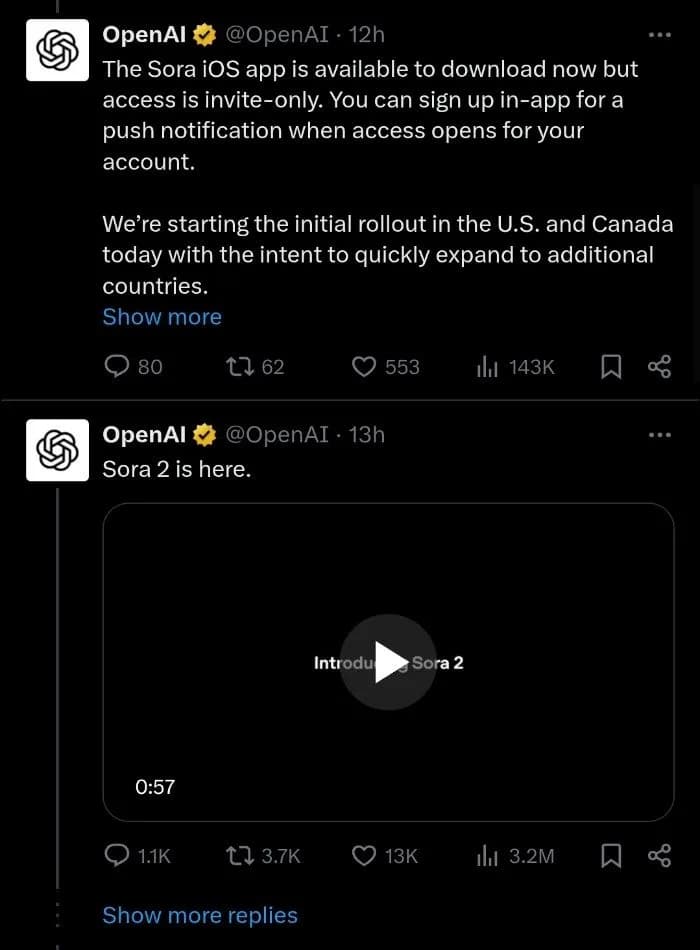
A brief social media post from AI researcher Rohan Paul indicates a significant shift in OpenAI's strategy for its Sora video generation model. According to the post, OpenAI is "killing Sora as a standalone app, its developer version, and video inside ChatGPT."
What Happened
Based on the source, OpenAI appears to be terminating several access points to its Sora text-to-video model:
- Standalone Sora App: A dedicated application for the Sora model.
- Developer Version: API or specialized access for developers to build with Sora.
- Video Inside ChatGPT: The integration of Sora's video generation capabilities directly within the ChatGPT interface.
The post concludes with a fragmentary analysis: "Shows they see coding, ent…", which suggests the poster believes this move indicates OpenAI's prioritization of other domains, like coding or enterprise solutions, over a broad-based video generation product.
Context
OpenAI's Sora, announced in February 2024, is a diffusion transformer model capable of generating high-fidelity, minute-long videos from text prompts. Its initial reveal was met with significant attention for the quality and coherence of its outputs. Access has been highly restricted to a small group of red teamers, visual artists, and filmmakers for safety and feedback purposes. There has never been a public API or general availability.
The reported discontinuation of a "standalone app" and "developer version" suggests OpenAI had been internally testing or planning such distribution channels but has now reversed course. Consolidating generative capabilities into a primary interface like ChatGPT aligns with OpenAI's established pattern of integrating modalities (like DALL-E image generation and browsing) into its flagship chatbot.
Immediate Implications
For the limited number of external testers with Sora access, this likely means their workflow will shift to using ChatGPT as the sole interface. For the broader developer and AI community, it signals that OpenAI does not currently plan to release Sora as an open platform or standalone product akin to Midjourney or Runway. This maintains Sora as a controlled, integrated feature within OpenAI's ecosystem, potentially limiting its direct competition with other video AI startups and focusing its utility on enhancing the ChatGPT experience.
gentic.news Analysis
This strategic retrenchment, while surprising given the hype around Sora, is consistent with OpenAI's recent operational focus. Following the leadership upheaval in late 2023 and the subsequent re-focusing under Sam Altman, OpenAI has visibly prioritized commercialization and product-market fit over pure research demos. The decision to fold Sora into ChatGPT mirrors the integration path of DALL-E 3, suggesting a "hub" model where ChatGPT becomes the unified interface for all of OpenAI's generative AI. This maximizes user retention within their ecosystem and simplifies the monetization path through ChatGPT Plus subscriptions.
Furthermore, this move may reflect the immense computational cost and potential safety challenges of scaling a video generation model to the public. By keeping it as a controlled feature within ChatGPT, OpenAI can manage capacity, implement stricter content safeguards, and avoid the uncontrolled proliferation of synthetic media that a standalone API might enable. The hint about prioritizing "coding" aligns with the intense competitive focus on AI assistants for software development, a sector where OpenAI is battling GitHub Copilot, Claude Code, and others. Resources may be shifting to fortify Codex-derived capabilities and the ChatGPT coding experience.
Ultimately, this is a signal that for OpenAI, integration and utility trump modality-specific innovation in the current product strategy. Sora's technology is not being abandoned, but its route to market is being channeled exclusively through their core product, making ChatGPT a more powerful multimodal assistant while reducing the surface area for competitive and safety risks.
Frequently Asked Questions
Is Sora being shut down completely?
No. According to the report, Sora as a model is not being shut down. Instead, OpenAI is discontinuing separate access points like a standalone application and a developer API. The capability is being consolidated solely within the ChatGPT interface for existing testers and, eventually, likely for broader users.
Can developers still build applications with Sora?
The report states OpenAI is "killing" the developer version of Sora. This strongly implies there will be no public API or SDK for developers to integrate Sora into their own applications in the foreseeable future. Development access appears to be restricted or discontinued.
Why would OpenAI do this?
Probable reasons include strategic product consolidation into ChatGPT, the high cost and complexity of managing a public video generation API, safety and content moderation concerns specific to video, and a potential re-allocation of resources to other competitive priorities like AI-powered coding assistants.
When will Sora be available in ChatGPT for everyone?
The source does not provide a timeline for general availability. The move to integrate it into ChatGPT is a step towards a potential release, but OpenAI has not announced a public launch date. Access remains limited to a select group of testers and safety evaluators.