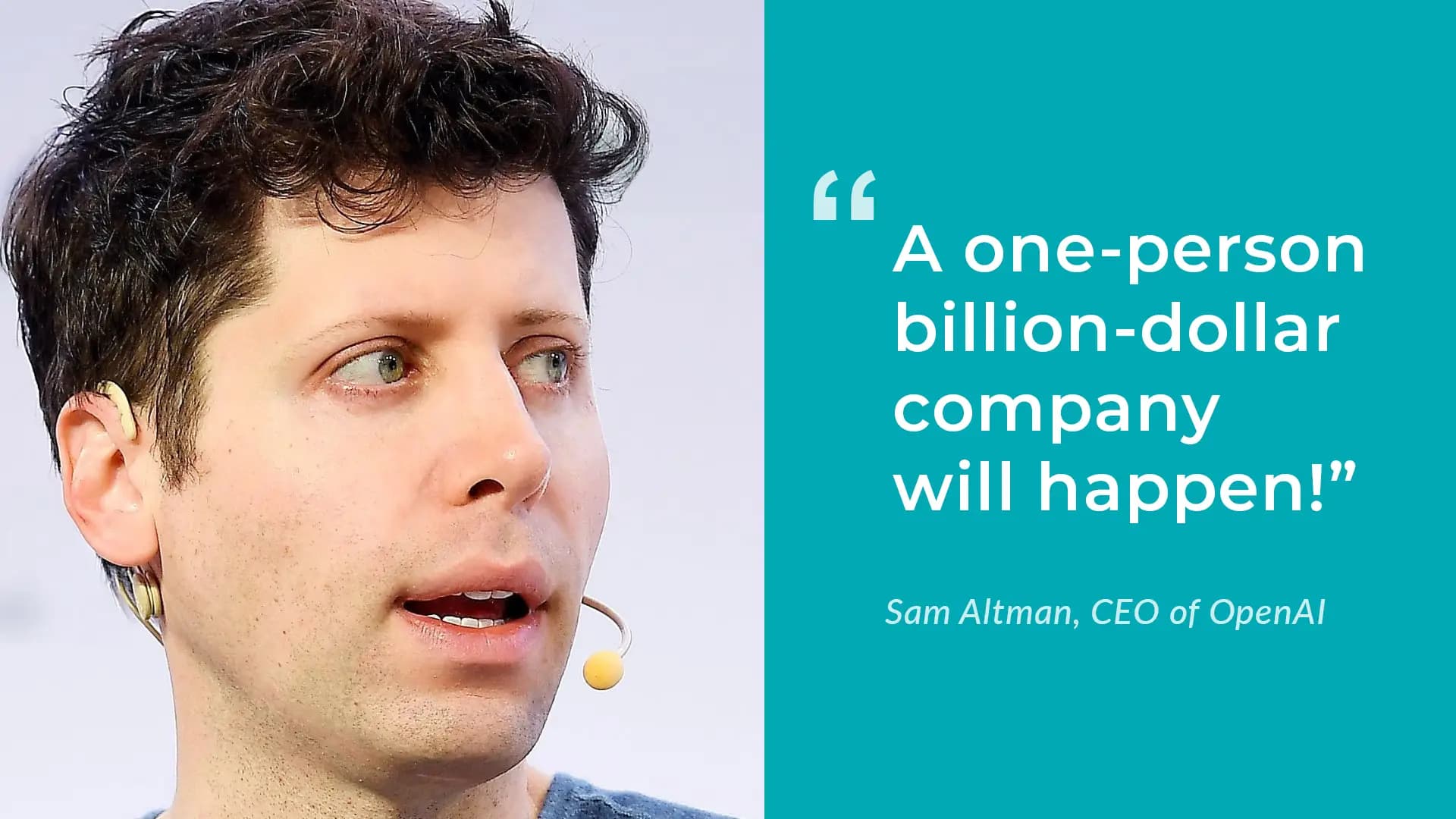
OpenAI CEO Sam Altman has doubled down on his vision of AI-driven business miniaturization, now predicting the rise of "one-person billion-dollar companies." The claim was made in a private group chat with other CEOs, which he referenced in a recent discussion.
What Happened
In a conversation highlighted by AI commentator Rohan Pandey (@rohanpaul_ai), Altman reiterated his belief that AI will enable radically smaller teams to build massively valuable companies. He stated: "We're going to see 10 person billion-dollar companies pretty soon." He then added a more extreme prediction: "In my little group chat with CEO-friends, there's this One-person billion-dollar company, which would have been unimaginable without AI, and now it'll happen."
The comment suggests Altman has direct knowledge of at least one solo founder or extremely small team leveraging AI to build a business on a trajectory toward a billion-dollar valuation. He positions this not as a theoretical future but as an imminent reality made possible by the current generation of AI tools.
Context
This is not a new theme for Altman. He has frequently discussed AI as a "force multiplier" for individual productivity and entrepreneurship. His prediction of 10-person billion-dollar companies has been part of his public commentary for over a year. The new escalation to a "one-person" threshold indicates he believes the capability of AI models and tools has progressed to a point where a single individual can orchestrate the functions that previously required departments of people—product development, marketing, customer support, operations, and strategy.
The tools enabling this shift likely include:
- Advanced coding assistants (like GitHub Copilot, Cursor, or Claude Code) that allow a single developer to architect and maintain complex systems.
- Generative AI for content and design (like Midjourney, DALL-E, or GPT-4) that handle marketing, branding, and product design.
- AI agents and automation platforms that can manage customer interactions, data analysis, and backend workflows with minimal human oversight.
This vision aligns with the broader industry trend of "AI-native" startups launching with tiny technical teams, often relying on cloud APIs and AI co-pilots instead of large engineering staffs.
gentic.news Analysis
Altman's prediction is a logical, if aggressive, extension of the productivity gains we are already measuring. Our previous reporting on AI coding benchmarks has shown tools like Claude 3.5 Sonnet and DeepSeek-Coder can already solve a majority of SWE-bench tasks, effectively acting as a senior engineer force multiplier. When this capability is combined with no-code automation platforms and AI-driven marketing suites, the foundational stack for a "single-person mega-startup" exists in prototype form.
However, the leap from a 10-person to a 1-person billion-dollar company is not merely linear. It implies overcoming significant non-technical bottlenecks: governance, strategic partnership negotiations, complex financial structuring, and managing regulatory scrutiny—areas where human networks, judgment, and credibility still dominate. The "one-person" company Altman references likely still relies on an extensive ecosystem of AI tools, cloud services, and potentially fractional human experts, but with the founder as the sole full-time decision-making core.
This trend directly pressures traditional venture capital models built around funding teams to execute labor-intensive plans. If the heaviest lifting is done by AI, the premium shifts to funding compute costs and distribution for singular visionary founders. We are already seeing early signals of this with the rise of AI agent startups and solopreneur-led ventures attracting significant angel investment. Altman's comment serves as a marker for investors: the benchmark for what constitutes a "fundable team" is being radically redefined by AI capabilities.
Frequently Asked Questions
What does a "one-person billion-dollar company" actually mean?
It refers to a business that achieves a valuation of one billion dollars (unicorn status) while having only one full-time employee: the founder. This person would leverage AI tools for coding, design, marketing, customer service, and operations, and might contract specialized tasks, but would retain all equity and core decision-making authority.
What kind of business could a single person run at that scale?
The most plausible candidates are software-as-a-service (SaaS) platforms, AI model marketplaces, or data platforms where the core product is software or an algorithm. The business would need to be highly automated, have massive gross margins, and address a very large market. It is less feasible for hardware, biotechnology, or businesses requiring complex physical logistics.
Is Sam Altman's prediction realistic?
It is an extreme projection of a very real trend. While a literal one-person, billion-dollar public company may be rare, AI is unequivocally enabling smaller teams to build and scale products faster than ever before. The more immediate impact will be the proliferation of highly valuable, capital-efficient startups with teams of 2-10 people, which is already happening.
How would a one-person company handle legal and financial complexity?
It would rely heavily on external services: law firms, accounting firms, banking platforms, and board advisors. The founder's role becomes primarily strategic and product-oriented, while outsourcing compliance, finance, and legal functions to trusted professional service providers, much like how large investment funds operate with small internal teams.