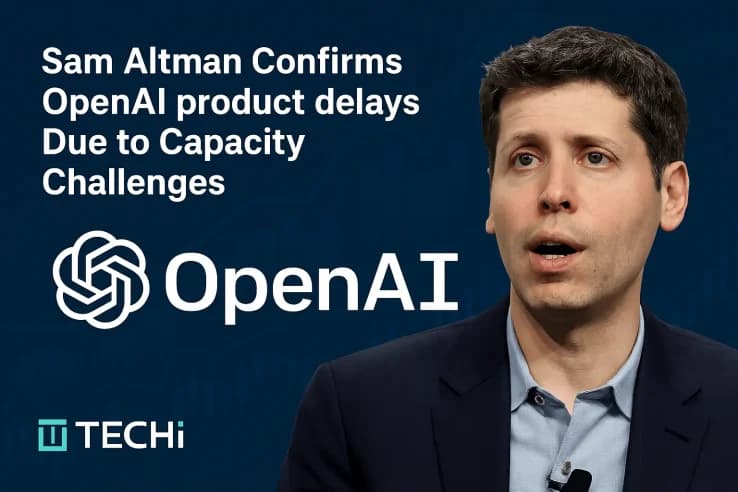
In a recent interview on The Ben & Parth Show (TBPN), OpenAI CEO Sam Altman was asked about the company's acquisition strategy, specifically whether it would focus on acquiring more product companies or research labs. His response pointed toward a hybrid approach.
What Happened
When prompted about OpenAI's acquisition preferences, Altman stated:
“The one I have in mind right now is something that looks very much like a mixture of both.”
This brief comment, shared via a social media post by AI commentator Rohan Pandey (@rohanpaul_ai), offers a rare glimpse into the strategic thinking of one of AI's most influential leaders. Unlike a definitive announcement of a specific deal, it's a directional signal about the type of asset OpenAI finds attractive at this stage.
Context: OpenAI's Acquisition History and Strategy
OpenAI's acquisition activity has been selective but strategic. Its most notable acquisition to date was Global Illumination, a digital product studio, in August 2023. The team joined OpenAI to work on core products, including ChatGPT. This move was classic "acqui-hire"—securing talented product and engineering teams to accelerate development.
Historically, large AI labs have pursued different acquisition paths:
- Research Lab Acquisitions: Aim to absorb breakthrough talent and intellectual property (e.g., Google's DeepMind acquisition, though not a startup).
- Product Company Acquisitions: Aim to integrate functional applications, user bases, or deployment platforms into an existing ecosystem.
Altman's "mixture" comment suggests OpenAI is not looking for a pure research group that publishes papers without a path to application, nor a purely commercial product team disconnected from frontier research. Instead, the target appears to be an entity that embodies both: a team capable of advancing the state of the art in a focused domain and building a robust, user-facing product around it.
What This Means in Practice
This hybrid model points to several strategic priorities for OpenAI:
- Faster Integration of Research into Products: Bridging the often-slow transition from research prototype to scalable, reliable product.
- Vertical Depth: Acquiring a team with deep, specialized expertise in a valuable application area (e.g., robotics, scientific discovery, enterprise workflow automation) where both novel AI research and product sense are required.
- Talent Density: Seeking teams where researchers, engineers, and product managers are already effectively collaborating, reducing integration friction.
gentic.news Analysis
Altman's comment, while vague, is a significant data point in understanding OpenAI's evolution from a primarily research-oriented organization to a product-centric platform company. It reflects the heightened pressure in 2026 to not only achieve scientific milestones but also to build durable competitive moats and revenue streams. The "mixture" acquisition strategy is a logical response to the market's demand for applied AI solutions that are both technologically superior and seamlessly integrated.
This aligns with a broader industry trend we've covered, where the distinction between AI research and product engineering is blurring. For instance, our analysis of Google's Gemini 2.0 launch noted its deep co-design of new model architectures with specific product features like "Project Astra." Similarly, startups like Cognition Labs (creator of Devin) are built from the ground up as hybrid research-product entities. Altman's statement confirms OpenAI intends to compete in this space by acquiring such teams rather than solely building them internally.
Furthermore, this strategic hint may relate to specific competitive fronts. With Anthropic's Claude 3.5 Sonnet demonstrating strong product-market fit in enterprise and coding, and xAI's Grok pursuing integrated access via the X platform, OpenAI may be looking for acquisitions that bolster its capabilities in specific high-value verticals where an integrated research-product approach could deliver a decisive advantage. The comment suggests the next major OpenAI product innovation could come from an integrated external team, not just from its core San Francisco research division.
Frequently Asked Questions
What has OpenAI acquired before?
OpenAI's most publicized acquisition was Global Illumination, a digital product studio, in August 2023. The team was integrated to work on core products like ChatGPT, demonstrating a precedent for acquiring product-focused talent to accelerate development.
What does a 'mixture of product and research' company look like?
In practice, this likely describes a startup or team that is simultaneously pushing the boundaries of AI in a specific domain (requiring research) and has built a functional application or prototype that demonstrates the value of that research to end-users. Examples could include companies in AI-powered robotics, scientific simulation, or advanced code generation where the product is directly the output of novel model research.
Does this mean OpenAI will stop doing internal research?
No. This is almost certainly a complementary strategy. OpenAI's core research team, led by Ilya Sutskever (or his successor in 2026), will continue foundational work on model architectures, alignment, and capabilities. The hybrid acquisition strategy is about adding specialized, vertical-focused teams that can operate with product-market urgency in areas where OpenAI wants to move faster or lacks deep in-house expertise.
When might such an acquisition happen?
Altman's phrasing ("the one I have in mind right now") indicates active consideration and likely ongoing discussions, but it does not announce a deal. The timeline could be weeks or several months. Regulatory scrutiny of major AI acquisitions has increased, which may also influence the timing and public disclosure of any deal.