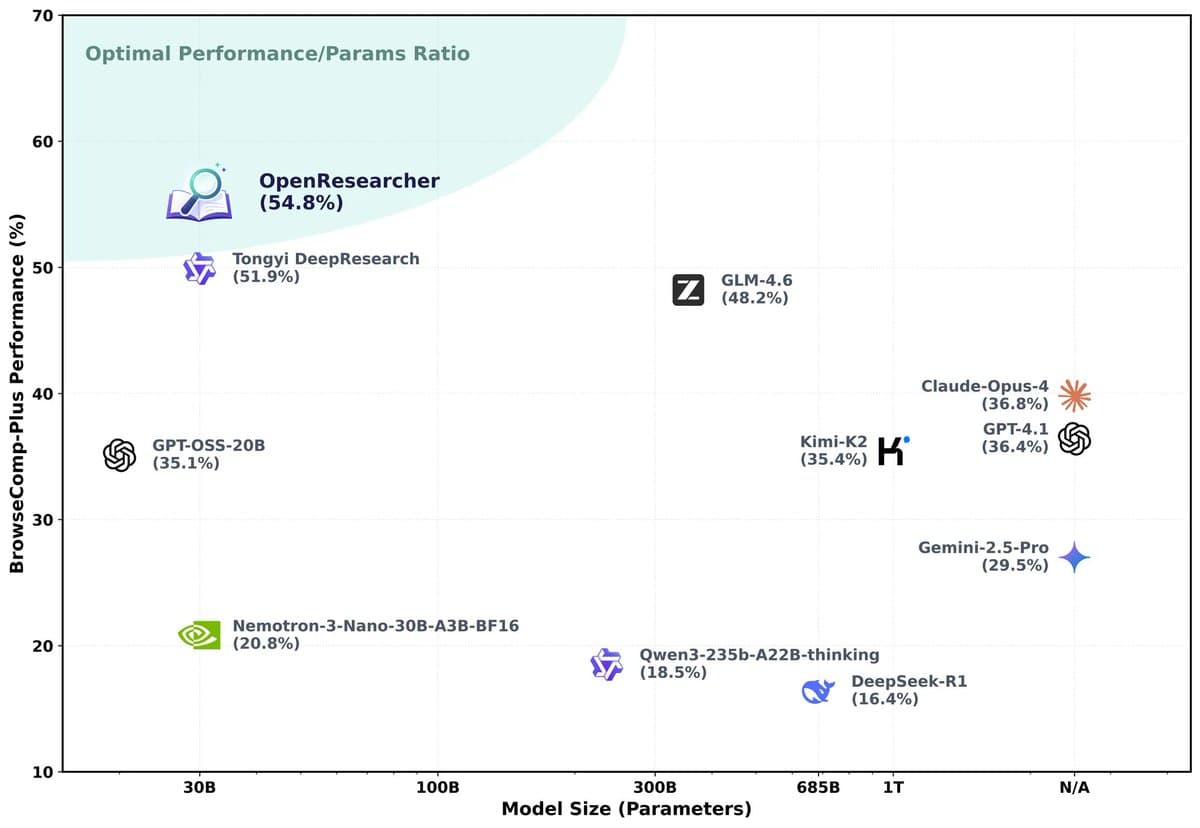
A new research paper titled OpenResearcher has been released, as announced by the authors on social media. The work explicitly explores methods for synthesizing long-horizon research trajectories for deep learning.
What Happened
The paper's release was announced via a post on X (formerly Twitter) by one of the authors, Zhuofeng Li. The announcement frames the work as an exploration into creating structured pathways for complex, multi-step AI research. The core premise is that many significant advances in deep learning require navigating a sequence of interconnected problems and experiments—a "research trajectory." The OpenResearcher method aims to model and synthesize these trajectories to provide guidance, potentially accelerating progress on challenging, long-term research goals.
Context
Research in machine learning and AI often involves exploring a vast space of possible ideas, architectures, training techniques, and datasets. For ambitious goals—such as developing a new class of models or solving a previously intractable problem—the path forward is rarely linear. It typically consists of a series of experiments, dead ends, and iterative refinements. Formalizing this process into a synthesizable trajectory could help researchers plan more effectively, learn from historical project patterns, and allocate resources to the most promising branches of inquiry.
gentic.news Analysis
The release of the OpenResearcher paper enters a growing niche focused on AI for Science and, more specifically, AI for accelerating AI research. This trend has gained significant momentum over the past 18 months, with entities like Google DeepMind (through its Gemini models applied to coding and reasoning) and Anthropic (with Claude's growing capability to assist in technical tasks) pushing the boundaries of AI-assisted development.
This work connects to a broader pattern we've tracked: the systematic application of AI to its own creation pipeline. For instance, our previous coverage of AlphaCode 2 and Devin highlighted the push toward automating software engineering, a foundational layer for research. OpenResearcher appears to operate at a higher level of abstraction, focusing not on writing code for a single function, but on planning the sequence of research actions needed to achieve a complex objective. If successful, such a tool could act as a strategic planner for research labs, helping to de-risk projects and identify critical path experiments.
However, the announcement is thin on technical details and benchmarks. The true test will be in its application: Can the synthesized trajectories lead to novel, published research outcomes that match or exceed those developed by human researchers? The field of meta-learning and automated machine learning (AutoML) has long sought to automate parts of the ML pipeline. OpenResearcher's focus on the "long-horizon" and "trajectory" suggests an ambition to move beyond hyperparameter tuning and into the realm of research strategy—a significantly harder problem. The community will be watching for the paper's methodology, the domains it's validated on, and any measurable impact on research velocity or outcome quality.
Frequently Asked Questions
What is OpenResearcher?
OpenResearcher is a research paper and proposed method for synthesizing long-horizon research trajectories in deep learning. It aims to create structured, multi-step plans to guide complex AI research projects from conception to completion.
How could OpenResearcher be used?
In practice, a researcher or lab could input a high-level goal (e.g., "improve the reasoning capability of a 7B parameter language model"). The OpenResearcher method would then generate a proposed trajectory—a sequence of experiments, architectural changes, or dataset creations—to efficiently reach that goal, potentially saving time and computational resources.
Is this related to AutoML?
Yes, but at a higher level. Traditional AutoML focuses on automating specific tasks like hyperparameter optimization or neural architecture search for a single model. OpenResearcher appears to target the synthesis of the entire research plan that might contain multiple AutoML stages, literature reviews, and hypothesis testing, making it a form of meta-research automation.
Where can I find the OpenResearcher paper?
The paper was announced on social media, but a direct link was not provided in the source. It is likely to be published on a preprint server like arXiv.org. Searching for "OpenResearcher" and the authors' names on arXiv or Google Scholar should yield the full document.