What Happened
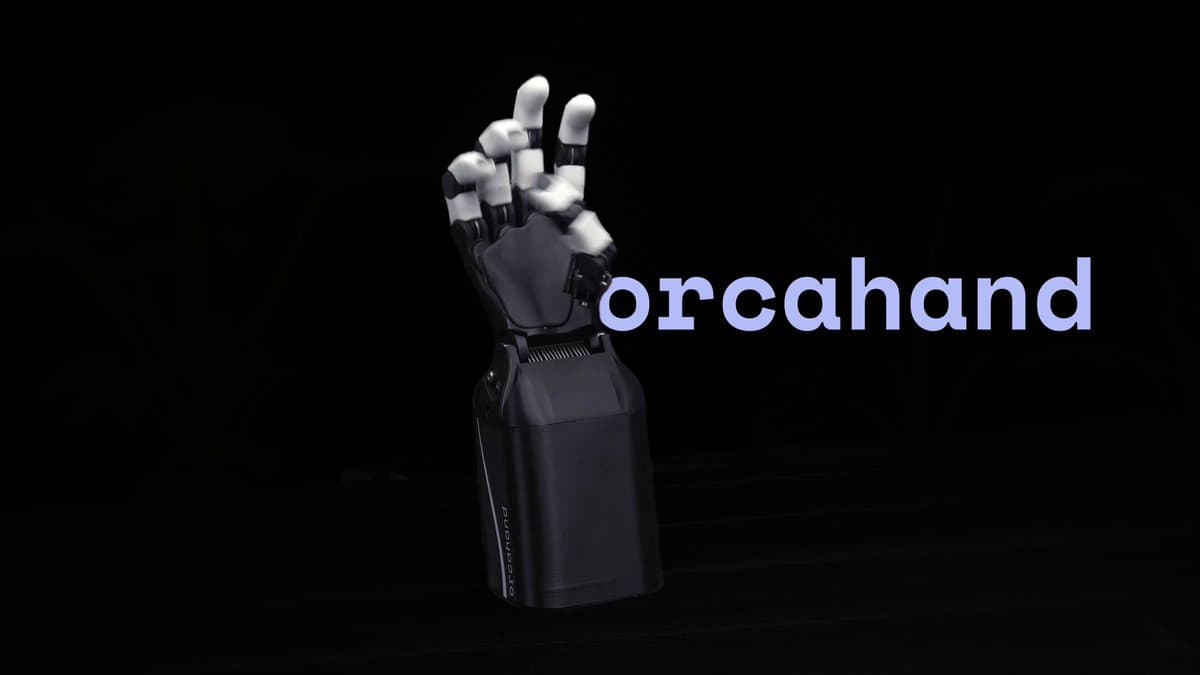
ORCA Dexterity has open-sourced the hardware designs for three anthropomorphic robotic hands, making them freely available as 3D-printable STL files. The hands are tendon-driven and incorporate a novel mechanical feature: self-dislocating joints designed to improve reliability during manipulation tasks.
According to the announcement, researchers can 3D-print the components, add off-the-shelf motors, and assemble a complete hand in under 8 hours for approximately $2,200 in total hardware costs. This significantly lowers the barrier to entry for labs wanting to conduct dexterous manipulation research without investing in expensive commercial platforms.
Key Hardware Specifications
One of the three variants, the OrcaHand Touch, includes integrated tactile sensing capabilities. Each fingertip features:
- 83 taxels (tactile elements) per fingertip
- 1mm spatial resolution
- 0.1N force detectability
These specifications suggest the hand could support fine manipulation tasks requiring precise force feedback and object contact detection.
Technical Design Philosophy
The hands use tendon-driven actuation, a common approach in anthropomorphic robotics that allows for compact actuators in the forearm or base while providing multiple degrees of freedom in the fingers. The standout mechanical feature is the self-dislocating joints, which appear to be designed to prevent damage during unexpected collisions or excessive force application by allowing controlled joint separation rather than breaking.
By providing open-source STL files, ORCA Dexterity enables researchers to modify, iterate, and reproduce the hardware without proprietary restrictions. The $2,200 estimated cost includes 3D printing materials, motors, tendons, and sensors, making this one of the most accessible platforms for dexterous manipulation research currently available.
Context and Availability
This release addresses a significant gap in robotics research: affordable, capable hardware for dexterous manipulation. Most research-grade robotic hands cost tens of thousands of dollars and are often proprietary. The open-source nature allows for rapid community development and customization.
The STL files are presumably available through ORCA Dexterity's website or repository, though the announcement didn't specify the exact distribution channel. Researchers will need access to 3D printing capabilities and basic mechanical assembly skills to build the hands.